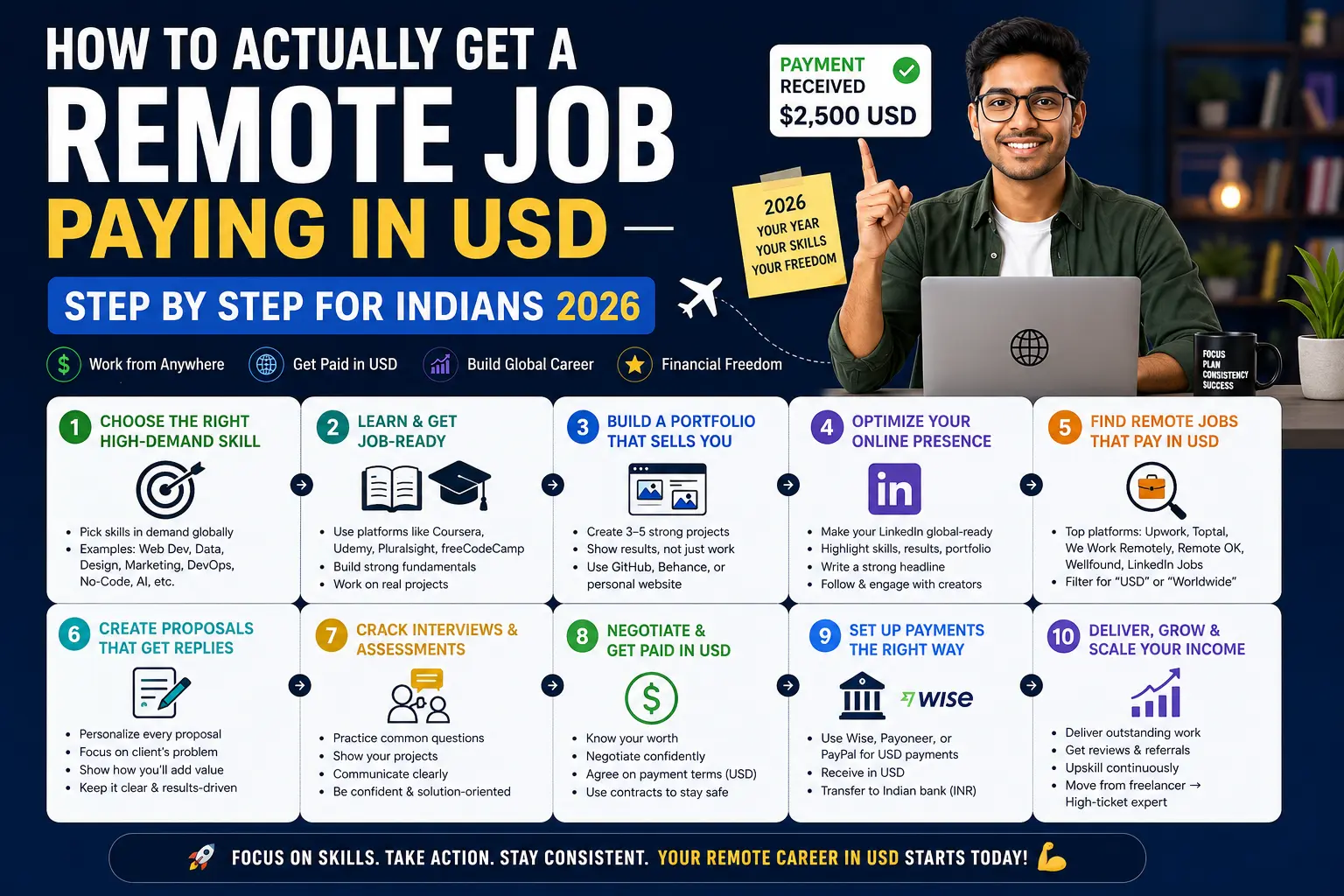
The first question every Indian professional asks after reading about remote jobs paying in USD is always the same.
🌟 Find YOUR Remote Work Path
Free readiness check — score, strongest path, next steps. Rs 499 personal plan available.
"Okay — but how do I actually get one?"
That question has a real, specific, actionable answer. And it is not "build your portfolio" or "network more" — the vague advice that fills every other article on this topic.
This guide covers the exact process — step by step — that Indian professionals are using right now in 2026 to land remote jobs paying $2,000–$10,000 per month from global companies, without leaving India, without a foreign degree, and without a pre-existing international network.
If you have not read our previous article on Remote Jobs That Pay in USD — Work from India for Global Companies — read that first. This article picks up exactly where that one ends.
Use our free International Salary Calculator to see what your current India salary looks like in USD — and what you should be targeting in a remote role.
The Reality Check First — Who This Actually Works For
Before the steps — an honest assessment. Remote USD jobs are real and accessible for Indians. But they are not accessible equally to everyone at every stage.
| Profile | Realistic Timeline to First USD Job | Starting Monthly Range |
|---|---|---|
| Software Developer (3+ yrs) | 4–8 weeks | $2,500–$6,000/month |
| Digital Marketer (2+ yrs) | 6–10 weeks | $1,500–$4,000/month |
| Content Writer (English) | 2–4 weeks | $800–$3,000/month |
| UI/UX Designer (portfolio) | 4–8 weeks | $2,000–$5,000/month |
| Data Analyst (SQL + Python) | 6–12 weeks | $2,000–$5,000/month |
| Virtual Assistant | 1–3 weeks | $500–$1,500/month |
| Cybersecurity Analyst | 8–14 weeks | $3,000–$8,000/month |
| AI/ML Engineer | 4–8 weeks | $4,000–$12,000/month |
| Video Editor / Motion Graphics | 2–5 weeks | $800–$3,500/month |
| Project Manager (PMP/Agile) | 8–14 weeks | $2,500–$6,000/month |
| Fresh Graduate (any field) | 3–6 months | $300–$800/month (build up) |
The timelines above assume you follow the steps in this guide actively — not casually browsing job boards once a week. "Actively" means 2–3 hours per day of focused job search activity.
Step 1 — Build a USD-Ready Profile (Most People Skip This)
The single most common reason Indian professionals fail to land USD remote jobs is not lack of skills. It is presenting those skills in a way that reads as "Indian freelancer" rather than "global professional."
Global companies — particularly US, UK, and Australian companies hiring remote workers — receive hundreds of applications from across Asia. The candidates who stand out do one thing differently: they present themselves as professionals solving business problems, not as employees looking for a salary.
Your LinkedIn Profile — The Most Important Document You Own
For remote USD jobs in 2026, LinkedIn is not a job board. It is your professional identity on the internet. Companies will Google you. Recruiters will find you. Clients will check you. Your LinkedIn profile works for you 24 hours a day.
Fix these 7 things before applying anywhere:
- Headline: Not "Software Engineer at
Infosys." Change it to your value proposition.
Example: "Full Stack Developer | React + Node.js | Helping SaaS companies ship faster | Open to Remote" - Location: Set to "India" but add "Open to Remote Worldwide" in your headline or about section. Do not hide that you are in India — global companies hiring remote workers know and expect this.
- About section: Write 3–4 sentences in first person. Start with what you do, who you help, and what makes you different. End with a clear statement: "Currently open to full-time remote opportunities with global companies."
- Experience section: Rewrite every
role in terms of business impact — not just
responsibilities.
Bad: "Developed REST APIs using Node.js"
Good: "Built payment API handling $2M monthly transactions, reducing checkout errors by 34%" - Skills section: Add your top 5 most in-demand skills in your field. LinkedIn's algorithm uses these for recruiter searches.
- Open to Work: Enable "Open to Work" but select "Share only with recruiters" — not the green banner which reduces perceived value.
- Profile photo: Professional, good lighting, plain background. Not a selfie. Not a group photo. Not a passport photo with a white background.
Official LinkedIn profile optimisation guide: LinkedIn Help — Profile Best Practices
Build a Personal Website — The Differentiator 90% of Applicants Don't Have
A personal website or portfolio separates you from thousands of other applicants instantly. It does not need to be complex. It needs to be clear, fast, and professional.
Minimum required pages:
- Home: Who you are, what you do, who you help — in 3 sentences
- Work/Portfolio: 3–5 best projects with context, your role, and measurable outcomes
- About: Your background, your approach, why you do what you do
- Contact: Email form and LinkedIn link
Free tools to build your portfolio:
- Webflow — best for designers
- Notion — simplest portfolio option
- GitHub Pages — best for developers (free)
- Read.cv — clean, minimal, professional
Step 2 — Know Exactly What USD Remote Jobs Pay in Your Field
Most Indians undervalue themselves significantly when applying for USD remote jobs — because they compare to Indian salaries. Before applying anywhere — know the global market rate for your specific role.
Official and reliable salary sources for 2026:
- US Bureau of Labor Statistics — Occupational Outlook Handbook — official US government salary data by occupation
- Levels.fyi — real verified tech salaries at global companies
- RemoteOK Salary Data — remote-specific compensation data
- Stack Overflow Developer Survey 2025 — global developer compensation benchmark
| Role | USD Market Rate (Remote, Global) | What Most Indians Ask For | Money Left on Table |
|---|---|---|---|
| Full Stack Developer (5 yrs) | $4,000–$8,000/month | $1,500–$2,500/month | $2,500–$5,500/month |
| Digital Marketing Manager | $2,500–$5,000/month | $800–$1,500/month | $1,700–$3,500/month |
| UX Designer (4 yrs) | $3,500–$7,000/month | $1,200–$2,000/month | $2,300–$5,000/month |
| Data Analyst (3 yrs) | $3,000–$6,000/month | $1,000–$2,000/month | $2,000–$4,000/month |
| Content Strategist | $2,000–$4,500/month | $500–$1,000/month | $1,500–$3,500/month |
The gap between what Indians ask for and what global companies pay is not because Indian professionals are less capable. It is purely a lack of market information. Know your number before every conversation.
Use our Salary Calculator to benchmark your current India salary against USD market rates in your field.
Step 3 — The Right Platforms for USD Remote Jobs in 2026
Not all job platforms are equal for Indian professionals targeting USD compensation. Here is the honest ranking based on quality, response rate, and USD salary prevalence:
Tier 1 — Highest Quality, Best USD Salaries
| Platform | Best For | Salary Range | Competition Level |
|---|---|---|---|
| LinkedIn Jobs | All professional roles | $2,000–$15,000/mo | High — but quality filters help |
| Wellfound (AngelList Talent) | Startups — tech, design, marketing | $3,000–$12,000/mo | Medium |
| RemoteOK | Tech, design, marketing | $2,000–$10,000/mo | Medium |
| We Work Remotely | Tech, customer support, sales | $1,500–$8,000/mo | Medium |
| Y Combinator Jobs | YC-backed startups | $4,000–$15,000/mo | High — but worth it |
Tier 2 — Good Quality, Consistent USD Roles
| Platform | Best For | Salary Range |
|---|---|---|
| Remote.com | Full-time remote — all roles | $1,500–$8,000/mo |
| Jobspresso | Tech, marketing, support | $1,500–$6,000/mo |
| Working Nomads | Developer, design, writing | $1,500–$7,000/mo |
| Himalayas | Tech — developer, design, data | $2,000–$9,000/mo |
| FlexJobs | All professional roles | $1,000–$6,000/mo |
Tier 3 — Freelance Platforms (Project-Based to Retainer)
| Platform | Best For | Earning Potential | Time to First Client |
|---|---|---|---|
| Upwork | All skills — project to contract | $20–$150/hour | 2–6 weeks |
| Toptal | Top 3% developers and designers | $60–$200/hour | 4–8 weeks (screening) |
| Gun.io | Developers only | $50–$150/hour | 2–4 weeks |
| Arc.dev | Remote developers | $60–$180/hour | 2–5 weeks |
| Fiverr | Creative, writing, marketing | $5–$500/project | 1–3 weeks |
Important note on Toptal: Toptal has a rigorous 3-step screening process that only 3% of applicants pass. But those who do earn $60–$200/hour from top global companies. If you have 5+ years of strong experience — apply. The screening itself is a useful benchmark of your global competitiveness.
Official Toptal screening process: toptal.com/top-3-percent
Step 4 — Write Applications That Actually Get Responses
🌟 Is This Country Right for Your Profile?
Get a free personalised country match, salary in INR and 6-month action plan. Takes 5 minutes.
Get Free Roadmap →Free · No agent · All professionsMost remote job applications from India get ignored — not because of skills but because of how they are written. Here is the exact framework that works:
The Cover Letter Formula for USD Remote Jobs
Global companies receive 200–500 applications for every remote role. The cover letters that get read follow a consistent structure:
Paragraph 1 — The Hook (2 sentences):
Lead with a specific result or achievement relevant
to their business — not with "I am applying for the
position of..." Everyone starts there.
Example: "In my last role I built a real-time analytics dashboard that reduced client reporting time from 4 hours to 12 minutes. I am applying because your job description mentions exactly this challenge at scale."
Paragraph 2 — The Evidence (3–4 sentences):
Specific proof that you can do what they need.
Numbers wherever possible.
Paragraph 3 — Why Them Specifically
(2 sentences):
One sentence showing you have actually read about
their company — product, recent news, mission.
Companies know when this is generic.
Paragraph 4 — The Close (1 sentence):
"Happy to show you my work on a quick call —
available any time zone."
Total length: 200–250 words maximum. Never more. Remote hiring managers read cover letters on mobile between meetings. Long letters get closed.
The CV Format for Global Remote Applications
Remote companies — particularly US startups and scale-ups — have specific CV preferences:
- Format: Single column, clean, no colours, no photographs (opposite of UAE CVs)
- Length: 1 page under 5 years experience. 2 pages maximum after.
- Top section: Name, email, LinkedIn URL, portfolio URL, GitHub (if developer). No address needed for remote roles.
- Experience format: Company → Role → Dates → 3 bullet points with measurable outcomes only.
- Skills section: List tools and technologies, not soft skills. "Communication" and "teamwork" are assumed — they do not need to be listed.
Free CV templates for remote applications:
- Overleaf LaTeX CV Templates — clean, ATS-friendly
- Resume.io — simple online builder
- Canva Resume Templates — visual roles only
Step 5 — The Remote Job Interview Process
Remote interviews differ from in-person interviews in specific ways that Indian professionals need to prepare for.
Stage 1 — Async Video Interview (Increasingly Common)
Many global companies now use asynchronous video interviews as a first screening — you record answers to questions on a platform like HireVue or Spark Hire. Tips:
- Good lighting — face the window, do not have a window behind you
- Plain background — a bookshelf works, a busy room does not
- Speak clearly at 80% of your normal speed — your accent is fine, your pace matters more
- Look at the camera — not at your own image on screen
Stage 2 — Technical or Skills Assessment
Most USD remote roles include a skills test at stage 2. Prepare using:
- Developers: LeetCode, HackerRank
- Marketers: Prepare a sample audit or campaign plan for their actual product
- Designers: Complete their brief with an extra unexpected insight
- Writers: Match their publication's exact tone and structure
- Data: Kaggle practice datasets
Stage 3 — Live Interview with Hiring Manager
The 3 questions that decide remote job interviews:
- "How do you manage working across
time zones?"
The right answer is not "I'll work your hours." It is: "I work async-first, document everything, use clear status updates, and flag blockers immediately. I'm comfortable with any time zone for overlap hours." - "How do you communicate progress
without being in the same office?"
Mention specific tools: Slack for async, Notion or Linear for project tracking, Loom for async video updates, weekly written status reports. - "Tell me about a time you worked
independently on a complex problem."
Have 2–3 specific examples ready with the STAR format (Situation, Task, Action, Result). Remote companies hire for autonomy above everything.
Tools Every Remote Worker Should Know (Show You Know These in Interviews)
| Category | Tools to Know |
|---|---|
| Communication | Slack, Microsoft Teams, Zoom |
| Project Management | Linear, Jira, Asana, Notion, ClickUp |
| Async Video | Loom, Vidyard |
| Documentation | Notion, Confluence, Google Docs |
| Time Tracking | Toggl, Harvest, Clockify |
| Version Control | GitHub, GitLab (developers) |
| Design Collaboration | Figma, Miro (designers) |
| AI Productivity | Claude, ChatGPT, GitHub Copilot |
Step 6 — How to Receive USD Payments in India (The Part Nobody Explains Clearly)
You have got the job. Now how does the money actually reach you — legally, quickly, and with minimum conversion loss?
Option A — Wise Business (Best for Most)
Wise gives you a real USD bank account number in the US (ACH + wire). Your employer sends USD to Wise as if sending to a US bank. Wise converts at mid-market rate with a small fee (0.4–0.7%). Money reaches your Indian bank account in 1–2 business days.
This is the most cost-effective method for regular monthly salary payments. Most Indian remote workers earning USD use Wise as their primary payment solution.
Option B — Payoneer
Payoneer provides a US payment service account. Works well with marketplaces like Upwork, Fiverr, and Amazon. Slightly higher fees than Wise (1–2%) but wider marketplace integration.
Option C — Direct SWIFT Transfer
Your employer wires USD directly to your Indian bank account via SWIFT. Your Indian bank converts at their rate — which is typically 0.5–1.5% worse than Wise. For large amounts ($5,000+/month) the conversion loss adds up. Negotiate with your employer to use Wise or Payoneer instead.
Option D — Deel or Remote.com (Employer of Record)
Many global companies now use Deel or Remote.com to hire Indian employees compliantly. These platforms handle payroll, taxes, and local compliance — you receive payment in INR directly to your Indian bank account with all deductions handled. Simpler but slightly less flexible than receiving USD directly.
Step 7 — Tax on USD Remote Income in India (Critical — Read This)
This is the question every Indian remote worker eventually asks — and gets wrong.
The clear answer: If you are an Indian tax resident — living in India for 182+ days per year — your USD remote income is fully taxable in India under the Income Tax Act.
Source: Income Tax Department of India — Residential Status and Tax Liability
Here is the practical breakdown:
| Monthly USD Income | Annual INR Equivalent | Approx Tax (New Regime) | Effective Tax Rate |
|---|---|---|---|
| $1,000/month | ₹10 lakh/year | ₹75,000 | 7.5% |
| $2,000/month | ₹20 lakh/year | ₹3,00,000 | 15% |
| $3,000/month | ₹30 lakh/year | ₹5,25,000 | 17.5% |
| $5,000/month | ₹50 lakh/year | ₹10,00,000 | 20% |
| $8,000/month | ₹80 lakh/year | ₹18,00,000 | 22.5% |
Tax applies — but here is the important context: even after paying Indian income tax, USD remote income at $3,000–$8,000/month leaves you with significantly more than equivalent Indian corporate employment — because USD salaries are 3–5x higher than Indian salaries for the same role.
3 legal tax advantages for remote workers in India:
- GST exemption on export of services: If you are working as a freelancer or through your own company — income from foreign clients is treated as "export of services" and is exempt from GST (effectively 0% GST). Source: CBIC, cbic-gst.gov.in
- Business expense deductions: If working as a sole proprietor or through a registered company — laptop, internet, home office proportionate rent, and professional subscriptions are deductible business expenses reducing taxable income.
- New tax regime benefits: The new income tax regime (2024 onwards) has lower rates for middle income earners — beneficial for remote workers earning ₹10–30 lakh/year. Source: Income Tax India Calculator
Important: Consult a CA experienced in international taxation before structuring your remote income. ICAI member directory: icai.org/post/find-a-ca
Step 8 — Scale from One Client to Consistent Income
The biggest risk of remote USD income is single-client dependency. If you have one client and they cancel — your income drops to zero. Here is how to build stability:
The 3-Client Rule
Never rely on fewer than 3 active clients simultaneously. Target this structure:
- Anchor client (60% of income): Long-term retainer, stable, known quantity. This is your base.
- Growth client (30% of income): Newer relationship with expansion potential. Could become your next anchor.
- Experimental client (10% of income): New relationship, testing your highest rates, developing new skills. Could fail — that is fine at 10%.
When to Raise Your Rates
Most Indians wait too long to increase their USD rates. The signals to raise rates:
- Client renews without negotiation for 3+ months
- You are consistently delivering ahead of deadlines
- Client refers you to others
- Your market rate research shows you are below average
- You are turning down other clients due to capacity
Rate increase process: 30 days notice, written email, frame as reflecting your "current market rate." Most good clients accept a 15–20% increase without pushback if you have delivered value.
Consider Registering as a Business
Once your USD remote income exceeds $2,000/month consistently — registering as a Private Limited Company or LLP in India has significant tax and credibility advantages. See our Start a Business Abroad guide for options if you want to expand internationally.
For India-based business registration: Ministry of Corporate Affairs — mca.gov.in
Step 9 — The Daily Action Plan (What to Actually Do Each Day)
Remote job searching fails because most people treat it like a passive activity — checking job boards when they remember. This is an active campaign. Treat it like one.
| Time | Activity | Duration |
|---|---|---|
| 8:00–9:00 AM | Check new listings on RemoteOK, We Work Remotely, Wellfound. Apply to 2–3 roles that genuinely match. | 60 min |
| 9:00–9:30 AM | LinkedIn: connect with 5 people at target companies. Comment genuinely on 3 posts in your field. | 30 min |
| 12:00–12:30 PM | Follow up on any applications older than 5 days. Check LinkedIn messages. | 30 min |
| 7:00–8:00 PM | Skill building — one Coursera/Udemy module OR one LeetCode problem OR write one portfolio piece. | 60 min |
Total active job search time: 3 hours per day. Most people spend 20 minutes. That is why most people do not get results in 4–8 weeks. The ones who do spend 3 hours.
The Certifications That Open USD Remote Doors Fastest in 2026
| Certification | Platform | Time to Complete | Salary Impact | Cost |
|---|---|---|---|---|
| AWS Cloud Practitioner | AWS | 4–6 weeks | +$800–$2,000/month | $100 exam |
| Google Analytics 4 Certification | Google Skillshop | 1–2 weeks | +$300–$800/month | Free |
| Meta (Facebook) Blueprint | Meta Blueprint | 2–3 weeks | +$400–$1,000/month | Free–$150 |
| HubSpot Marketing Certification | HubSpot Academy | 1–2 weeks | +$300–$700/month | Free |
| Coursera — Deep Learning Specialization | Coursera / DeepLearning.AI | 3–4 months | +$1,500–$4,000/month | $49/month |
| PMI PMP Certification | PMI | 3–6 months | +$800–$2,500/month | $405–$555 |
| Figma Professional — UI/UX | Figma | 2–4 weeks | +$500–$1,500/month | Free |
Frequently Asked Questions
Can Indians legally work for a foreign company remotely from India?
Yes — completely legal. There is no Indian law prohibiting working remotely for a foreign company from India. You receive payment in USD (or foreign currency), convert to INR, and pay income tax in India as per your residential status. The Income Tax Act covers this under "income earned from services rendered in India." Source: Income Tax Department of India.
Do I need a special visa or work permit to work remotely for a foreign company?
No. You are working from India — not from the foreign company's country. No visa, work permit, or immigration filing is required. You are simply providing services to a foreign client from your location in India. This is legally equivalent to a service export.
How much does a remote job from India actually pay in USD?
Ranges vary significantly by role and experience. Entry-level: $500–$1,500/month. Mid-level professionals: $2,000–$5,000/month. Senior/specialist roles: $5,000–$12,000/month. AI/ML and cloud specialists: $8,000–$15,000+/month. Use our Salary Calculator for your specific role.
Which is better — full-time remote employment or freelancing for USD?
Full-time remote employment offers stability, benefits, and predictable income — but fewer clients and less flexibility. Freelancing offers higher hourly rates, multiple clients, and complete flexibility — but requires active client acquisition and income can fluctuate. Most professionals start freelancing to build confidence and portfolio, then transition to full-time remote roles at higher rates once they have proof of global work quality.
What internet speed do I need to work remotely for a global company?
Minimum 25 Mbps stable broadband for most remote roles. 50+ Mbps recommended for video calls and large file transfers. Always have a mobile hotspot backup. Power backup (UPS or inverter) is essential in areas with frequent outages. Most global companies understand Indian infrastructure realities — they just need reliability, not perfection.
Should I tell my current Indian employer I am doing remote work for a foreign company?
Check your employment contract for moonlighting and conflict of interest clauses. Many Indian IT companies now have explicit policies against working for other companies simultaneously. If your contract prohibits it — do not do both simultaneously. Build the remote work income to a stable level and then transition. Violating an employment contract has legal and professional consequences that outweigh short-term dual income.
The Bottom Line
Getting a remote job paying in USD is not a matter of luck, connections, or foreign degrees. It is a systematic process — the same process thousands of Indian professionals have followed in the last 3 years to earn $2,000–$10,000 per month while living in India.
The process has 9 steps. Each step is specific. Each step is actionable. The only variable is whether you execute them consistently for 4–12 weeks.
Most people read articles like this one, feel motivated for 48 hours, and then return to their current routine. The ones who change their income — and by extension their entire financial trajectory — are the ones who open a document after reading this and write down the three things they are going to do tomorrow morning.
This is your reminder to be the second type.
Check what your skills are worth globally — use our free International Salary Calculator. Not sure whether to stay in India remotely or move abroad? Take our Find My Path quiz for a personalised recommendation. Browse current remote job listings at letsmoveglobally.com/jobs.
💬 Join Our WhatsApp Community
Weekly job opportunities, visa updates and salary data for Indian professionals. Free. No spam.
💬 Join Free →Tax laws, platform terms, and remote work regulations change frequently. All tax information is based on Indian Income Tax Act provisions as of May 2026. Consult a qualified CA for personalised tax advice on your specific remote income situation. letsmoveglobally.com is an independent information platform — not a tax advisor or employment agency.
🌟 Also Read
See exact salary data — profession by profession in INR for US remote jobs.
Working Remotely from India for US Company — Real Salary in INR 2026 →



0 Comments
Have a question or insight? Share it below. All comments are moderated within 24 hours.
Be the first to share your thoughts.
Leave a Comment
Your email will not be published. Fields marked * are required.