🎯 Is 🇦🇺 Australia actually right for YOUR profile?
Free 5-minute assessment — country scores, salary in INR, visa pathway. No agent. No fees.
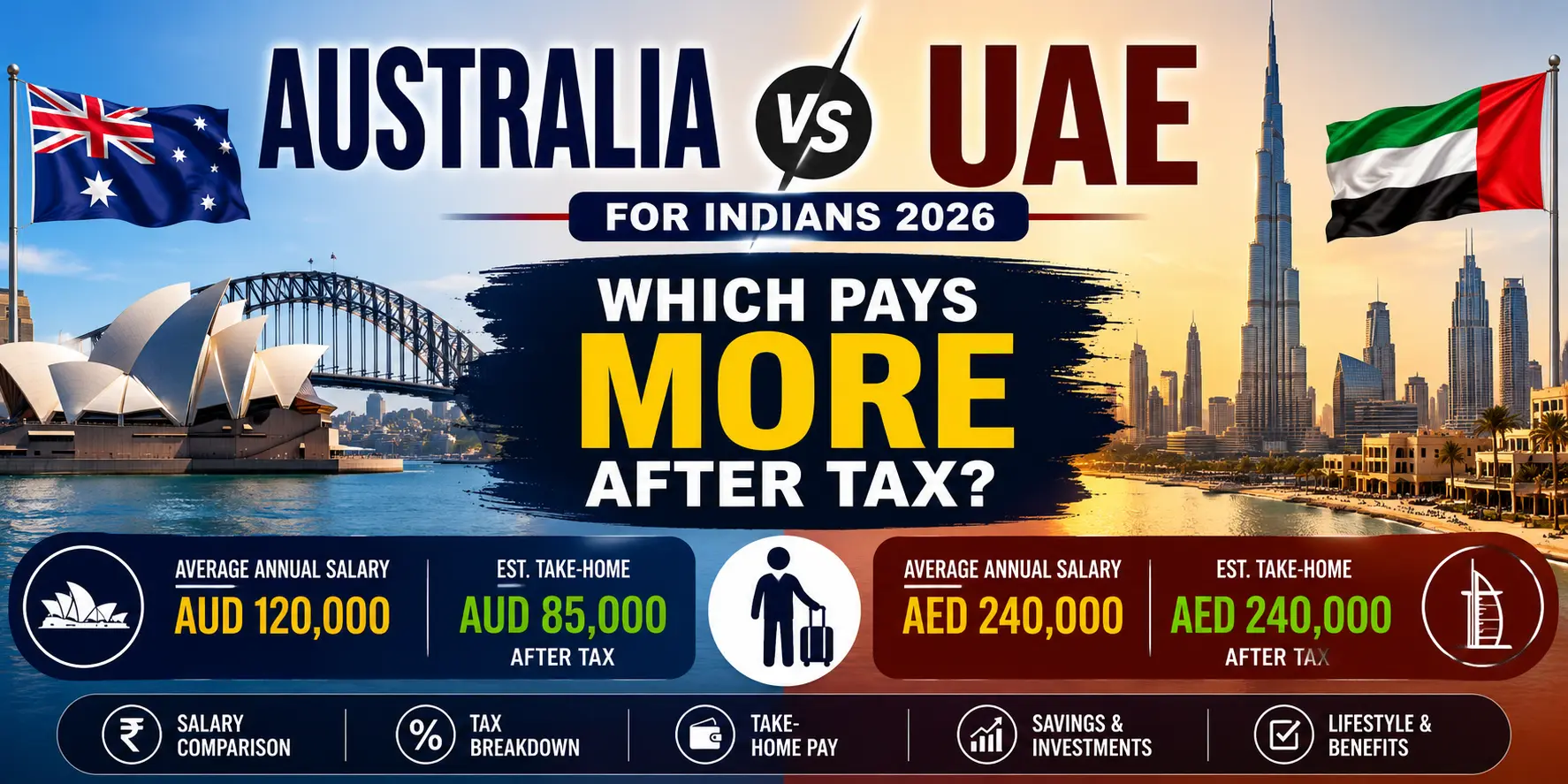
Every Indian professional considering a move abroad eventually arrives at the same crossroads.
Australia or UAE?
Both are in the top five destinations for Indian professionals. Both have large, established Indian communities. Both offer significantly higher salaries than India. And both are regularly recommended by well-meaning friends, relatives, and LinkedIn posts — usually without any actual numbers.
This article gives you the actual numbers. Real salaries. Real tax rates. Real take-home pay. Real savings potential. And the honest answer to which country puts more money in your pocket — and why the answer is more complicated than most people think.
Before reading further — use our free International Salary Calculator to see exactly what your specific role would pay in both Australia and UAE after conversion and tax. The difference is often surprising.
The Fundamental Difference — Tax Philosophy
The entire Australia vs UAE comparison starts and ends with one word: tax.
UAE operates on a zero personal income tax model. Every dirham you earn as an employee is yours to keep. There is no income tax, no social security contribution for expatriates, no national insurance. The UAE government funds itself through corporate tax (9% on business profits above AED 375,000), VAT (5%), and oil revenues — not through taxing individual salaries.
Australia operates on a progressive income tax system with rates ranging from 19% to 45% depending on income level — plus a 2% Medicare levy on top. A professional earning AUD $100,000/year pays approximately AUD $26,000 in income tax and Medicare levy — meaning 26% of their gross salary disappears before they spend a single dollar.
This single difference — zero tax vs 26%+ tax — is the lens through which every other comparison must be viewed.
Source: Australian Taxation Office (ATO), ato.gov.au, 2025–26 tax year. UAE Federal Tax Authority, tax.gov.ae, 2026.
Australian Tax Rates 2025–26 — What You Actually Pay
| Annual Income (AUD) | Tax Rate | Tax Payable | Medicare Levy | Total Deduction |
|---|---|---|---|---|
| $0 – $18,200 | 0% | $0 | 0% | $0 |
| $18,201 – $45,000 | 19% | $5,092 | 2% | $5,988 |
| $45,001 – $120,000 | 32.5% | $29,467 | 2% | $31,867 |
| $120,001 – $180,000 | 37% | $51,667 | 2% | $55,267 |
| $180,001+ | 45% | $70,000+ | 2% | $73,600+ |
Source: Australian Taxation Office, Individual Income Tax Rates 2025–26. Note: Superannuation (11.5% employer contribution in 2025–26) is additional to salary and paid separately by employer — it is not a deduction from your salary but is locked until retirement age.
Role-by-Role Salary Comparison — After Tax
Let us compare the same roles in both countries — gross salary, tax paid, take-home, and INR equivalent:
Software Engineer / Developer
| Item | Australia | UAE (Dubai) |
|---|---|---|
| Typical gross salary | AUD $110,000/year | AED 22,000/month |
| Annual gross (INR) | ₹59.4 lakh | ₹60.7 lakh |
| Income tax | AUD $27,700 (25.2%) | AED 0 |
| Medicare levy | AUD $2,200 | AED 0 |
| Monthly take-home | AUD $6,675 (₹36,045) | AED 22,000 (₹5,06,000) |
| Annual take-home (INR) | ₹43.3 lakh | ₹60.7 lakh |
| Advantage | — | 🇦🇪 UAE +₹17.4 lakh/year |
Civil / Structural Engineer
| Item | Australia | UAE (Dubai) |
|---|---|---|
| Typical gross salary | AUD $95,000/year | AED 18,000/month |
| Annual gross (INR) | ₹51.3 lakh | ₹49.7 lakh |
| Income tax + Medicare | AUD $22,600 | AED 0 |
| Monthly take-home | AUD $6,033 (₹32,578) | AED 18,000 (₹4,14,000) |
| Annual take-home (INR) | ₹39.1 lakh | ₹49.7 lakh |
| Advantage | — | 🇦🇪 UAE +₹10.6 lakh/year |
Registered Nurse
| Item | Australia | UAE (Dubai) |
|---|---|---|
| Typical gross salary | AUD $80,000/year | AED 12,000/month |
| Annual gross (INR) | ₹43.2 lakh | ₹33.1 lakh |
| Income tax + Medicare | AUD $17,800 | AED 0 |
| Monthly take-home | AUD $5,183 (₹27,989) | AED 12,000 (₹2,76,000) |
| Annual take-home (INR) | ₹33.6 lakh | ₹33.1 lakh |
| Advantage | 🇦🇺 Australia +₹50,000/year | — |
Nursing is the one major exception where Australia's higher gross salary nearly compensates for the tax difference. Australian nurses also benefit from award wage protections, penalty rates for nights and weekends, and superannuation — making the total package genuinely competitive with UAE.
Electrician (Skilled Trade)
| Item | Australia | UAE (Dubai) |
|---|---|---|
| Typical gross salary | AUD $95,000–$120,000/year | AED 5,500/month |
| Annual gross (INR) | ₹51–65 lakh | ₹15.2 lakh |
| Income tax + Medicare | AUD $22,600–$31,600 | AED 0 |
| Monthly take-home | AUD $6,033–$7,358 | AED 5,500 (₹1,26,500) |
| Annual take-home (INR) | ₹38.8–47.3 lakh | ₹15.2 lakh |
| Advantage | 🇦🇺 Australia +₹23–32 lakh/year | — |
Australia is dramatically better for electricians. Skilled trades in Australia earn among the highest wages in the world, and electricians are on the skills shortage list — meaning priority visa processing and in some cases state government relocation incentives. See our Trade Skills Abroad guide for the complete breakdown.
Financial Analyst / CA
| Item | Australia | UAE (Dubai) |
|---|---|---|
| Typical gross salary | AUD $100,000/year | AED 18,000/month |
| Annual gross (INR) | ₹54 lakh | ₹49.7 lakh |
| Income tax + Medicare | AUD $26,000 | AED 0 |
| Monthly take-home | AUD $6,167 (₹33,302) | AED 18,000 (₹4,14,000) |
| Annual take-home (INR) | ₹39.9 lakh | ₹49.7 lakh |
| Advantage | — | 🇦🇪 UAE +₹9.8 lakh/year |
Data Scientist / AI Engineer
| Item | Australia | UAE (Dubai) |
|---|---|---|
| Typical gross salary | AUD $130,000/year | AED 25,000/month |
| Annual gross (INR) | ₹70.2 lakh | ₹69 lakh |
| Income tax + Medicare | AUD $35,200 | AED 0 |
| Monthly take-home | AUD $7,900 (₹42,660) | AED 25,000 (₹5,75,000) |
| Annual take-home (INR) | ₹51.2 lakh | ₹69 lakh |
| Advantage | — | 🇦🇪 UAE +₹17.8 lakh/year |
Source: Australian Bureau of Statistics (ABS), Employee Earnings and Hours Survey 2024. UAE Ministry of Human Resources and Emiratisation (MOHRE), Wage Indicator 2025. Exchange rates: AUD 1 = ₹54, AED 1 = ₹23 (May 2026).
The Superannuation Factor — Australia's Hidden Advantage
Before concluding UAE wins on take-home pay — there is one major Australian benefit that most comparisons overlook entirely: Superannuation.
In Australia, your employer is legally required to contribute 11.5% of your gross salary (rising to 12% from July 2025) into a superannuation fund on top of your salary. This is not deducted from your pay — it is an additional employer contribution.
For a software engineer earning AUD $110,000/year:
- Superannuation contribution: AUD $12,650/year (~₹6.83 lakh)
- This money grows in a fund invested in Australian and international markets
- It is accessible at retirement (preservation age 60)
- Returns have averaged 8–10% per year historically
Over 10 years — AUD $12,650/year in superannuation at 9% annual return grows to approximately AUD $198,000 (~₹1.07 crore). This is wealth that UAE employment simply does not offer — UAE has end-of-service gratuity but no compulsory wealth accumulation equivalent to Australian superannuation.
When superannuation is included in the total compensation calculation — the gap between Australia and UAE narrows significantly for professional roles.
Source: Australian Taxation Office, Super for Individuals, ato.gov.au, 2026.
Cost of Living Comparison — The Other Half of the Equation
Take-home pay is only half the picture. What you keep after living costs is what actually builds wealth.
| Expense | Sydney, Australia | Dubai, UAE | Cheaper |
|---|---|---|---|
| 2 BHK apartment (rent) | AUD $3,200/mo (₹1,72,800) | AED 7,500/mo (₹1,72,500) | 🟰 Similar |
| Groceries (family) | AUD $800/mo (₹43,200) | AED 1,200/mo (₹27,600) | 🇦🇪 Dubai |
| Dining out (8x/month) | AUD $600/mo (₹32,400) | AED 1,000/mo (₹23,000) | 🇦🇪 Dubai |
| Car (ownership/lease) | AUD $1,200/mo (₹64,800) | AED 1,800/mo (₹41,400) | 🇦🇪 Dubai |
| Children's school | AUD $1,500/mo (₹81,000) | AED 2,000/mo (₹46,000) | 🇦🇪 Dubai |
| Healthcare | Covered (Medicare + Super) | Employer-provided | 🟰 Both free |
| Utilities + internet | AUD $400/mo (₹21,600) | AED 700/mo (₹16,100) | 🇦🇪 Dubai |
| Domestic help | AUD $1,600/mo (₹86,400) | AED 1,400/mo (₹32,200) | 🇦🇪 Dubai |
| India flights (annual) | AUD $2,400/yr (₹1,29,600) | AED 4,800/yr (₹1,10,400) | 🇦🇪 Dubai (closer) |
| Total monthly | AUD $9,300 (₹5,02,200) | AED 15,600 (₹3,58,800) | 🇦🇪 Dubai cheaper |
Sydney is one of the world's most expensive cities. Rent, food, childcare, car costs, and domestic help are all significantly more expensive than Dubai in absolute terms.
Melbourne and Brisbane are 15–20% cheaper than Sydney — making the comparison closer. Many Indian professionals in Australia deliberately choose Melbourne or Brisbane over Sydney for this reason.
Monthly Savings Comparison — Software Engineer Profile
Let us bring everything together for a software engineer with a family of 3, living in Sydney vs Dubai:
| Item | Sydney | Dubai |
|---|---|---|
| Monthly take-home | AUD $6,675 (₹3,60,450) | AED 22,000 (₹5,06,000) |
| Monthly expenses | AUD $9,300 (₹5,02,200) | AED 15,600 (₹3,58,800) |
| Monthly savings | -AUD $2,625 (deficit) | +AED 6,400 (₹1,47,200) |
| + Superannuation | +AUD $1,054/mo (₹56,916) | — |
| Net monthly position | -AUD $1,571 (still deficit) | +AED 6,400 surplus |
Even with superannuation included — a software engineer in Sydney on AUD $110,000/year cannot cover a family lifestyle in Sydney without going into deficit. The same engineer in Dubai saves AED 6,400 per month after all expenses.
This is the uncomfortable truth about Sydney: the salaries are high but the costs are higher. The maths only works in Sydney at AUD $150,000+ salary or if living in a lower-cost city like Brisbane or Adelaide.
The PR Pathway — Where Australia Wins Decisively
If take-home salary was the only consideration — UAE would win for most professional roles. But the comparison does not end at salary.
Australia offers one of the world's most accessible and transparent permanent residency pathways. UAE offers no standard PR for most professionals.
| Factor | Australia | UAE |
|---|---|---|
| PR pathway | Yes — Skilled Independent (189), State Nominated (190) | No standard PR pathway |
| PR timeline | 1–3 years from skills assessment | N/A |
| Citizenship | 4 years after PR | Not available for most expats |
| Australian passport | Visa-free: 185 countries | N/A |
| Job loss impact | PR holders can stay and job search | Visa tied to employer |
| Family permanence | PR for whole family | Dependent visas require employment |
| Long-term security | Permanent — no renewal needed | Employment visa renewal required |
| Children's education | Free public schooling after PR | Paid — AED 15,000–45,000/year |
| Healthcare | Medicare — free for PR holders | Employer-provided — stops with job |
For Indian professionals who want to build a permanent life abroad — not just accumulate savings and return — Australia is the only answer between these two. UAE provides no pathway to call it home permanently for most people.
See our complete Visa Timeline Tracker for the step-by-step process for both Australia and UAE.
Which Roles Are Better in Each Country — The Clear Answer
| Role | Better Country | Reason |
|---|---|---|
| Software Engineer | 🇦🇪 UAE | ₹17+ lakh more take-home after tax |
| Data Scientist / AI | 🇦🇪 UAE | ₹17+ lakh more after tax |
| Financial Analyst / CA | 🇦🇪 UAE | ₹10 lakh more after tax |
| Civil / Structural Engineer | 🇦🇪 UAE | ₹10 lakh more take-home |
| Electrician | 🇦🇺 Australia | ₹23–32 lakh more — gross gap too large |
| Plumber / Carpenter | 🇦🇺 Australia | Trade salaries significantly higher |
| Registered Nurse | 🇦🇺 Australia | Higher gross + award protections |
| Doctor / Specialist | 🇦🇺 Australia | AUD $200K–$400K vs AED $300K cap |
| Hospitality / Chef | 🇦🇺 Australia | Award wages + penalty rates |
| Truck Driver | 🇦🇺 Australia | AUD $80–100K with PR pathway |
| General Manager | 🇦🇪 UAE | AED 35K–50K/month tax-free |
| Retail / Sales Manager | 🇦🇪 UAE | Lower tax burden on mid salaries |
The UAE Golden Visa — Changing the PR Equation
One development that has shifted the Australia vs UAE calculation since 2022 is the UAE Golden Visa — a long-term residency programme offering 5 or 10-year renewable visas that are not tied to a specific employer.
Golden Visa eligibility for Indian professionals:
- Salary-based: Monthly salary of AED 30,000+ qualifies for a 10-year Golden Visa
- Property investment: Property worth AED 2 million+ qualifies
- Skilled professional: Doctors, engineers, scientists, artists with recognised credentials qualify
- Entrepreneur: Business owners with AED 500,000+ capital qualify
A Golden Visa holder can stay in UAE even after losing their job — for up to 6 months — and sponsor family members independently. While it is not permanent residency in the traditional sense and does not lead to citizenship, it addresses the biggest complaint about UAE: job security.
For senior Indian professionals earning AED 30,000+/month — the Golden Visa combined with UAE's 0% tax creates a compelling long-term case that was not available before 2019.
Source: UAE Federal Authority for Identity, Citizenship, Customs and Port Security (ICP), icp.gov.ae, 2026.
Quality of Life — Beyond the Numbers
Climate
Australia: Varied climate — Sydney is Mediterranean (warm summers, mild winters). Melbourne is unpredictable ("four seasons in one day"). Brisbane and Perth are warm year-round. No extreme heat events except during summer heatwaves (December–February).
UAE: Extreme heat May–September (45°C+). Pleasant October–April. Outdoor life essentially restricted to 7 months per year.
Advantage: Australia for most Indians who prefer a climate closer to home.
Indian Community
Australia: Approximately 900,000 Indians — the fastest growing migrant community. Strong Indian communities in Melbourne (Dandenong), Sydney (Parramatta, Harris Park), Brisbane (Sunnybank). Indian schools, temples, grocery stores, and cultural festivals well established.
UAE: 3.5 million Indians — the largest Indian diaspora community in any single country. India is effectively the second culture of Dubai. Hindi, Malayalam, Tamil, Telugu all spoken freely. Indian hospitals, CBSE schools, cultural events at Indian consulate scale.
Advantage: UAE for immediate Indian community integration.
Safety
Australia: Consistently ranked among the world's safest countries. Low violent crime. Strong rule of law. Safe for women and children independently.
UAE: Dubai ranked #3 globally in the 2024 Safe Cities Index. Extremely low crime. One of the world's safest environments for expatriates and families.
Advantage: Both equal — genuinely world-class safety in both countries.
Work Culture
Australia: Strong worker protections. Fair Work Act guarantees minimum wages, overtime, annual leave, sick leave, parental leave. Standard working hours 38 hours/week. Work-life balance significantly better than most Asian countries.
UAE: Less regulated than Australia. Working hours can be long — particularly in trading, hospitality, and construction. Labour law has improved significantly since 2022 reforms but worker protections remain weaker than Australia.
Advantage: Australia on worker rights and work-life balance.
Distance from India
Australia: 8–12 hour flight. Return tickets ₹60,000–₹1,20,000. Most families visit once per year.
UAE: 3 hour flight. Return tickets ₹8,000–₹20,000. Most Indian families visit 3–4 times per year.
Advantage: UAE — significantly closer to India for family visits and emergencies.
The Decision Framework — Which Country is Right for You?
| Your Situation | Best Choice | Why |
|---|---|---|
| IT / Software / Data professional wanting maximum take-home | 🇦🇪 UAE | ₹17+ lakh/year more after tax |
| Trade worker — electrician, plumber, carpenter | 🇦🇺 Australia | Gross salaries 3–4x higher than UAE |
| Healthcare — doctor, specialist | 🇦🇺 Australia | Higher gross, Medicare, PR pathway |
| Nurse wanting PR and permanent life abroad | 🇦🇺 Australia | Skills shortage, fast PR, award wages |
| Family wanting permanent settlement | 🇦🇺 Australia | Only option with true PR + citizenship |
| Single professional — 5-7 year wealth sprint | 🇦🇪 UAE | Maximum savings in shortest time |
| Senior manager / executive | 🇦🇪 UAE | AED 35K–50K/month tax-free |
| Wants to stay close to India | 🇦🇪 UAE | 3-hour flight, massive Indian community |
| Prioritises work-life balance | 🇦🇺 Australia | Fair Work Act, 38hr week, strong rights |
| Wants Australian passport mobility | 🇦🇺 Australia | Visa-free 185 countries after citizenship |
The Smartest Strategy — What Many Indians Actually Do
Here is what an increasing number of Indian professionals are doing — and it is smarter than choosing one over the other:
Phase 1 (Years 1–7): UAE — maximise tax-free savings. Live lean. Save AED 8,000–12,000/month. Build ₹1+ crore in savings.
Phase 2 (Years 7–10): Australia — use UAE savings to fund the PR process, settle comfortably during the income adjustment, and build long-term security with PR and eventually citizenship.
Many Indians arrive in Australia with AED 800,000–1,200,000 (₹1.84–₹2.76 crore) saved from UAE — enough to buy property, absorb the higher tax burden comfortably, and establish permanent roots with genuine financial security.
The UAE savings fund the Australian dream. Each country serves a different life stage.
Use our Find My Path quiz to get a personalised recommendation based on your specific role, experience, salary, and goals.
Frequently Asked Questions
Does Australia pay more than UAE for Indians?
It depends on the role. In gross salary terms — Australia often pays more for trade workers, healthcare professionals, and doctors. In take-home salary terms after tax — UAE pays more for most professional roles because UAE has 0% income tax versus Australia's 19–45% tax rates. A software engineer takes home ₹17 lakh more per year in UAE than Australia despite similar gross salaries.
Can I get PR in UAE like Australia?
No. Australia offers clear permanent residency through Skilled Independent (subclass 189) and State Nominated (subclass 190) visas — accessible to most Indian professionals after a skills assessment. UAE has no standard PR pathway for employment visa holders. The UAE Golden Visa (5–10 years) is available for qualifying professionals and investors but is not permanent residency and does not lead to citizenship.
Which country is better for Indian families?
For families prioritising permanence, Australian schooling (free after PR), Medicare, and long-term roots — Australia is better. For families prioritising proximity to India, the existing Indian community, and maximum savings in the short term — UAE is better. Many Indian families spend 5–7 years in UAE and then move to Australia when children reach secondary school age.
Is Dubai safe for Indian families?
Yes. Dubai consistently ranks among the world's top 3 safest cities. The 2024 Safe Cities Index placed Dubai at number 3 globally. Crime rates are extremely low. Both countries — UAE and Australia — are considered genuinely safe for Indian families.
What is the minimum salary to live comfortably in Sydney?
A family of 3 needs a minimum AUD $12,000–$14,000/month gross salary (approximately AUD $145,000–$170,000/year) to live comfortably in Sydney after tax and living costs. In Melbourne or Brisbane, this figure drops to AUD $100,000–$120,000/year. Use our Cost of Living Calculator to build your exact budget.
Which country is easier to get a job in from India?
UAE is significantly easier to enter from India. Employers sponsor your employment visa — the process takes 3–6 weeks and does not require a points test, skills assessment, or long-form immigration application. Australia requires a formal skills assessment (4–8 months), points test, and immigration application. However, once in Australia — the job market is larger and more diverse than UAE's.
The Bottom Line
Australia and UAE are both excellent destinations for Indian professionals — but they serve fundamentally different goals.
Choose UAE if: You are in IT, finance, engineering, or senior management. You want maximum take-home pay. You want to be close to India. You have a 5–7 year wealth-building goal. You are single or a couple without school-age children.
Choose Australia if: You are in a trade, healthcare, or medical profession. You want permanent residency and eventual citizenship. You have school-age children who need free quality education. You value work-life balance and strong employment protections. You are thinking in terms of decades not years.
The answer is not which country is better. The answer is which country is better for your specific life stage, role, and goals.
Take our Find My Path quiz — 60 seconds and you get a personalised match with real salary estimates, visa timeline, and monthly savings calculation for both countries.
Ready to compare your specific role? Use our free Salary Calculator to see your exact take-home in both Australia and UAE — or browse current job listings in both countries on Let's Move Globally. Also see our complete Visa Timeline for both countries side by side.
Let's Talk Money — Monika Halan
India's most trusted personal finance book — essential reading before moving abroad as an NRI.
* Amazon affiliate link — we earn a small commission at no extra cost to you
Immigration policies, visa requirements, and salary thresholds change frequently. All information on this page has been verified using official government sources as of October 2026. Always confirm current requirements directly at the official government website before making any application or financial decision. letsmoveglobally.com is an independent information platform — not a visa agent, immigration consultant, or legal advisor.



0 Comments
Have a question or insight? Share it below. All comments are moderated within 24 hours.
Be the first to share your thoughts.
Leave a Comment
Your email will not be published. Fields marked * are required.