LMG Career Desk
Already done your Career Score?
See jobs matched to your profile — free 15-day trial, no credit card
🎯 Is 🇩🇪 Germany actually right for YOUR profile?
Free 5-minute assessment — country scores, salary in INR, visa pathway. No agent. No fees.
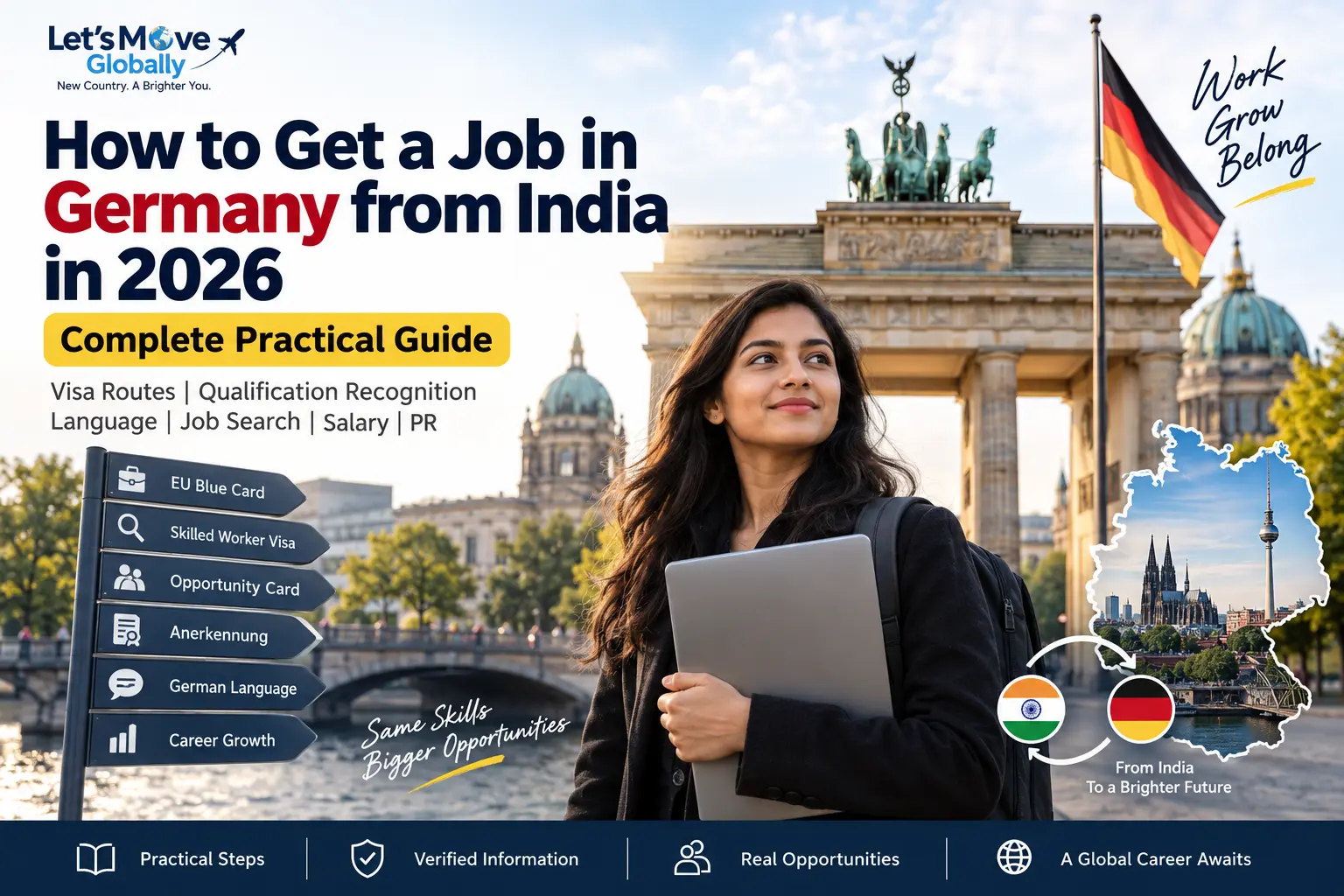
Germany's immigration landscape changed significantly in 2024–2026. The traditional 6-month Job Seeker Visa (§20) has been largely replaced by the Opportunity Card (Chancenkarte) as the primary route for Indians applying from India. EU Blue Card salary thresholds updated to €50,700/€45,934.20 from January 2026. IT professionals can now qualify without a degree. Indians can retain their Indian passport on German naturalisation since 2024. All sections below reflect these 2026 updates.
Germany has a problem most countries would love to have. Its economy is the largest in Europe, its unemployment rate sits at a historically low 3%, and its engineering and technology sectors are growing faster than its domestic workforce can fill. The country needs skilled professionals — and it has specifically designed a visa to attract them from abroad.
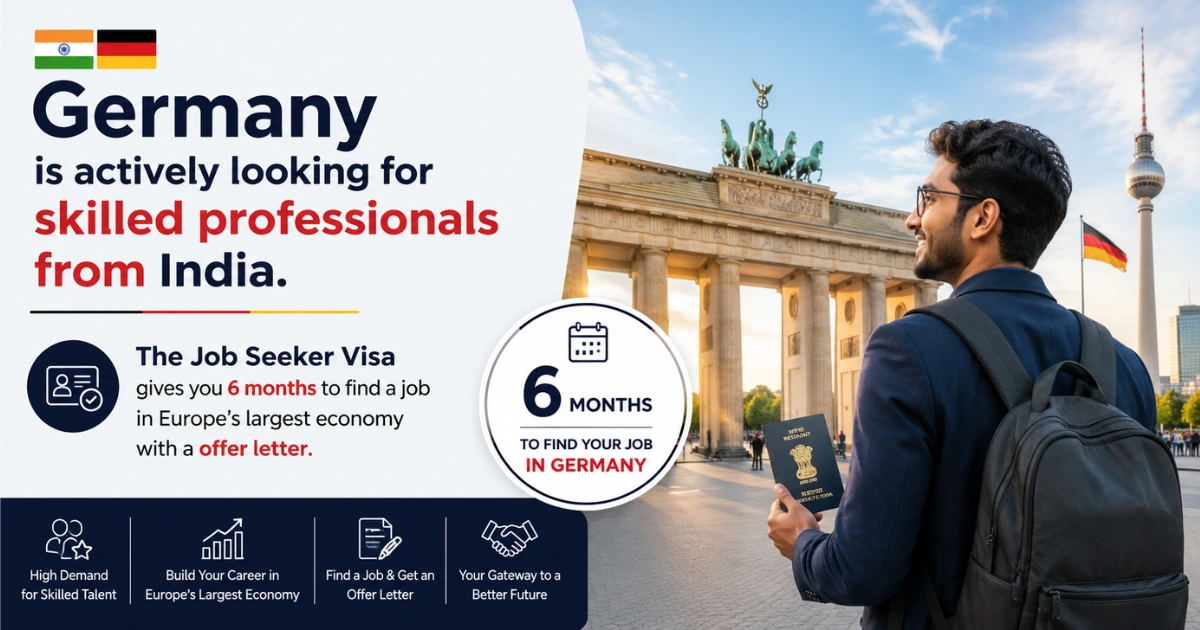
The Germany Job Seeker Visa — officially called the Arbeitsuchende Visum — is one of the most unique immigration pathways available to Indian professionals in 2026. It allows you to enter Germany for up to 6 months and search for a job in person, without needing a job offer before you apply.
This guide covers every aspect of the Germany Job Seeker Visa — who qualifies, exactly what documents you need, how to apply step by step, what to do once you land, and how to convert your stay into a full work permit and eventually permanent residency.
2026 Update — Which Visa Is Right for You? Read This First
Before diving into the full guide — one critical clarification that will save you weeks of wasted effort.
There are now three distinct pathways for Indians to enter Germany for work in 2026. Most articles — including older versions of this one — describe only the traditional Job Seeker Visa. That is no longer the complete picture.
| Your Situation | Correct 2026 Pathway |
|---|---|
| In India, no job offer yet | Opportunity Card (Chancenkarte) — 12 months, part-time work allowed, points-based, blocked account €13,092 |
| In India, have a qualifying job offer | EU Blue Card — apply directly, fastest PR (21 months with B1) |
| Already in Germany on student visa | Traditional Job Seeker Visa §20 — 18 months, in-Germany application only |
| Job offer, salary below Blue Card threshold | Skilled Worker Visa (Fachkräftevisum) |
The rest of this guide covers all pathways in detail. If you are in India right now without a job offer — jump to the Opportunity Card section immediately below the original Job Seeker Visa content. That is your 2026 route.
Still deciding whether Germany is right for your profile? Read our complete country comparison guide for Indians 2026 comparing Germany with UAE, Canada, UK and Australia across salary, visa ease, PR timelines and family fit.
What is the Germany Job Seeker Visa?
The Germany Job Seeker Visa is a temporary residence permit introduced under the German Skilled Immigration Act (Fachkräfteeinwanderungsgesetz). It was designed specifically for qualified professionals from non-EU countries who want to look for work in Germany without having secured a job offer in advance.
This makes it fundamentally different from a standard German work visa, which requires a confirmed job offer and employer sponsorship before you can even apply.
Key facts about the visa:
- Valid for 6 months — enough time to attend interviews, network, and secure an offer
- Does not allow you to start working while on this visa
- Can be converted to a work permit inside Germany once you have a job offer
- No employer sponsorship required to apply
- Available to nationals of all countries, including India
The official legal basis for this visa is Section 20 of the German Residence Act (Aufenthaltsgesetz). You can verify current requirements directly on the Make it in Germany government portal — the official resource maintained by the German Federal Government for international skilled workers.
Who is Eligible — Complete Criteria
This is where many applicants go wrong. The Germany Job Seeker Visa has specific eligibility requirements. Meeting all of them is non-negotiable.
1. Recognised Qualification
Your degree or vocational qualification must be officially recognised in Germany. This is the most critical requirement. A Bachelor's or Master's degree from an Indian university recognised by the Anabin database — maintained by the German Standing Conference of the Ministers of Education — qualifies.
Check your specific institution and degree on the Anabin database before applying. Degrees marked H+ (fully recognised) or H± (partially recognised) generally qualify. Degrees marked H- are not recognised and you will need to get an evaluation from KMK or uni-assist.
2. Minimum 5 Years of Work Experience
You must have at least 5 years of professional work experience in your field after completing your qualifying degree. Internships and academic training do not count. Full-time professional employment only.
3. Sufficient Financial Resources
You must prove you can financially support yourself during the 6-month stay without working. The minimum required is approximately €1,027 per month (2026 updated threshold) — the current German standard of living threshold set by the Federal Government. For the full 6 months, you need to show at least €5,682 in accessible funds.
This can be shown through:
- Bank statements showing sufficient balance
- A blocked account (Sperrkonto) — the most commonly accepted method
- A formal guarantee letter from a German resident
4. Health Insurance
You must have travel and health insurance valid for the entire duration of your stay in Germany, with minimum coverage of €30,000.
5. Language Skills (Recommended)
German language skills are not legally mandatory for the Job Seeker Visa itself. However, practically speaking, your job search success is directly tied to your German proficiency. Most employers — even in international companies — expect at least B1 level German. Engineering and technical roles often require B2. Only a small percentage of roles in Germany are conducted entirely in English.
We strongly recommend achieving at least A2 German before arriving and working towards B1 during your stay. The Goethe Institut offers German language courses and certifications accepted by German employers and immigration authorities.
Which Indians Qualify Best
Based on current German labour market demand, the following Indian professional profiles have the highest success rate with the Job Seeker Visa:
| Field | In-Demand Roles | Avg German Salary | German Required |
|---|---|---|---|
| Information Technology | Software Engineer, DevOps, Data Scientist | €60,000 – €90,000 | B1–B2 |
| Mechanical Engineering | Automotive Engineer, Manufacturing, R&D | €55,000 – €85,000 | B2 |
| Electrical Engineering | Power Systems, Embedded, Controls | €55,000 – €80,000 | B2 |
| Healthcare | Doctors, Nurses, Pharmacists | €50,000 – €120,000 | B2–C1 |
| Finance & Accounting | Financial Analyst, Controller, Auditor | €50,000 – €80,000 | B2 |
| Architecture & Civil | Structural Engineer, Architect, Planner | €45,000 – €70,000 | B2 |
Documents Required — Complete Checklist
Missing even one document will result in your application being rejected or delayed. Compile every item on this list before submitting.
Mandatory Documents
- Valid passport — minimum 6 months validity beyond your intended stay. Must have at least 2 blank pages.
- Visa application form — completed in German or English. Available on the German Federal Foreign Office portal (VidEx).
- Biometric passport photographs — 2 photos, taken within last 6 months, white background, 35×45mm.
- Academic degree certificates — originals and certified copies. Must include marksheets and provisional/final certificates.
- Degree recognition document — from Anabin database printout showing your institution's recognition status. If H±, you may need additional evaluation.
- Work experience letters — from all employers covering your 5+ years. Must be on company letterhead, signed, and include designation, duration, and responsibilities.
- Updated CV in German format — the Lebenslauf. German CVs follow a specific format. Use the Make it in Germany CV guide to format correctly.
- Cover letter / motivation letter — explaining why you want to work in Germany, your target industry, and your job search plan.
- Proof of financial resources — bank statements for last 3–6 months OR blocked account statement showing minimum €5,682.
- Health insurance document — travel health insurance valid for Germany, minimum €30,000 coverage for full visa duration.
- Accommodation proof — hotel booking, rental agreement, or invitation letter from a German contact for at least the first few weeks.
Recommended Additional Documents
- German language certificate (Goethe Institut, TestDaF, or telc) — even A2 strengthens your application
- LinkedIn profile URL in your application letter
- Reference letters from previous employers
- Professional certifications relevant to your field
Step-by-Step Application Process
Step 1 — Check Your Degree Recognition (Week 1–2)
Before anything else, go to anabin.kmk.org and search for your university and degree. Note the H rating. If your degree is H+, proceed directly. If H±, you may need a Statement of Comparability from the German Academic Exchange Service (KMK ZAB) — budget 4–8 weeks for this.
Step 2 — Open a Blocked Account (Week 2–3)
A blocked account (Sperrkonto) is the safest way to prove financial sufficiency to the German consulate. You deposit the required amount which is then released to you monthly once you are in Germany.
The most used providers for Indians are:
- Fintiba — fintiba.com — most popular, fully online, setup takes 3–5 days
- Expatrio — expatrio.com — similar service with bundled health insurance
- Deutsche Bank — requires more documentation but widely accepted
Deposit the full 6-month amount: €5,682 minimum. The account setup fee is typically €49–€99.
Step 3 — Get Health Insurance (Week 2–3)
Purchase travel health insurance valid for Germany for the full visa period. Providers commonly used by Indian applicants include Care Health, HDFC Ergo Travel Insurance, or international providers like Mawista. Ensure the policy explicitly covers Germany and meets the €30,000 minimum requirement.
Step 4 — Prepare Your German-Format CV (Week 2–4)
The German CV format is different from Indian CVs. Key differences:
- Includes a professional photo in the top right corner
- Lists personal details including date of birth and nationality
- Reverse chronological order — most recent experience first
- Maximum 2 pages for most professionals
- Signed and dated at the bottom
Write your CV in German if your German is B1+. English is acceptable for international tech companies.
Step 5 — Book Consulate Appointment (Week 3–4)
Book your visa appointment at the German Consulate in your city. Germany has consulates in Mumbai, New Delhi, Chennai, Kolkata, Bangalore, and Hyderabad. Appointments are booked through the German Mission in India portal.
Important: Appointment slots are in high demand. Book as early as possible — waiting times can be 4–12 weeks depending on the city and season. Delhi and Mumbai tend to have longer queues.
Step 6 — Compile and Submit Documents (1 week before appointment)
Organise all documents in a clear folder in the following order:
- Visa application form (VidEx printout)
- Passport + photocopies
- Passport photographs
- Degree certificates + Anabin printout
- Work experience letters
- CV and motivation letter
- Blocked account statement
- Health insurance document
- Accommodation proof
Bring originals AND certified copies of every document. German consulates are strict about documentation.
Step 7 — Attend Visa Interview
The consulate interview is typically 15–30 minutes. The visa officer will review your documents, verify your qualification recognition, and assess your genuine intention to find employment. Be prepared to explain:
- Why Germany specifically
- Which industries and companies you plan to target
- Your German language level
- How you will financially support yourself
- Your plan if you don't find a job within 6 months
Answer clearly, honestly, and specifically. Vague answers reduce approval chances.
Step 8 — Wait for Decision (4–12 weeks)
Processing time varies by consulate. Delhi typically takes 8–12 weeks. Mumbai 6–10 weeks. Bangalore and Hyderabad 4–8 weeks. Do not book flights until your visa is approved.
Visa Costs — Complete Breakdown
| Expense | Amount | Notes |
|---|---|---|
| Visa application fee | €75 (~₹6,800) | Non-refundable |
| Blocked account deposit | €5,682 (~₹5.1 lakh) | Returned to you monthly in Germany |
| Blocked account setup fee | €49–€99 | One-time fee to Fintiba/Expatrio |
| Health insurance (6 months) | €150–€400 | Varies by provider and coverage |
| Document translation | ₹5,000–₹15,000 | If German translations required |
| Flight to Germany | ₹45,000–₹80,000 | One-way, varies by season |
| First month accommodation | €500–€900 | Shared apartment or temporary housing |
| Total estimated cost | ~₹6–7 lakh | Excluding blocked account (returned) |
What to Do After You Land in Germany
Arriving in Germany is just the beginning. Your 6 months starts immediately. Here is exactly what to do in the first 2 weeks.
Week 1 — Registration and Setup
Register your address (Anmeldung) — within 2 weeks of arrival, you must register at your local city office (Bürgeramt or Einwohnermeldeamt). This is mandatory by German law and gives you an official German address, which you need for almost everything else. Bring your passport, visa, and rental/accommodation agreement.
Open a bank account — with your Anmeldung certificate, open a German bank account. N26, DKB, and Deutsche Bank are popular with expats. Online banks like N26 (n26.com) can be opened within days.
Get a German SIM card — Aldi Talk, Lidl Connect, or O2 offer affordable prepaid SIMs. A local number is essential for job applications.
Week 2 onwards — Active Job Search
Use these platforms to search for jobs in Germany:
- Make it in Germany Job Board — government-backed job portal specifically for international professionals
- LinkedIn Jobs — filter by Germany + your role. Message hiring managers directly.
- XING — Germany's equivalent of LinkedIn. Widely used by German companies for recruitment.
- StepStone — one of Germany's largest job portals with 60,000+ listings
- Indeed Germany — filter by location and job type
- Bundesagentur für Arbeit — Germany's Federal Employment Agency job board
Attend networking events — Germany's professional networks are built in person. Attend industry meetups, career fairs, and professional association events. Meetup.com lists tech and professional events in every major German city.
Converting to a Work Permit
Once you have a job offer, you can convert your Job Seeker Visa into a German Work Permit (Aufenthaltserlaubnis zur Ausübung einer Beschäftigung) at the local Foreigners' Office (Ausländerbehörde) — without leaving Germany.
Required for conversion:
- Signed employment contract
- Employer details and company registration
- Proof of qualifications
- Current passport and visa
- Anmeldung certificate
- Biometric photos
The work permit is typically issued within 2–6 weeks. You can begin work as soon as the Foreigners' Office gives written approval — you do not need to wait for the physical permit.
Pathway to Permanent Residency and Citizenship
This is where Germany becomes genuinely attractive for long-term settlement:
| Stage | Timeline | Requirements |
|---|---|---|
| Job Seeker Visa | 0–6 months | Arrive, search for job |
| Work Permit | Month 1–2 after offer | Job offer + qualification recognition |
| EU Blue Card | Immediately with offer €45,300+/yr | High-salary jobs in shortage occupations |
| Permanent Residency (PR) | 21 months with B1 German on Blue Card | Language B1, pension contributions, stable income |
| German Citizenship | 8 years (5 yrs with integration) | Language B1, clean record, financial self-sufficiency |
If you secure an EU Blue Card — available when your salary exceeds €45,934.20 (shortage) / €50,700 (standard) from Jan 2026 in a shortage occupation — permanent residency is possible in as little as 21 months with B1 German. This is one of the fastest PR pathways in Europe.
Common Reasons for Rejection — and How to Avoid Them
- Degree not recognised — check Anabin before applying. Get KMK evaluation if needed.
- Insufficient funds — ensure blocked account shows full 6-month amount before interview
- Unclear job search plan — bring a specific list of target companies and roles to the interview
- No German language skills — even basic A2 certification significantly improves perception
- Missing documents — use the checklist in this guide. Bring originals and copies of everything
- No accommodation plan — have at least the first 2–4 weeks of accommodation confirmed
- Ties to home country concern — demonstrate you have assets and family in India (paradoxically strengthens visa case by showing you are not planning to overstay illegally)
Germany vs Other Countries — Is It Worth It?
| Factor | Germany | UAE | Canada | UK |
|---|---|---|---|---|
| Job offer needed to apply | ❌ No | ✅ Yes | ❌ No (Express Entry) | ✅ Yes |
| Income tax | 14–45% | 0% | 20–43% | 20–45% |
| PR timeline | 21 months (Blue Card + B1 German) | Very limited | 2–3 years | 5 years |
| Healthcare | Free (after employment) | Employer-provided | Free | Free (NHS) |
| Language barrier | High (German needed) | Low (English) | Low (English) | None |
| Cost of living | Medium | High | High | Very High |
| Long-term security | Very High | Low | Very High | High |
Germany is not the easiest country to enter. The language requirement is real and the job search requires persistence. But for Indian professionals willing to invest in German language skills, it offers something rare — a clear pathway to permanent residency, free healthcare, excellent job security, and a stable European base.
Honest Advice — What Nobody Tells You
The language barrier is the real challenge. Every Indian professional who succeeds in Germany will tell you the same thing — German language skills make or break your job search. Budget 6–12 months of language learning before you arrive. Goethe Institut India offers courses in Mumbai, Delhi, Chennai, Kolkata, Bangalore, and Pune.
Start your job search before you land. Apply on LinkedIn, XING, and Step Stone while still in India. Have interviews scheduled before you even get on the plane. Your 6 months goes faster than you think.
The Indian community in Germany is large and helpful. Cities like Frankfurt, Munich, Stuttgart, and Berlin have established Indian professional communities. Facebook groups like "Indians in Germany" and "Indians in Munich" are active and genuinely helpful for job leads, accommodation, and settling-in advice.
Rejection is common — persistence is everything. Most successful applicants send 50–100+ job applications. German hiring processes are slow — 6–12 weeks from application to offer is normal. Start early, follow up professionally, and don't interpret slow responses as rejection.
Quick Summary — Key Facts
- Visa validity: 6 months
- Work allowed: No (job search only)
- Minimum experience: 5 years
- Financial requirement: €5,682 for 6 months
- Visa fee: €75
- Processing time: 4–12 weeks
- German language: Not mandatory but strongly recommended
- PR pathway: Yes — 4–5 years standard, 21 months with EU Blue Card
- Best for: Engineers, IT professionals, healthcare workers, finance professionals
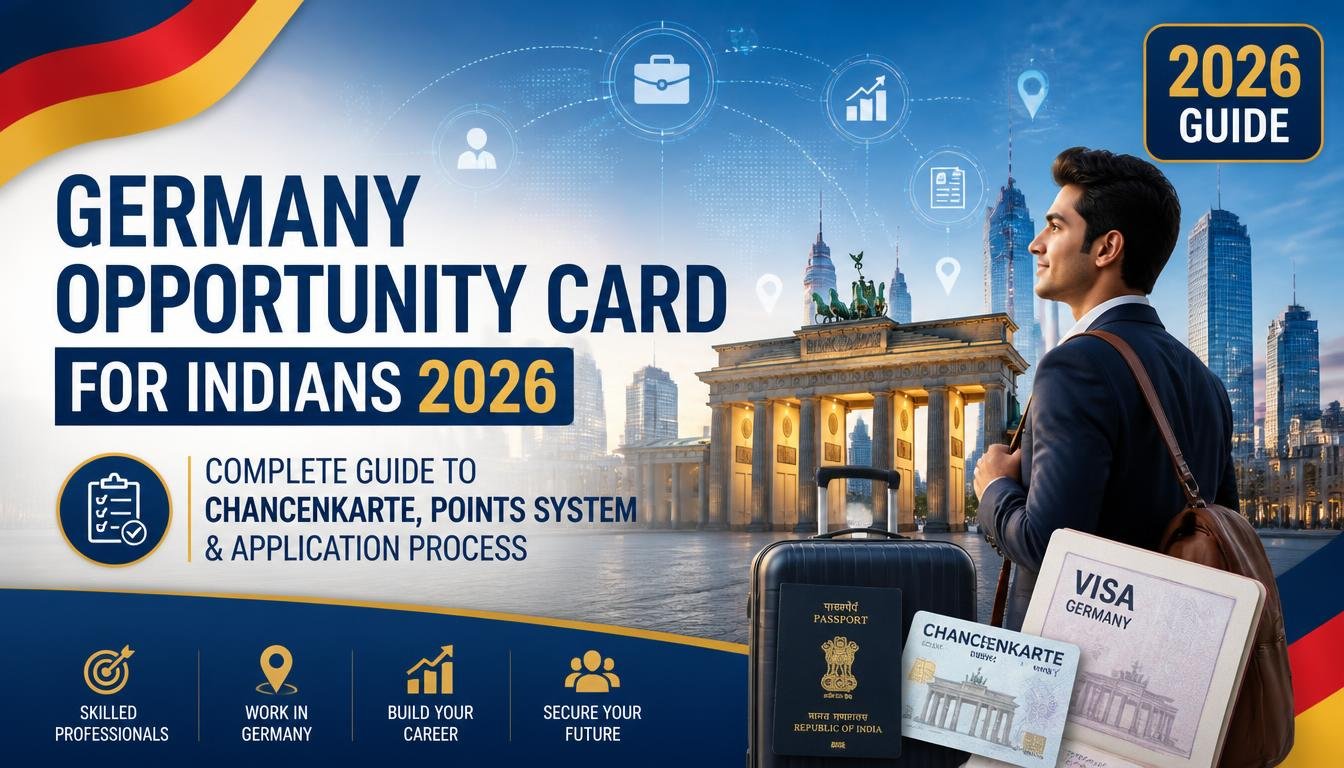
Opportunity Card (Chancenkarte) — The 2026 Route for Indians Applying from India
Introduced in June 2024 and fully operational in 2026, the Opportunity Card is Germany's first points-based immigration visa — modelled after Canada's Express Entry and Australia's Skill Select systems. India is the single largest source country for Chancenkarte visas globally, accounting for nearly one-third of all visas issued worldwide in 2026. Source: Make it in Germany, 2026.
Key Differences — Old Job Seeker Visa vs Opportunity Card
| Factor | Old §20 Job Seeker Visa | Opportunity Card (Chancenkarte) |
|---|---|---|
| Duration | 6 months | 12 months |
| Part-time work | Not allowed | Up to 20 hours/week allowed |
| Financial proof | €5,682 (6 months) | €13,092 (12 months) |
| Eligibility | Recognised degree + 5 yrs experience | Points-based — 6 points minimum |
| Work experience (no degree) | Not accepted | 5 years experience can substitute |
| Who applies | Mainly students in Germany transitioning | Indians in India — primary 2026 route |
Opportunity Card — Points System
| Category | Detail | Points |
|---|---|---|
| Degree recognition (full) | Recognised via Anabin database | 4 |
| Degree recognition (partial) | Partially recognised or pending | 2 |
| Experience (5+ years) | Relevant professional experience | 2 |
| Experience (3–4 years) | Relevant professional experience | 1 |
| German B2 | Certified language certificate | 3 |
| German B1 | Certified language certificate | 2 |
| German A2 | Certified language certificate | 1 |
| Age under 35 | At time of application | 2 |
| Previous Germany stay | Minimum 6 months previously | 1 |
| Spouse qualification | Partner meets German qualification standards | 1 |
Minimum required: 6 points. Exception: If your degree is fully recognised in Anabin (H+), you may qualify with as few as 1 point under the direct recognition route.
Check your degree recognition status: anabin.kmk.org
Blocked Account — 2026 Updated Figure
The blocked account requirement for the Opportunity Card is €13,092 (~₹11.8–12 lakh) for the 12-month duration — released at approximately €1,027 per month. This is different from the older €5,682 figure that applies to the 6-month §20 Job Seeker Visa.
Open your blocked account online from India:
2026 EU Blue Card Updates — What Changed for Indians
Updated 2026 Salary Thresholds
| Category | 2026 Salary Threshold | INR Equivalent |
|---|---|---|
| Standard occupations | €50,700/year gross | ~₹46.6 lakh/year |
| Shortage occupations (IT, engineering, healthcare) | €45,934.20/year gross | ~₹42.2 lakh/year |
Source: EU Blue Card — Make it in Germany, 2026.
IT Professionals Without a Degree — Now Eligible for Blue Card
Since 2025 — fully applied in 2026 — IT professionals without a university degree can now qualify for the EU Blue Card with:
- At least 3 years relevant IT experience within the last 7 years
- Signed employment contract in IT sector
- Salary of at least €45,934.20/year
- Federal Employment Agency (BA) approval
This is a significant win for Indian software developers, system administrators, network engineers and data analysts who built careers through experience rather than a formal engineering degree.
EU Blue Card PR Timeline — Updated
| German Language Level | PR Eligibility (Settlement Permit) |
|---|---|
| B1 certified | After 21 months Blue Card employment |
| A1 certified | After 27 months Blue Card employment |
| No German | After 33 months Blue Card employment |
Dual Citizenship — Indians Can Now Keep Their Indian Passport
Since the 2024 German Nationality Act amendment — Indians who naturalise in Germany are now permitted to retain their Indian passport. This was the single biggest barrier most Indian professionals had to pursuing German citizenship. It has been removed. Source: Federal Ministry of the Interior, bmi.bund.de, 2024.
Updated Cost Comparison — 2026 Figures
| Expense | Old §20 Job Seeker Visa | Opportunity Card 2026 |
|---|---|---|
| Blocked account deposit | €5,682 (~₹5.1L) | €13,092 (~₹12L) |
| Visa duration | 6 months | 12 months |
| Part-time work income | Not allowed | Up to 20 hrs/week — offsets costs |
| Visa fee | €75 | €75 (same) |
| Health insurance | €150–€400 | €250–€600 (12 months) |
| Total out-of-pocket (excl blocked acc) | ~₹6–7 lakh | ~₹8–10 lakh |
The blocked account is returned to you monthly — it is not a cost, it is a deposit. The real cash outlay for the Opportunity Card is approximately ₹8–10 lakh excluding the returnable deposit.
Compare Germany with UAE, Canada, UK and Australia on salary, visa ease and PR timelines: Which Country Is Best for Relocation 2026?
Calculate your Germany net salary versus UAE, Canada and UK after tax: Free Salary Calculator
Track your Germany visa timeline: Visa Timeline Tracker
Not sure if Germany is right for you: Find My Path in 60 seconds
🎯 Also Read
Germany Opportunity Card (Chancenkarte) 2026 — enter Germany without a job offer and search on the ground for up to 1 year.
Germany Opportunity Card — Complete Guide for Indians 2026 →Download our free 2026 Global Opportunities Guide for country-by-country salary benchmarks, visa checklists, and step-by-step relocation plans for UAE, Canada, UK, Germany, and Australia.
Prepare for IELTS — Online, Affordable
Magoosh IELTS prep — 200+ video lessons, practice tests, expert guidance. Used by thousands of Indians targeting UK, Canada and Australia.
Try Magoosh IELTS Free →Cambridge IELTS 18 Academic — Practice Tests with Answers
Official Cambridge IELTS practice tests — used by most Indians targeting UK, Canada and Australia visas.
* Amazon affiliate link — we earn a small commission at no extra cost to you
Immigration policies, visa requirements, and salary thresholds change frequently. All information on this page has been verified using official government sources as of September 2026. Always confirm current requirements directly at the official government website before making any application or financial decision. letsmoveglobally.com is an independent information platform — not a visa agent, immigration consultant, or legal advisor.

0 Comments
Have a question or insight? Share it below. All comments are moderated within 24 hours.
Be the first to share your thoughts.
Leave a Comment
Your email will not be published. Fields marked * are required.