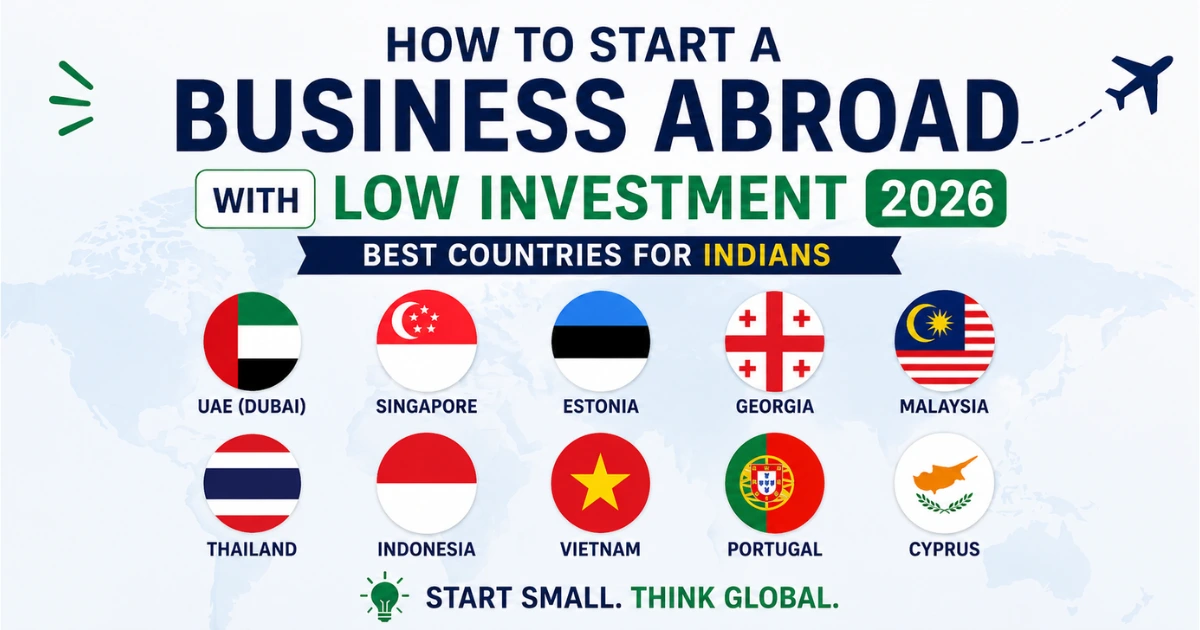
🎯 Which country suits YOUR business idea?
Free 5-minute assessment — country scores, setup costs in INR, visa pathway. No agent.
Most people think starting a business abroad requires a large amount of capital, a network in a foreign country, and years of local experience.
None of that is true anymore.
In 2026, the combination of remote work infrastructure, digital commerce platforms, global payment systems, and low-cost business registration has created a genuine window for Indian entrepreneurs to start profitable businesses abroad — many with an investment of under ₹5 lakh ($6,000).
This guide covers exactly which business types work, which countries give you the best environment, what products and services have the highest success rates, and the real costs involved — so you can make an informed decision rather than an expensive mistake.
Why Start a Business Abroad Instead of India?
Before the how, understand the why. Starting a business abroad is not just about escaping competition — it is about accessing structural advantages that simply do not exist in India.
| Factor | India | UAE | UK | Canada | Singapore |
|---|---|---|---|---|---|
| Corporate tax rate | 25–30% | 9% | 25% | 15–27% | 17% |
| Personal income tax | Up to 30% | 0% | Up to 45% | Up to 33% | Up to 22% |
| Business setup time | 15–30 days | 1–5 days | 1 day | 1–5 days | 1–3 days |
| Global market access | Limited | Very High | Very High | High | Very High |
| Banking infrastructure | Moderate | Excellent | Excellent | Excellent | Excellent |
| Investor credibility | Moderate | High | Very High | High | Very High |
A business registered in the UAE, UK, or Singapore carries significantly more credibility with international clients than an Indian-registered company. It can receive USD, GBP, and EUR payments without the friction of FEMA regulations. And in the UAE's case, it pays zero personal income tax.
For Indian entrepreneurs targeting global clients — this difference is not minor. It is transformational.
The 5 Best Countries to Start a Low-Investment Business in 2026
1. UAE — Best Overall for Indians
The UAE is the single best destination for Indian entrepreneurs in 2026. The combination of zero income tax, world-class banking, a massive Indian professional community, and genuine ease of doing business makes it unmatched.
Why UAE works for Indians:
- 3.5 million Indians already living and working there — instant network
- 0% personal income tax — every dirham you earn is yours
- Free Zones allow 100% foreign ownership with no local partner required
- Business can be set up in 1–5 days
- Strategic location between Asia, Europe, and Africa
- World-class logistics infrastructure — ideal for trading businesses
Minimum investment to start: AED 15,000 – AED 25,000 (~₹3.5 lakh – ₹6 lakh) for a Free Zone company
Best Free Zones for low-cost setup: IFZA (International Free Zone Authority), SHAMS (Sharjah), RAKEZ (Ras Al Khaimah)
Corporate tax (2026): 9% on profits above AED 375,000 — businesses below this threshold pay zero
2. UK — Best for Service Businesses and SaaS
The UK allows you to register a Limited Company online in 24 hours for just £12 (~₹1,300). No physical presence required. You can be an Indian resident and own a fully operational UK company.
Why UK works:
- Register online in 24 hours for £12
- No requirement to be physically present in the UK
- GBP invoicing — highest-value currency for service businesses
- Massive market of English-speaking clients
- Excellent reputation with US and European clients
- Stripe, PayPal, Wise — all work natively
Minimum investment: £12 registration + bank account setup (~₹2,000 total to legally exist)
Corporate tax: 25% on profits above £250,000 — small profits rate of 19% up to £50,000
Register at: Companies House UK
3. Canada — Best for Long-Term Settlement + Business
Canada combines business opportunity with a clear PR pathway. If you intend to eventually settle in Canada, starting a business here accelerates your immigration pathway through the Start-Up Visa or Self-Employed Persons programs.
Why Canada works:
- Stable, large domestic market of 38 million consumers
- Business income can support PR applications
- Strong e-commerce and digital services market
- Access to US market through CUSMA (formerly NAFTA)
- Government grants and funding available for small businesses
Minimum investment: CAD $1,000–$5,000 (~₹60,000–₹3 lakh) for provincial registration
Business visa: Start-Up Visa for innovative businesses, Self-Employed Persons for freelancers
4. Singapore — Best for Asia-Pacific Market Access
Singapore is Asia's business capital. A Singapore-registered company is trusted by clients across Southeast Asia, Japan, Australia, and China. Setup takes 1–3 days online and the corporate tax rate of 17% is competitive.
Why Singapore works:
- World's #1 ranked ease of doing business
- Gateway to 650 million ASEAN consumers
- Startup-friendly tax incentives — Startup Tax Exemption scheme
- Excellent banking and payment infrastructure
- Strong IP protection laws
Minimum investment: SGD $1 share capital + ~SGD $300 registration (~₹20,000)
Register at: ACRA Singapore
5. Estonia — Best Digital-First Business
Estonia's e-Residency program allows anyone in the world to register an EU company entirely online — no travel required. You get an EU company, EU IBAN bank account, and access to the European single market from your laptop in India.
Why Estonia works:
- Register an EU company from India — 100% online
- Access to EU market and EU client trust
- 0% corporate tax on reinvested profits
- Digital-first infrastructure — everything managed online
- Wise Business, LHV Bank accept e-Residents
Minimum investment: €100 e-Residency card + €265 company registration (~₹35,000 total)
Apply at: e-resident.gov.ee
10 Best Low-Investment Business Ideas with High Success Rates
1. Digital Marketing Agency — Investment: ₹50,000–₹2 lakh
Every business in every country needs digital marketing. Most Western companies — especially small and medium businesses in the UK, USA, Canada, and Australia — cannot afford large agencies and actively look for offshore talent.
Services to offer: SEO, Google Ads, Meta Ads, email marketing, social media management, content marketing
Target clients: UK and US small businesses, e-commerce brands, local service businesses (dentists, law firms, real estate agents)
Revenue potential: $2,000–$15,000/month within 6–12 months
What you need to start: Laptop, internet, basic Google/Meta Ads knowledge, a UK or US company registration
Why it works: Western businesses pay $1,500–$3,000/month for services that cost $500/month to deliver from India. The margin is built into the geography.
2. Software Development / IT Services — Investment: ₹30,000–₹1.5 lakh
India's single greatest export has always been software talent. In 2026, this remains the most scalable, highest-margin, and most globally recognised service a business can offer.
Services to offer: Custom software development, mobile app development, web development, API integrations, cloud migration, AI/ML solutions
Target clients: Startups in UK and USA, mid-size businesses needing custom software, e-commerce companies
Revenue potential: $5,000–$50,000/month at scale
Starting point: Register a UK or UAE company. List on Clutch, Upwork, and LinkedIn. Get your first 2 clients at cost to build reviews.
Why it works: UK clients pay £75–£150/hour for developers. Your cost is ₹800–₹1,500/hour. The arbitrage is enormous.
3. E-Commerce — Indian Products to Global Markets — Investment: ₹1–₹5 lakh
India produces products that the world wants — but most Indian manufacturers have no idea how to sell internationally. This is your opportunity.
Best Indian products to sell globally:
- Ayurvedic and herbal products — massive demand in UAE, UK, USA, and Canada among Indian diaspora and wellness-conscious consumers
- Handcrafted home decor — Rajasthani, Kashmiri, and South Indian crafts sell for 8–15x their Indian price on Etsy and Amazon
- Organic spices and superfoods — turmeric, ashwagandha, moringa, and black seed oil have exploded globally
- Ethnic and designer fashion — Indian sarees, kurtas, and fusion wear sell well in UAE and UK
- Sustainable products — bamboo goods, jute bags, brass kitchenware
- Yoga and wellness products — mats, blocks, meditation cushions
Platforms to sell on: Amazon UK, Amazon UAE, Etsy, Noon (UAE), Shopify
Revenue potential: ₹3–₹20 lakh/month at scale
Low-cost start: Begin with Amazon FBA UK or UAE — ship your products to Amazon's warehouse, Amazon handles storage, packing, and delivery. You need minimal investment to test which products sell.
4. Content Creation and Copywriting Agency — Investment: ₹20,000–₹80,000
Every company in the world needs content — blog posts, website copy, email sequences, social media, product descriptions, whitepapers. Most cannot produce it fast enough internally and outsource it.
Services to offer: Blog writing, SEO content, website copywriting, email marketing copy, LinkedIn content, press releases, technical writing
Target clients: SaaS companies, e-commerce brands, B2B companies, marketing agencies (white-label)
Revenue potential: $3,000–$20,000/month with a team of 3–5 writers
Starting investment: Register a UK company (£12). Build a portfolio of 10 sample articles. List on Contently, ClearVoice, and Upwork.
5. Recruitment and Staffing Agency — Investment: ₹1–₹3 lakh
Companies in the UAE, UK, and Canada are actively recruiting skilled Indians. A recruitment agency that connects Indian talent with international employers earns placement fees of 8–20% of the placed candidate's annual salary.
How it works:
- A UK company hiring a software engineer at £70,000/year pays you £5,600–£14,000 as a placement fee
- You source candidates from India for free using LinkedIn and job portals
- Your cost is registration, a LinkedIn Recruiter licence (~£5,000/year), and outreach time
Revenue potential: £50,000–£200,000/year with 10–30 placements
Register as: A UK or UAE recruitment agency — both markets are highly active
6. Online Education and Coaching — Investment: ₹50,000–₹2 lakh
India has the world's strongest pool of educators, coaches, and trainers. The global e-learning market is projected to reach $400 billion by 2026. The opportunity to monetise Indian expertise globally has never been larger.
High-demand course topics globally:
- Programming and software development (Python, React, AI/ML)
- Digital marketing and SEO
- IELTS and English language preparation
- Financial literacy and investment
- Yoga, meditation, and wellness
- Indian cooking and food culture
- Vedic astrology and spirituality (massive audience in UAE and UK)
Platforms to start on: Udemy, Teachable, Kajabi, YouTube + Patreon
Revenue potential: $2,000–$30,000/month depending on audience size and course pricing
7. Import-Export Trading — Investment: ₹2–₹10 lakh
India is one of the world's top exporters of pharmaceuticals, textiles, spices, gems, engineering goods, and IT services. Connecting Indian suppliers with international buyers is a business model that has created thousands of millionaires.
Easiest products to start exporting:
| Product | Top Markets | Margin | Starting Capital |
|---|---|---|---|
| Spices and condiments | UAE, UK, USA, Canada | 40–80% | ₹1–3 lakh |
| Handloom textiles | UAE, Europe, USA | 60–120% | ₹2–5 lakh |
| Ayurvedic products | UAE, UK, Southeast Asia | 50–150% | ₹2–5 lakh |
| Leather goods | Europe, USA, UAE | 40–80% | ₹3–8 lakh |
| Organic rice and grains | UAE, UK, Europe | 20–40% | ₹5–10 lakh |
| Pharmaceutical generics | Africa, Southeast Asia | 30–60% | ₹5–15 lakh |
How to start: Register on IndiaMart and TradeIndia to find verified suppliers. Register your export company with DGFT to get an Import Export Code (IEC) — costs ₹500 online. Find buyers on Alibaba or directly through Indian embassies abroad.
8. IT Consulting and Managed Services — Investment: ₹1–₹4 lakh
Small and medium businesses in the UK, UAE, and Canada need IT infrastructure, cybersecurity, cloud migration, and support — but cannot afford full-time IT staff. They outsource to managed service providers.
Services to offer: Cloud management (AWS, Azure, GCP), cybersecurity audits, IT helpdesk, network management, Microsoft 365 and Google Workspace setup
Revenue model: Monthly retainer of $1,000–$5,000 per client
Revenue potential: $10,000–$50,000/month with 5–15 clients
Starting point: Get certified in AWS, Azure, or Google Cloud (costs $300–$500). Register a UAE or UK company. Cold outreach to 50 businesses per week.
9. Real Estate Consulting — Investment: ₹50,000–₹2 lakh
Thousands of Indians buy property in the UAE, UK, Canada, and Portugal every year — but navigate the process with limited local knowledge and language barriers. A consultant who bridges this gap earns 1–3% commission on property transactions.
How it works:
- Partner with licensed real estate agents in the target country
- Generate leads from Indian community groups, WhatsApp networks, and social media
- Refer qualified buyers to your agent partner
- Earn 30–50% of the agent's commission as a referral fee
Revenue per transaction: A ₹2 crore UAE apartment generates 2% commission = ₹4 lakh. Closing 1–2 deals per month = ₹4–8 lakh/month.
Required: No licence needed to be a referral partner. Just a network and a professional UAE or UK company registration.
10. SaaS Micro-Tools — Investment: ₹1–₹5 lakh
You do not need to build the next Salesforce. Micro-SaaS products — small software tools that solve one specific problem for a niche audience — can generate $2,000–$20,000/month with a single developer and minimal infrastructure cost.
Examples of successful micro-SaaS:
- Invoice generator for UK freelancers
- Review management tool for local businesses
- Scheduling tool for yoga studios
- Automated reporting tool for digital agencies
- Proposal generator for consultants
How to find your idea: Look at problems people complain about in Reddit communities, Facebook groups, and product forums. Build the simplest possible solution. Charge $29–$99/month.
Platforms: Stripe for payments, Lemon Squeezy for SaaS billing, AWS or DigitalOcean for hosting
Investment vs Expected Return — Reality Check
| Business Type | Starting Investment | Month 6 Revenue | Month 12 Revenue | Risk Level |
|---|---|---|---|---|
| Digital Marketing Agency | ₹50K–₹2L | $2,000–$5,000 | $5,000–$15,000 | Low |
| IT Services / Dev Agency | ₹30K–₹1.5L | $3,000–$8,000 | $10,000–$30,000 | Low |
| E-Commerce (Products) | ₹1L–₹5L | $500–$3,000 | $3,000–$15,000 | Medium |
| Content Agency | ₹20K–₹80K | $1,500–$4,000 | $5,000–$20,000 | Low |
| Recruitment Agency | ₹1L–₹3L | $0–$5,000 | $10,000–$40,000 | Medium |
| Online Education | ₹50K–₹2L | $500–$2,000 | $2,000–$15,000 | Low |
| Import-Export | ₹2L–₹10L | $1,000–$5,000 | $5,000–$25,000 | Medium |
| IT Consulting / MSP | ₹1L–₹4L | $2,000–$8,000 | $10,000–$50,000 | Low |
| Real Estate Consulting | ₹50K–₹2L | $0–$8,000 | $5,000–$20,000 | Medium |
| Micro-SaaS | ₹1L–₹5L | $200–$2,000 | $2,000–$20,000 | High |
How to Register Your Business — Step by Step
Option A — UAE Free Zone Company (Most Popular for Indians)
- Choose your Free Zone — IFZA, SHAMS, or RAKEZ for lowest cost. IFZA starts at AED 15,000/year.
- Choose your business activity — Trading, Services, Consulting, or E-commerce
- Submit documents — Passport copy, passport photo, business plan (simple one page)
- Pay registration fee — AED 15,000–25,000 depending on Free Zone
- Receive your trade licence — typically within 3–5 working days
- Open a corporate bank account — Emirates NBD, Mashreq, or RAK Bank. Takes 2–4 weeks.
- Get a residency visa — your trade licence allows you to apply for a 2–3 year UAE residency visa
Total cost to be fully operational: AED 20,000–35,000 (~₹4.5–8 lakh) including licence + visa + bank account
Option B — UK Limited Company (Cheapest Globally)
- Go to Companies House
- Register online — takes 24 hours, costs £12
- Get a UK business address — use a virtual office service like Regus for £30–£50/month
- Open a business bank account — Wise Business or Starling Bank accept non-residents
- Register for VAT if revenue exceeds £85,000/year
- Hire a UK accountant — £50–£150/month for small business accounting
Total cost to be fully operational: ~£500–£800/year (~₹55,000–₹90,000) — the cheapest legitimate international company structure in the world
Option C — Estonia e-Residency (Best for Pure Digital Businesses)
- Apply for e-Residency at e-resident.gov.ee — costs €100
- Collect your e-Residency digital ID card from the Estonian embassy in New Delhi
- Register your company online using the digital ID — costs €265
- Open a business bank account with Wise Business or LHV Bank
- Manage everything — accounting, taxes, filings — 100% digitally
Total cost: ~€500 first year (~₹45,000) — an EU company for less than ₹50,000
The 7 Biggest Mistakes First-Time Entrepreneurs Make Abroad
1. Choosing the country before choosing the business
The business model determines the ideal country — not the other way around. A digital services business belongs in UK or Estonia. A trading business belongs in UAE. A business targeting the Asian market belongs in Singapore. Decide what you are selling first, then choose where to register.
2. Underestimating cash flow timing
Most service businesses take 3–6 months to generate their first invoice and 4–8 months to receive their first payment. New entrepreneurs often run out of cash not because their business failed — but because they didn't plan for the gap between starting and earning. Have 6 months of personal expenses saved before you begin.
3. Trying to do everything alone
The most successful low-investment businesses are built by specialists who outsource everything else. A developer who builds software should hire a freelance salesperson and a part-time accountant. A marketer who runs agencies should hire a freelance developer for client work. Do the thing you are best at and pay someone else for the rest.
4. Not building a digital presence before launching
International clients Google you before they ever reply to your email. Before you have a client, build a professional website, a LinkedIn company page, and publish 3–5 pieces of content showing your expertise. A business with no online presence does not exist in the minds of Western buyers.
5. Pricing at Indian rates for international clients
This is the most expensive mistake. A digital marketing agency charging $300/month to UK clients when the UK market rate is $1,500/month is leaving 80% of their revenue on the table. Research what local agencies charge in your target market and price accordingly. Your cost base is Indian — your pricing should be local to your market.
6. Ignoring tax compliance
A UK or UAE company has real tax obligations — filing annual accounts, VAT returns if applicable, corporate tax. Many first-time entrepreneurs ignore these and face penalties that dwarf their registration savings. Budget £100–£200/month for a local accountant from day one.
7. Giving up in months 2–4
Every business has a silent period — months where you are working hard and getting no results. Most businesses that fail internationally do not fail because of a bad idea. They fail because the founder quit during the silent period. Give yourself a genuine 12-month commitment before evaluating whether the business is working.
Which Business is Right for You? — Decision Framework
| Your Background | Best Business | Best Country to Register | Investment |
|---|---|---|---|
| IT / Software Engineer | IT Services Agency or Micro-SaaS | UK or UAE | ₹50K–₹3L |
| Digital Marketer | Digital Marketing Agency | UK or Estonia | ₹30K–₹1.5L |
| Finance / CA / MBA | IT Consulting or Recruitment Agency | UAE or UK | ₹1L–₹4L |
| Manufacturing / Trading | Import-Export or Amazon FBA | UAE | ₹2L–₹10L |
| Teacher / Trainer / Coach | Online Education Platform | UK or Estonia | ₹50K–₹2L |
| Writer / Content Creator | Content and Copywriting Agency | UK or Estonia | ₹20K–₹80K |
| Real Estate Background | Property Consulting | UAE | ₹50K–₹2L |
| Any Background | E-Commerce — Indian Products | UAE or UK | ₹1L–₹5L |
Realistic Timeline — What to Expect
| Month | Milestone |
|---|---|
| Month 1 | Company registered, bank account open, website live, LinkedIn active |
| Month 2–3 | First outreach campaigns, first conversations, first proposals sent |
| Month 3–5 | First client signed, first invoice raised, first payment received |
| Month 6 | 2–3 active clients, revenue covering operating costs |
| Month 9 | Processes systematized, first hire or contractor engaged |
| Month 12 | Stable recurring revenue, referrals starting, scaling possible |
Frequently Asked Questions
Can I run a UK or UAE company from India?
Yes. A UK Limited Company has no requirement for you to live in the UK. You can be an Indian resident and own, operate, and manage a UK company entirely remotely. UAE Free Zone companies are slightly different — most Free Zones offer a residency visa as part of the package, which you are not obligated to use but have the option to.
How do I receive international payments in India?
Open a Wise Business account linked to your foreign company. Clients pay into your Wise multi-currency account in USD, GBP, or EUR. You transfer to your Indian bank account at near mid-market rates with a small fee. Alternatively, Payoneer and direct SWIFT transfers to your Indian bank also work.
Do I pay tax in India on foreign business income?
If you are an Indian tax resident — living in India for 182+ days per year — your global income including foreign business income is taxable in India. However, if your foreign company retains profits and pays you a salary or dividend, the tax treatment differs. Consult a CA with international tax experience before structuring your income.
What is the minimum investment to start a UAE Free Zone company?
IFZA (International Free Zone Authority) and SHAMS (Sharjah) offer the most affordable options — starting from AED 15,000 (~₹3.5 lakh) per year including the trade licence. This covers one business activity and one visa eligibility.
Which business has the fastest path to profitability?
Service businesses — digital marketing, IT services, content writing, consulting — are the fastest to profitability because they have near-zero cost of goods sold. Your only costs are registration, tools, and your time. Product-based businesses take longer due to inventory, logistics, and returns.
Do I need to speak the local language?
For UAE, UK, Canada, and Singapore — no. English is the language of business in all four markets. For Germany and other European markets, local language skills are important for B2C businesses but less critical for B2B services.
The Bottom Line
Building a business abroad in 2026 has never been more accessible for Indian entrepreneurs. The barriers — capital, geography, language, infrastructure — have all shrunk dramatically in the last five years.
The opportunity is real. The infrastructure exists. The global market actively buys from well-presented Indian businesses every single day.
What separates the entrepreneurs who succeed from those who don't is not capital. It is not connections. It is not even skill.
It is the decision to start.
Choose the business that matches your existing skills. Choose the country that gives your business the best environment. Register the company. Build the presence. Send the first outreach.
The first client is the hardest. Everything after that is momentum.
Download our free 2026 Global Business Guide for country-specific registration checklists, tax summaries, and the exact tools used by Indian entrepreneurs running successful international businesses. Visit our Business Hub for more resources.




0 Comments
Have a question or insight? Share it below. All comments are moderated within 24 hours.
Be the first to share your thoughts.
Leave a Comment
Your email will not be published. Fields marked * are required.