🎯 Is 🇦🇪 UAE vs India actually right for YOUR profile?
Free 5-minute assessment — country scores, salary in INR, visa pathway. No agent. No fees.
Two cities. Both aspirational. Both expensive. Both full of ambitious Indians chasing better lives.
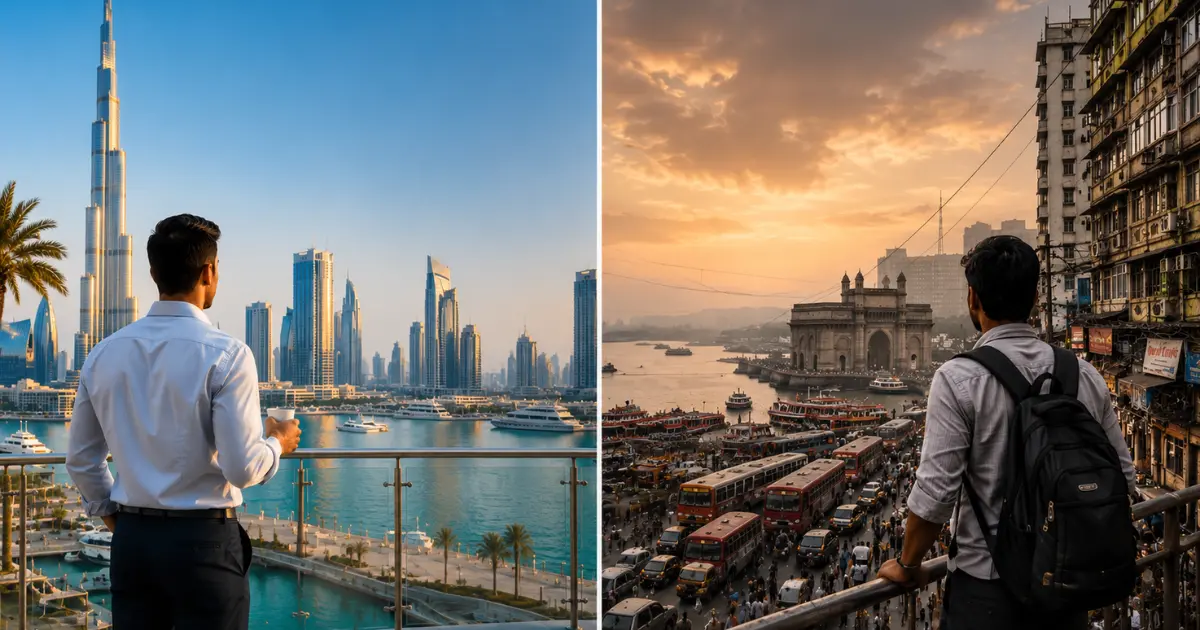
Mumbai — India's financial capital. The city that never sleeps. The place where dreams either get made or get crushed quietly in a 400 sq ft flat in Andheri.
Dubai — the Gulf's crown jewel. Glass towers, tax-free salaries, and 3.5 million Indians who already made the move and never looked back.
If you are sitting in Mumbai right now — or anywhere in India dreaming of Mumbai — this comparison is for you. Because the question most people never actually calculate is this: what does the same career, the same effort, and the same ambition actually produce in each city?
The answer, backed by real numbers, is the most important financial comparison a working Indian professional can make in 2026.
Before we dive in — use our free International Salary Calculator to see what your specific Mumbai salary would translate to in Dubai. The result changes the entire conversation.
The Setup — Who This Comparison Is For
This is not a comparison for tourists or short-term visitors. This is a comparison for working professionals — people who are considering where to build their career, save money, raise a family, and actually get ahead financially.
We are going to compare two realistic profiles:
- Profile A — Mumbai Professional: Software engineer, 5 years experience, earning ₹18 LPA. Living in a rented 2 BHK in Powai or Andheri. Has a car. Sends child to a decent private school.
- Profile B — Dubai Professional: Same software engineer, same 5 years experience, earning AED 22,000/month (~₹50.6 LPA equivalent). Living in a rented 2 BHK in JVC or Al Furjan. Has a car. Child in a CBSE school.
Same person. Same skills. Same industry. Different city. Let's see what actually happens.
Round 1 — Salary and Take-Home Pay
The most fundamental difference between Mumbai and Dubai is not what you earn — it is what you keep.
| Item | Mumbai | Dubai |
|---|---|---|
| Gross Annual Salary | ₹18,00,000 | AED 2,64,000 (~₹60,72,000) |
| Income Tax | -₹3,24,000 (old regime) | AED 0 (zero tax) |
| EPF / PF | -₹21,600 | AED 0 |
| Professional Tax | -₹2,400 | AED 0 |
| Monthly Take-Home | ₹1,21,000 | AED 22,000 (₹5,06,000) |
Stop there. Read that again.
The Mumbai professional earns ₹18 LPA and takes home ₹1.21 lakh per month after all deductions.
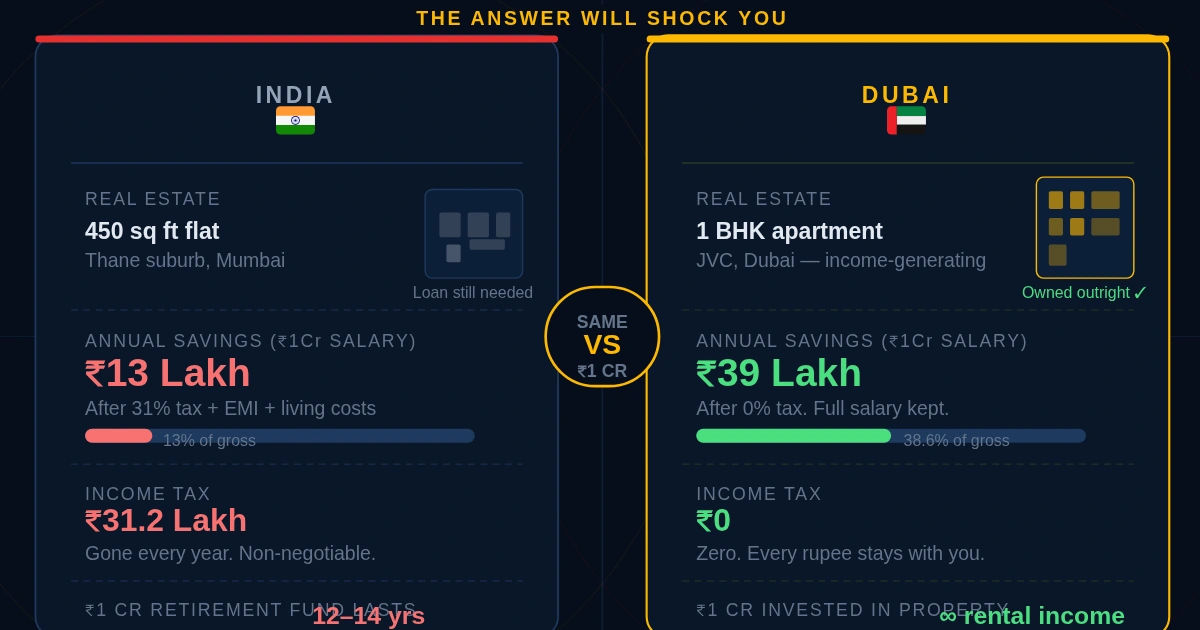
The Dubai professional earns the equivalent of ₹60 LPA and takes home every single dirham — ₹5.06 lakh per month. Zero deductions. Zero tax. Zero PF.
This is not a comparison of two different salaries. This is what the same effort and skillset produces in two different tax environments. And the difference starts here, before a single rupee is spent.
Round 2 — Housing (The Biggest Expense)
Housing consumes the largest share of income in both cities. Here is what the same quality of life actually costs:
| Home Type | Mumbai Location | Monthly Rent | Dubai Location | Monthly Rent |
|---|---|---|---|---|
| 1 BHK basic | Andheri East | ₹28,000–₹35,000 | International City | AED 3,500 (₹80,500) |
| 2 BHK mid-range | Powai | ₹55,000–₹70,000 | JVC / Al Furjan | AED 7,000 (₹1,61,000) |
| 2 BHK premium | Bandra West | ₹1,10,000–₹1,50,000 | Dubai Marina | AED 12,000 (₹2,76,000) |
| 3 BHK family | Goregaon | ₹70,000–₹90,000 | Mirdif / Dubailand | AED 9,000 (₹2,07,000) |
Dubai rent is significantly higher in absolute terms. A 2 BHK in JVC costs AED 7,000/month vs ₹55,000–₹70,000 in Powai.
But as a percentage of income — this is where the reality shifts:
- Mumbai: ₹65,000 rent on ₹1,21,000 take-home = 53.7% of income on rent
- Dubai: AED 7,000 rent on AED 22,000 take-home = 31.8% of income on rent
The Mumbai professional spends more than half their take-home salary on housing alone. The Dubai professional spends less than a third. This single difference defines the entire financial trajectory of the two careers.
One important Dubai advantage most people miss: Many Dubai employers provide housing allowance of AED 2,000–5,000/month on top of salary — effectively reducing your real rent cost to AED 2,000–5,000/month. Mumbai employers provide no housing support to employees.
Round 3 — Daily Cost of Living
Beyond rent, how does day-to-day life compare? Here is a real monthly expense breakdown for a family of 3 in each city:
| Expense | Mumbai (₹) | Dubai (AED) | Dubai (₹) | Cheaper City |
|---|---|---|---|---|
| Rent (2 BHK mid) | ₹65,000 | AED 7,000 | ₹1,61,000 | 🇮🇳 Mumbai |
| Groceries (home cooking) | ₹12,000 | AED 1,200 | ₹27,600 | 🇮🇳 Mumbai |
| Eating out (8x/month, family) | ₹8,000 | AED 1,000 | ₹23,000 | 🇮🇳 Mumbai |
| Domestic help (cook+maid) | ₹12,000 | AED 1,400 | ₹32,200 | 🇮🇳 Mumbai |
| Car (EMI/lease + fuel) | ₹28,000 | AED 2,200 | ₹50,600 | 🇮🇳 Mumbai |
| Child's school fees | ₹15,000 | AED 1,800 | ₹41,400 | 🇮🇳 Mumbai |
| Healthcare / insurance | ₹4,000 | AED 0 | ₹0 (employer-provided) | 🇦🇪 Dubai |
| Utilities (electricity/water) | ₹3,500 | AED 600 | ₹13,800 | 🇮🇳 Mumbai |
| Internet + phone | ₹2,000 | AED 300 | ₹6,900 | 🇮🇳 Mumbai |
| Entertainment + lifestyle | ₹8,000 | AED 1,200 | ₹27,600 | 🇮🇳 Mumbai |
| Annual flights to hometown | ₹0 | AED 800/mo avg | ₹18,400 | 🇮🇳 Mumbai |
| Total Monthly | ₹1,57,500 | AED 17,500 | ₹4,02,500 |
India wins on almost every individual line item. Food, domestic help, car, school, utilities — all cheaper in Mumbai in absolute rupee terms.
But here is the critical calculation that most people never do:
- Mumbai: Monthly expenses ₹1,57,500 vs take-home ₹1,21,000 = ₹36,500 DEFICIT every month
- Dubai: Monthly expenses AED 17,500 vs take-home AED 22,000 = AED 4,500 (₹1,03,500) SURPLUS every month
The Mumbai professional is going into debt every single month to maintain a mid-range lifestyle. The Dubai professional is saving ₹1 lakh every month after all expenses.
Want to calculate your exact situation? Use our Cost of Living Comparison tool.
Round 4 — Savings and Wealth Building
This is where the comparison becomes impossible to ignore. Let us project both professionals over a 10-year career:
| Metric | Mumbai Professional | Dubai Professional |
|---|---|---|
| Monthly take-home | ₹1,21,000 | ₹5,06,000 |
| Monthly expenses | ₹1,57,500 | ₹4,02,500 |
| Monthly savings | -₹36,500 (deficit) | +₹1,03,500 |
| Annual savings | -₹4,38,000 | +₹12,42,000 |
| 5-year savings | -₹21,90,000 (debt) | +₹62,10,000 |
| 10-year savings | -₹43,80,000 (debt) | +₹1,24,20,000 |
The Mumbai professional, earning ₹18 LPA, cannot afford a mid-range Mumbai lifestyle without going into deficit. This is not hypothetical — this is the lived reality of millions of Mumbai professionals who survive on credit cards, family support, or by compromising on quality of life.
The Dubai professional saves ₹1.24 crore over 10 years — from the exact same career path, same skillset, same effort.
That ₹1.24 crore difference is not talent. It is not luck. It is geography and tax policy.
Round 5 — Quality of Life
Numbers tell part of the story. Quality of life tells the rest. Here is the honest comparison of what daily life actually feels like:
Commute
Mumbai: The average Mumbai professional spends 2–3 hours per day commuting. Local train in peak hours is genuinely one of the most physically demanding commuting experiences in the world. Traffic on Western and Eastern Express Highways adds 45–90 minutes on bad days. This commute happens 5–6 days per week, 50 weeks per year. Over 10 years, the average Mumbai professional loses approximately 5,200 hours to commuting — that is 217 full days of their life, spent in a train or sitting in traffic.
Dubai: Dubai traffic exists — particularly on Sheikh Zayed Road during peak hours. But average commute times are 35–55 minutes. Most Indian professionals in Dubai live near their workplace by choice since rent varies significantly by area. Many companies provide transport or allowance. Average commute time saved vs Mumbai: 1–1.5 hours per day.
Air Quality
Mumbai: Mumbai's AQI regularly reaches 150–200 (Unhealthy) in winter months, particularly in areas like Kurla, Chembur, and Andheri. Children and elderly family members bear the heaviest impact. The 2024 air quality report ranked Mumbai among India's most polluted metros during November–February.
Dubai: Dubai's AQI typically sits between 30–80 (Good to Moderate). Occasional sandstorms temporarily spike AQI but these are short-lived. Year-round, Dubai air quality is significantly better than Mumbai's peak pollution months.
Safety
Mumbai: Mumbai is relatively safe by Indian standards — significantly safer than Delhi or Bengaluru for street crime. However, traffic accidents, local train incidents, and petty crime remain real concerns. Women's safety varies significantly by neighbourhood and time of day.
Dubai: Dubai consistently ranks among the world's top 5 safest cities. The 2024 Safe Cities Index placed Dubai at number 3 globally. Crime rates are extremely low. Women can walk alone at night in most areas without safety concerns. This is one of the most cited reasons Indian families choose Dubai for long-term settlement.
Space and Living Standards
Mumbai: Space is Mumbai's most painful constraint. The average 2 BHK in a mid-range Mumbai neighbourhood is 650–800 sq ft. Most buildings are old (20–40 years), lifts are often unreliable, parking is a daily negotiation, and building common areas are typically poorly maintained. For ₹65,000/month, you get functional but rarely luxurious.
Dubai: The same ₹65,000-equivalent (AED 2,800/month) in Dubai gets you a studio in International City. But AED 7,000/month — which the Dubai professional can comfortably afford — gets a modern 2 BHK in a well-maintained building with gym, pool, covered parking, and 24-hour security. The difference in living standard for the same budget percentage is dramatic.
Healthcare
Mumbai: Good private healthcare exists in Mumbai — Kokilaben, Lilavati, Hinduja are world-class hospitals. But costs are entirely out-of-pocket unless your employer provides a policy. A family health insurance covering hospitalisation costs ₹25,000–₹40,000/year with significant co-pays and exclusions.
Dubai: Dubai Health Authority (DHA) mandates that every employer provides health insurance to employees and their dependents. This is not optional — it is law. The typical employer-provided policy covers outpatient, inpatient, dental, and maternity with minimal co-pay. A family of 3 receiving employer-provided Dubai health insurance is getting the equivalent of a ₹3–4 lakh annual policy for free.
Indian Community and Culture
Mumbai: Obviously home. Every festival celebrated fully. Family within driving distance. Hindi, Marathi, regional languages everywhere. Familiar food, familiar faces, familiar frustrations.
Dubai: 3.5 million Indians make Dubai feel more like an Indian city than a foreign one. Diwali, Holi, Onam, Navratri — all celebrated publicly with the same energy as India. Indian grocery stores (Lulu Hypermarket, West Zone) stock every regional product. Indian restaurants on every street. CBSE and ICSE schools for children. Indian hospitals with Indian doctors. Malayalam, Hindi, Tamil, Telugu — all spoken freely. The cultural adjustment is significantly softer than any Western country.
Round 6 — Career Growth
Beyond money and lifestyle — which city offers better career growth?
Mumbai Career Advantages
- Bollywood, media, and entertainment — only Mumbai
- Indian startup ecosystem — strong in Mumbai and Bangalore
- Proximity to Indian market — if your career is India-focused
- Legal and regulatory expertise — India-specific careers
- BFSI sector — Indian banking and financial services hub
Dubai Career Advantages
- International exposure — working with 200+ nationalities daily builds global perspective
- Tax-free savings accelerate career risk-taking — you can afford to take bolder moves
- MENA market access — the Middle East and North Africa market is massive and India-connected
- Global company presence — Emirates, DP World, ADNOC, Mashreq are world-class organisations
- CV weight — "Dubai experience" signals international competence to global recruiters
- Networking quality — expat communities connect you to opportunities across 20+ countries
If your career ambition is India-specific — politics, Indian media, domestic FMCG, Bollywood — Mumbai wins. If your ambition is international, Dubai accelerates it.
Want to know which companies in Dubai are actively hiring for your profile? See our Top 10 Companies Hiring Indians in UAE guide.
Round 7 — Family Considerations
For professionals with families — or planning one — the comparison shifts in important ways.
Children's Education
Mumbai: Good private schools cost ₹1.5–₹4 lakh per year in Mumbai. Competition for admission to top schools is intense. School quality varies dramatically by area — a flat in Bandra gives different school options than a flat in Mira Road. Many Mumbai parents spend significant energy and money on private tuitions on top of school fees.
Dubai: CBSE schools in Dubai cost AED 15,000–25,000 per year (~₹3.45–5.75 lakh). More expensive than Mumbai but many employers provide education allowance of AED 15,000–30,000 per year — covering most or all of the cost. Dubai's CBSE schools follow the exact same curriculum as India — your child's education is uninterrupted if you return to India. School quality is generally high with modern facilities.
Parents and Extended Family
This is Dubai's real limitation. If your parents are in India and need regular support or have health issues — Dubai's 3-hour flight is manageable but not free. Return flights cost AED 800–1,200 per person. Most Dubai-based Indians visit India 2–3 times per year.
The financial math often works in favour of the Dubai professional: saving ₹1 lakh/month means they can fly home whenever needed, send money home easily, and actually build the financial stability to support aging parents better than if they stayed in Mumbai struggling with a deficit lifestyle.
Long-Term Permanence
Dubai's honest limitation — there is no standard pathway to permanent residency for most employment visa holders. You are legally here as long as you are employed. This creates a level of uncertainty that Canada, Australia, or the UK do not. See our Visa Timeline Tracker for countries with clear PR pathways.
The Golden Visa (5–10 years) addresses this for high earners and investors — but is not automatic for all professionals.
The Honest Scorecard
| Category | Mumbai | Dubai | Winner |
|---|---|---|---|
| Take-home salary | ₹1,21,000/mo | ₹5,06,000/mo | 🇦🇪 Dubai |
| Monthly savings | -₹36,500 (deficit) | +₹1,03,500 | 🇦🇪 Dubai |
| Rent (absolute cost) | ₹65,000 | ₹1,61,000 | 🇮🇳 Mumbai |
| Rent (% of income) | 53.7% | 31.8% | 🇦🇪 Dubai |
| Food cost | Cheaper | 2x more expensive | 🇮🇳 Mumbai |
| Domestic help | Very affordable | Expensive | 🇮🇳 Mumbai |
| Healthcare | Out of pocket | Free (employer) | 🇦🇪 Dubai |
| Air quality | Poor in winter | Good year-round | 🇦🇪 Dubai |
| Safety | Moderate | World's top 3 | 🇦🇪 Dubai |
| Commute | 2–3 hours/day | 35–55 min/day | 🇦🇪 Dubai |
| Space and living standard | Cramped, older buildings | Modern, spacious | 🇦🇪 Dubai |
| Indian community | Home country | 3.5M Indians | 🇮🇳 Mumbai |
| Family proximity | Immediate | 3 hours away | 🇮🇳 Mumbai |
| Career — international | Limited | Excellent | 🇦🇪 Dubai |
| Permanent residency | Home country | No standard PR | 🇮🇳 Mumbai |
| 10-year wealth built | -₹43.8 lakh (debt) | +₹1.24 crore | 🇦🇪 Dubai |
What Mumbai Professionals Always Say — And the Real Answer
"But Dubai is so expensive"
Yes — individual items cost more. But your salary is also 3–4x higher and untaxed. The question is never "what does it cost?" — it is "what does it cost as a percentage of what I earn?" On that measure, Dubai wins convincingly.
"I'll miss my family too much"
Valid and real. But a 3-hour flight that costs ₹8,000–₹15,000 return is accessible 3–4 times per year on a Dubai salary. More importantly — the Dubai professional saving ₹1 lakh/month can financially support their Indian family significantly better than the Mumbai professional running at a monthly deficit.
"Dubai has no stability — what if I lose my job?"
Also valid. Employment visa depends on employment. But the financial cushion built in Dubai — saving ₹1 crore in 8–10 years — creates the exact stability that Mumbai professional life denies. A Mumbai professional with no savings has zero stability. A Dubai professional with ₹1 crore in savings has enormous stability.
"I want to settle permanently — Dubai doesn't give PR"
True for most. If permanent settlement is your priority, Canada or Australia are better choices. Dubai is optimal for the 5–10 year wealth acceleration phase — build the financial foundation, then settle where you choose. Many Indians do exactly this: 7–10 years in Dubai, ₹1 crore+ saved, then return to India or move to Canada with a financial head start.
"Mumbai has better career opportunities in my field"
For some fields — yes. If you are in Indian law, domestic FMCG, regional media, or Bollywood — Mumbai is irreplaceable. But for software, engineering, finance, healthcare, hospitality, and most professional services — Dubai offers comparable or superior opportunities with dramatically better financial outcomes. Use our Find My Path tool to check if your specific profile matches Dubai's demand.
The One Number That Decides Everything
If there is one number to take from this entire comparison, it is this:
The Mumbai professional earning ₹18 LPA runs a monthly deficit of ₹36,500 trying to maintain a decent standard of living.
The Dubai professional in the same career runs a monthly surplus of ₹1,03,500.
That is a swing of ₹1,40,000 every single month — not because of a better job title, not because of smarter investments, not because of family wealth. Simply because of which city they chose to work in.
Over 10 years, compounded with investment returns, that decision is worth ₹2–3 crore.
Mumbai is a great city. It has energy, culture, opportunity, and heart unlike anywhere else in India. But for a working professional trying to build wealth, provide well for a family, and actually get financially ahead — the numbers make it one of the hardest places in the world to do so.
Dubai is not for everyone. But for the right person — ambitious, willing to adapt, focused on financial progress — it is the single most efficient wealth-building decision available to an Indian professional in 2026.
The question is not whether Dubai is better than Mumbai. The question is: what are your goals for the next 10 years — and which city actually helps you achieve them?
Ready to find out if Dubai is the right move for your specific profile? Take our free Find My Path quiz — 60 seconds, personalised salary estimate, visa timeline, and monthly savings calculation. Or browse current Dubai job listings on Let's Move Globally.
Frequently Asked Questions
Is Dubai more expensive than Mumbai?
Individual items — rent, food, domestic help — cost more in Dubai in absolute terms. However, Dubai salaries are 3–4x higher than Mumbai for the same role and there is zero income tax. As a percentage of income, Dubai's cost of living is actually lower than Mumbai's, which is why Dubai professionals save significantly more despite higher absolute costs.
Can I get PR in Dubai like I can in Canada?
Dubai does not have a standard permanent residency pathway for most employment visa holders. You can renew your employment visa indefinitely as long as you are employed. The Golden Visa (5–10 years) is available for professionals earning above AED 30,000/month, investors, and exceptional talents. For a clear PR pathway, Canada and Australia are better choices.
How many Indians live in Dubai?
Approximately 2.8 million Indians live in Dubai specifically, and 3.5 million across the UAE as a whole — making it the single largest Indian diaspora community in any city outside India. CBSE schools, Indian hospitals, Indian grocery stores, and active community organisations make the cultural transition significantly easier than moving to a Western country.
What salary do I need to live comfortably in Dubai?
A single professional needs AED 8,000–10,000/month to live comfortably in Dubai. A family of 3 needs AED 15,000–18,000/month for a comfortable mid-range lifestyle. Use our Cost of Living Calculator to build your specific Dubai monthly budget based on your family situation and lifestyle preferences.
Is it easy to find a job in Dubai from Mumbai?
Yes — Dubai is the most accessible international market for Mumbai professionals. No language barrier, short flight, massive Indian professional network, and employers familiar with Indian education and work culture. Apply directly on company websites for best results. Our Top 10 Companies Hiring Indians in UAE guide covers the highest-volume employers and exactly how to apply.
What happens to my career if I return to India from Dubai?
Dubai international experience significantly strengthens your Indian CV. Professionals returning from Dubai typically command 40–60% salary premiums in Indian hiring over candidates who stayed in India. The combination of international exposure, global company experience, and demonstrated financial responsibility makes returning Dubai professionals highly attractive to Indian employers — particularly in BFSI, consulting, technology, and senior management roles.



0 Comments
Have a question or insight? Share it below. All comments are moderated within 24 hours.
Be the first to share your thoughts.
Leave a Comment
Your email will not be published. Fields marked * are required.