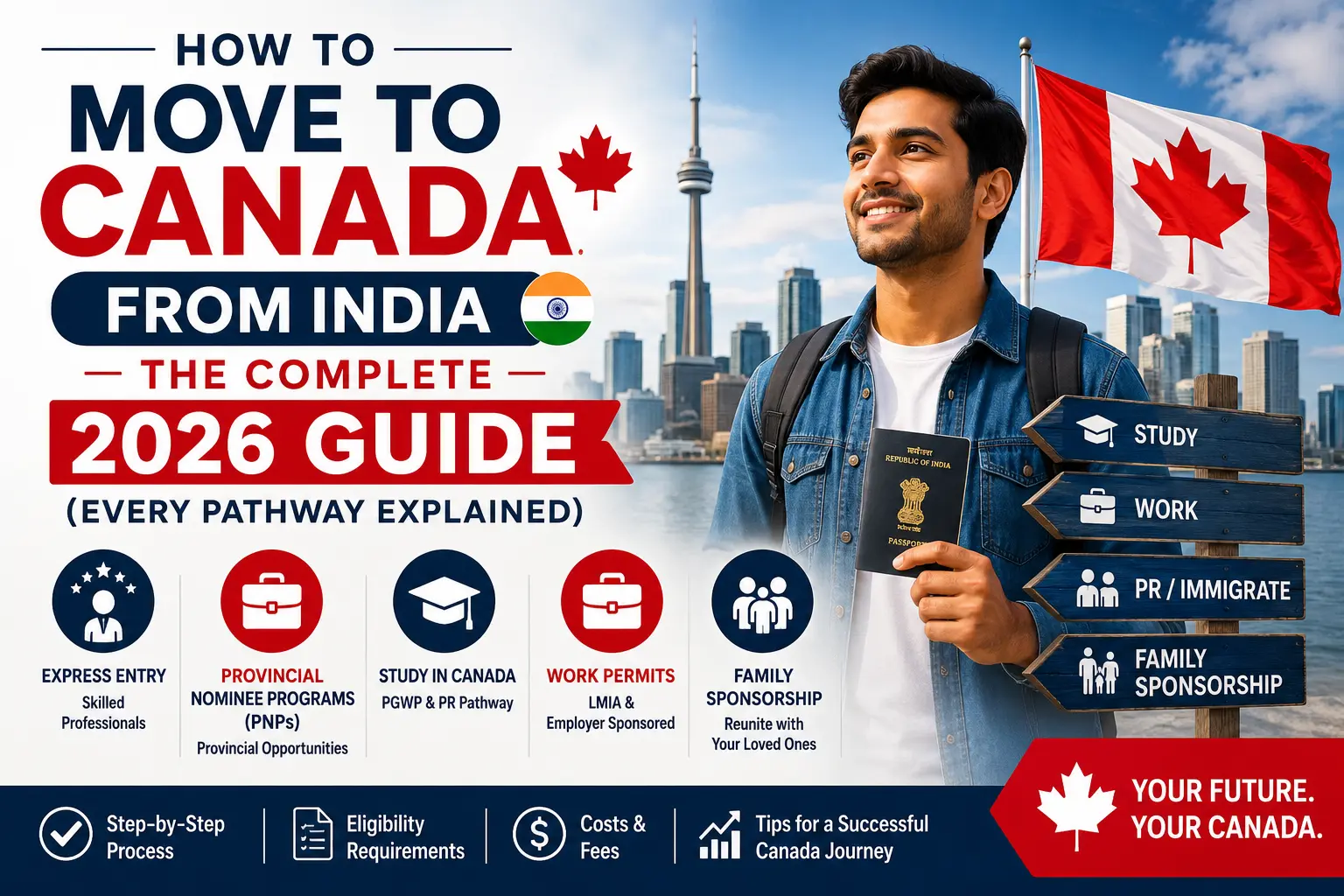
🎯 Is 🇨🇦 Canada actually right for YOUR profile?
Free 5-minute assessment — country scores, salary in INR, visa pathway. No agent. No fees.
Canada is not a dream for most Indians anymore. It is a plan.
A very specific, very researched, very seriously considered plan that millions of Indian families are working toward right now — with timelines written on paper, savings targets set, and IELTS dates already booked.
And yet — despite all that research — most people trying to move to Canada from India still cannot clearly answer three basic questions: Which pathway actually applies to me? What will it realistically cost? And how long will it actually take?
This guide answers all three. Honestly. Without the sales pitch that immigration consultants give you, without the fear-mongering that makes you feel the process is impossible, and without the oversimplification that makes it sound easier than it is.
Comparing Canada with UAE, Australia, UK and Germany before deciding? Our guide to the best country for relocation from India in 2026 covers all six countries side by side — PR pathways, net savings, family fit and realistic timelines — so you can confirm Canada is the right choice before investing months in the process.
Before going further — if you are still deciding between Canada and other countries, take our free Find My Path quiz. It analyses your specific profile and tells you which country and pathway gives you the best shot — in 60 seconds.
Why Canada — The Actual Numbers Behind the Interest
Indians are the largest source of new permanent residents in Canada. In 2024, Indians received 127,256 permanent resident admissions — more than any other nationality. This is not a coincidence or a cultural preference. It is a response to specific, concrete advantages that Canada offers Indian professionals that very few other countries can match simultaneously.
| Factor | Canada Reality | Why It Matters for Indians |
|---|---|---|
| Permanent Residency pathway | Available in 2–3 years | Legal right to stay permanently — not dependent on employer |
| Citizenship timeline | 3 years after PR | Canadian passport — visa-free access to 185+ countries |
| Average tech salary | CAD $90,000–$130,000/year | 3–5x Indian salary for same role |
| English requirement | IELTS CLB 7 (most pathways) | Most Indians already proficient |
| Indian community | 1.8 million Indians in Canada | Largest diaspora in any country outside Middle East |
| Healthcare | Free after PR (provincial) | Family covered — no annual insurance cost |
| Children's education | Free public schooling after PR | Saves CAD $15,000–$20,000/year vs UAE/UK private schools |
Source: Immigration, Refugees and Citizenship Canada (IRCC), canada.ca, 2024 Annual Report.
The 5 Pathways to Move to Canada from India
There is no single "Canada visa." There are multiple pathways — each suited to a different profile. Choosing the wrong one wastes years. Here are the five most relevant for Indians in 2026, in order of how many Indians actually use them:
Pathway 1 — Express Entry (Most Common for Professionals)
Express Entry is Canada's flagship immigration system for skilled workers. It is not a visa itself — it is a selection system that manages three immigration programs:
- Canadian Experience Class (CEC) — for people already working in Canada on a work permit
- Federal Skilled Worker Program (FSWP) — for people applying from outside Canada (most Indians use this)
- Federal Skilled Trades Program (FSTP) — for electricians, plumbers, welders, and other skilled tradespeople
You create a profile in the Express Entry pool. IRCC assigns you a Comprehensive Ranking System (CRS) score based on your age, education, work experience, language scores, and other factors. When IRCC holds a draw — they invite the highest scorers to apply for PR.
The critical reality of Express Entry in 2026:
| Draw Type | Q1 2026 Cutoff CRS | Who Qualifies |
|---|---|---|
| Canadian Experience Class (CEC) | 507–511 | People already in Canada on work permit |
| Healthcare Occupations | 467 | Doctors, nurses, pharmacists |
| STEM Occupations | Dormant since early 2024 | No draws currently |
| French Language Proficiency | 393–400 | TCF/TEF B2 level French |
| Transport Occupations | 435–440 | Truck drivers, heavy vehicle |
| Senior Managers | 429 | Senior management roles |
Source: IRCC Express Entry Draw Results, canada.ca/express-entry-rounds, Q1 2026.
Check your own CRS score right now with our free CRS Calculator — it takes 3 minutes and gives you an accurate score without any registration required.
The honest picture for Indians applying from India: The general pool (All Programs draw) has been largely discontinued in 2026 in favour of category-based draws. Indians with CRS scores of 460–500 who do not qualify for a category draw should either:
- Improve CRS through IELTS/French improvement
- Pursue a Provincial Nominee Program (PNP) nomination — which adds 600 points and guarantees a draw invitation
- Get a Canadian work permit first (through LMIA) and apply as CEC later
Pathway 2 — Provincial Nominee Programs (PNP)
If Express Entry feels out of reach — PNP is where most Indians with moderate CRS scores find their pathway. Each Canadian province runs its own immigration program with different requirements, targeting workers their local economy needs.
A provincial nomination adds 600 CRS points to your Express Entry profile — effectively guaranteeing you will receive an Invitation to Apply (ITA) in the next draw.
| Province | Program Name | Best For Indians | Processing Time |
|---|---|---|---|
| Ontario | Ontario Immigrant Nominee Program (OINP) | Tech workers, healthcare, in-demand skills | 60–120 days nomination |
| British Columbia | BC PNP Tech, Skills Immigration | IT, engineering, skilled trades | 2–8 weeks (Tech stream) |
| Alberta | Alberta Immigrant Nominee Program (AINP) | Engineering, oil & gas, construction | 3–6 months |
| Saskatchewan | Saskatchewan Immigrant Nominee Program (SINP) | Skilled workers, entrepreneurs | 3–4 months |
| Manitoba | Manitoba Provincial Nominee Program (MPNP) | Skilled workers, international students | 3–4 months |
| Nova Scotia | Nova Scotia Nominee Program (NSNP) | Healthcare, skilled trades, graduates | 3–6 months |
| New Brunswick | New Brunswick PNP (NBPNP) | Skilled workers with job offer | 3–4 months |
Official PNP directory: canada.ca/provincial-nominees
The strategy most Indians miss: You do not have to live in the province that nominates you forever. After receiving PR through a PNP, you can move anywhere in Canada you choose. Many Indians get nominated by smaller provinces like Manitoba or New Brunswick — then move to Toronto or Vancouver once PR is confirmed.
Pathway 3 — Study Visa (For Younger Applicants)
The study-to-PR pathway is the most common route for Indians under 30 who do not yet have the experience or CRS score for direct Express Entry. The logic is straightforward: study in Canada, work during and after studies, apply for PR from inside Canada as a Canadian Experience Class applicant — with a significantly higher chance of success.
The three-stage process:
- Study Permit: Apply for a Designated Learning Institution (DLI) program. Processing: 4–8 weeks. canada.ca/study-permit
- Post-Graduation Work Permit (PGWP): After completing a 2-year program, you receive a 3-year open work permit. This is your time to build Canadian work experience for CEC.
- Canadian Experience Class (CEC): With 1 year of skilled work experience in Canada, apply through Express Entry CEC — which has significantly lower CRS cutoffs than FSWP.
Realistic costs for Indian students:
| Expense | Annual Cost (CAD) | Notes |
|---|---|---|
| Tuition — 2-year college program | $14,000–$22,000/year | College of Applied Arts and Technology |
| Tuition — University degree | $22,000–$40,000/year | Varies by program and institution |
| Living expenses (shared accommodation) | $12,000–$16,000/year | Depends on city — Toronto highest |
| Health insurance (mandatory) | $600–$800/year | Most provinces — students pay |
| Part-time work income (20hrs/week) | -$12,000 to -$18,000/year | CAD $17.30/hour minimum wage Ontario |
| Net annual cost after working | $16,000–$22,000/year | Approximately ₹10–13 lakh/year |
Source: Statistics Canada, statcan.gc.ca, Average Student Living Costs 2024–25. Ontario minimum wage: ontario.ca/minimum-wage, 2026.
Important 2025–26 update: Canada reduced international student intake caps significantly — 437,000 permits issued in 2024, down from 900,000 in 2023. Competition for top DLI programs has increased. Apply to your chosen institution early and have backup options ready. Source: IRCC, canada.ca/immigration-levels-plan, 2025.
Pathway 4 — Work Permit (LMIA-Based)
If a Canadian employer wants to hire you — they apply for a Labour Market Impact Assessment (LMIA) from Employment and Social Development Canada (ESDC). The LMIA confirms that no Canadian citizen or PR holder was available for the role. Once approved, you get a closed work permit tied to that employer.
This pathway is slower and more employer-dependent than Express Entry — but it gets you inside Canada, where you can build the 1 year of Canadian work experience needed for CEC Express Entry.
LMIA-exempt pathways also exist for:
- Intra-company transfers (if your Indian company has a Canadian branch)
- CETA — Canadian companies hiring Europeans (not applicable for Indians)
- Open Work Permits for spouses of certain work permit holders
Source: Employment and Social Development Canada, esdc.gc.ca/foreign-workers, 2026.
Pathway 5 — Family Sponsorship
If you have a Canadian citizen or permanent resident spouse, parent, or child — they can sponsor your PR application. Processing times have improved significantly after post-COVID delays.
| Relationship | Processing Time 2026 | Requirements |
|---|---|---|
| Spouse / Common-law Partner | 12–24 months | Genuine relationship proof, sponsor income threshold |
| Dependent Child | 12 months | Age under 22, not married |
| Parents / Grandparents | 24–36 months | Lottery system — not guaranteed to get an application slot |
Source: IRCC Family Sponsorship, canada.ca/family-sponsorship, 2026.
Step-by-Step Process — Express Entry from India (Most Common Route)
This is the process most Indians will follow. Each step has a specific timeline — understanding this prevents the most common mistake: rushing into an application before prerequisites are complete.
Step 1 — IELTS General Training (Month 1–3)
The single most controllable factor in your CRS score is your IELTS band. The difference between CLB 8 and CLB 9 in all four bands can add 30–50 points to your CRS score — potentially the difference between getting an ITA and waiting indefinitely in the pool.
| IELTS Score | CLB Level | CRS Points (FSWP, under 30) |
|---|---|---|
| 6.0 in all four bands | CLB 7 | 136 points (first language) |
| 7.0 in all four bands | CLB 9 | 160 points (first language) |
| 8.0 in all four bands | CLB 10 | 184 points (first language) |
Book your IELTS at: britishcouncil.in/ielts (British Council India) or idp.com/india
Tip: Attempt IELTS twice before submitting your Express Entry profile. Your best scores from each band across multiple attempts cannot be combined — but your most recent best full-test result is what counts. Many Indians improve 0.5–1.0 band on a second attempt after analysing their first result.
Step 2 — Educational Credential Assessment (Month 2–5)
For FSWP, your Indian degree must be assessed by a designated organisation. The most used by Indians is World Education Services (WES).
- Organisation: WES Canada
- Website: wes.org/ca
- Processing time: 7–9 weeks standard / 3–5 weeks rush
- Cost: CAD $250–$350 depending on evaluation type
- What you need: Official transcripts sent directly from your Indian university to WES (not from you — from the university directly)
Request transcripts from your university at the same time as you book IELTS — these two steps together take the longest and are the most common cause of delays.
Step 3 — Create Express Entry Profile (Month 4–6)
Once you have your IELTS scores and WES assessment — create your Express Entry profile at canada.ca/express-entry
You will enter:
- Personal information and travel history
- Education details (use your WES reference number)
- Work experience (NOC codes for each role)
- Language scores (IELTS reference number)
- Adaptability factors (Canadian relatives, previous Canada experience)
- Job offer (if applicable — adds 50–200 CRS points)
The NOC code matters enormously. Your occupation must be classified under the correct National Occupation Classification (NOC) code. Since November 2022, Canada uses NOC 2021 — a 5-digit system with TEER levels 0–5. Most professional jobs for Indians are TEER 0–3.
Find your NOC code: canada.ca/find-noc-code
Step 4 — Wait for Invitation to Apply (Month 6–18)
Once your profile is in the pool — IRCC holds draws periodically and invites the highest-scoring candidates. Draws typically happen every 2 weeks.
While waiting in the pool:
- Check your CRS score weekly using our CRS Calculator — update it if anything changes
- Apply to Provincial Nominee Programs simultaneously — do not wait passively
- Consider improving IELTS if your score has room for improvement
- Consider French language courses — French proficiency adds significant CRS points and opens lower-cutoff category draws
Step 5 — Submit PR Application (Month 14–20)
When you receive your Invitation to Apply (ITA), you have 60 days to submit your complete PR application. This is not 60 days to start collecting documents — have everything ready before the ITA.
Documents required:
| Document | How to Get It | Time Required |
|---|---|---|
| Valid passport (all pages) | Passport office if renewal needed | 2–4 weeks for renewal |
| Police Clearance Certificate (PCC) | Passport Seva Portal — passport.gov.in | 2–6 weeks |
| Medical exam | IRCC-designated physician in India | 1–2 weeks |
| WES Educational Credential Assessment | wes.org/ca | Already done in Step 2 |
| Employment reference letters | From current + previous employers | 2–4 weeks to collect |
| Bank statements (proof of funds) | Your bank — at least 6 months | Immediate if account is ready |
| IELTS results | British Council/IDP | Already done in Step 1 |
Police Clearance Certificate for Canada — apply at: passportindia.gov.in
IRCC-designated physicians in India: canada.ca/find-a-doctor
Step 6 — Receive COPR and Land (Month 20–26)
After submitting your PR application, IRCC processes it and if approved, issues a Confirmation of Permanent Residence (COPR). You must land in Canada before the COPR expiry date to activate your PR.
Standard processing after ITA: 6 months for straightforward applications. Applications requiring additional documents or background checks can take 8–12 months.
The Proof of Funds Requirement — What You Actually Need
This surprises many Indians. You must prove you have sufficient funds to support yourself and your family when you arrive in Canada — even if you already have a job offer.
| Family Size | Minimum Funds Required (CAD) | Approximate INR |
|---|---|---|
| 1 person (alone) | CAD $14,690 | ₹9.0 lakh |
| 2 people (couple) | CAD $18,288 | ₹11.2 lakh |
| 3 people (couple + 1 child) | CAD $22,483 | ₹13.8 lakh |
| 4 people (couple + 2 children) | CAD $27,297 | ₹16.7 lakh |
| 5 people | CAD $30,690 | ₹18.8 lakh |
Source: IRCC, canada.ca/proof-of-funds, 2026.
This must be in your bank account — not a loan, not a relative's account, not a fixed deposit that cannot be liquidated. Six months of bank statements showing these funds consistently is the standard requirement.
Complete Cost Breakdown — Moving to Canada from India
Here is the complete, honest cost of the entire process — with no hidden surprises:
| Cost Item | Amount (CAD/INR) | Notes |
|---|---|---|
| IELTS exam (×2 attempts) | ₹32,000–₹40,000 | ₹16,000–₹20,000 per attempt |
| WES educational assessment | CAD $250–₹15,000 | One-time. Non-refundable. |
| Police Clearance Certificate | ₹500–₹1,000 | Per applicant |
| Medical examination | CAD $350–450 per person | Each family member separately |
| PR application fee (principal applicant) | CAD $1,505 | Right of Permanent Residence + processing fee |
| PR application fee (spouse) | CAD $1,505 | Same as principal applicant |
| PR application fee (each child) | CAD $260 | Under 22 years old |
| Biometrics fee (per person) | CAD $85 | Maximum CAD $170 per family |
| Translation of documents | ₹5,000–₹15,000 | Non-English documents only |
| Flights to Canada (family of 3) | ₹1,50,000–₹2,50,000 | Delhi/Mumbai to Toronto/Vancouver |
| First month rent + deposit | CAD $4,000–$6,000 | 2 months rent upfront typical |
| Initial settlement costs | CAD $3,000–$5,000 | Furniture, groceries, SIM, transport |
| Total estimate (couple + 1 child) | CAD $15,000–$20,000 | ₹9–12 lakh approx |
Source: IRCC fee schedule, canada.ca/immigration-fees, 2026.
Not included above: Immigration consultant fees — if you use a Regulated Canadian Immigration Consultant (RCIC), expect CAD $2,000–$5,000 in additional fees. Many Indians successfully complete this process without a consultant using the official government websites linked throughout this guide.
Salary Reality — What You Will Actually Earn in Canada
Many Indians arrive in Canada with salary expectations based on what their recruiter told them — without accounting for tax, the cost of living differences between cities, or the fact that Canadian salary offers can vary enormously by province.
| Role | Toronto Salary (CAD) | Vancouver Salary (CAD) | Monthly Take-Home After Tax | INR Equivalent |
|---|---|---|---|---|
| Software Engineer (5 yrs) | $110,000–$140,000 | $100,000–$130,000 | CAD $6,800–$8,500 | ₹3,67,200–₹4,59,000 |
| Civil Engineer (5 yrs) | $85,000–$110,000 | $80,000–$105,000 | CAD $5,400–$6,800 | ₹2,91,600–₹3,67,200 |
| Registered Nurse | $80,000–$100,000 | $75,000–$95,000 | CAD $5,100–$6,300 | ₹2,75,400–₹3,40,200 |
| Data Scientist | $100,000–$140,000 | $95,000–$130,000 | CAD $6,300–$8,500 | ₹3,40,200–₹4,59,000 |
| Accountant / CPA | $70,000–$95,000 | $65,000–$90,000 | CAD $4,600–$6,000 | ₹2,48,400–₹3,24,000 |
| Electrician (Red Seal) | $80,000–$100,000 | $85,000–$110,000 | CAD $5,200–$6,500 | ₹2,80,800–₹3,51,000 |
| Truck Driver | $65,000–$85,000 | $70,000–$90,000 | CAD $4,300–$5,600 | ₹2,32,200–₹3,02,400 |
Source: Statistics Canada, Survey of Employment, Payroll and Hours, 2024. Exchange rate: CAD 1 = ₹54 (May 2026).
Use our International Salary Calculator to see exactly what your specific Canadian take-home compares to your current Indian salary after tax.
Cost of Living in Canada — By City for Indian Families
Canada is not uniformly expensive. Where you settle makes a dramatic difference to your financial position — a family earning CAD $100,000 in Toronto struggles; the same family in Edmonton or Winnipeg builds wealth comfortably.
| Expense | Toronto | Vancouver | Calgary | Winnipeg |
|---|---|---|---|---|
| 2 BHK rent/month | CAD $2,800–$3,800 | CAD $3,000–$4,000 | CAD $1,800–$2,400 | CAD $1,400–$1,900 |
| Groceries/month (family) | CAD $900–$1,200 | CAD $900–$1,200 | CAD $800–$1,100 | CAD $700–$900 |
| Transport/month | CAD $150–$200 | CAD $100–$150 | CAD $120–$180 | CAD $100–$150 |
| Children's school | Free (public) | Free (public) | Free (public) | Free (public) |
| Healthcare | Free (after 3 months) | Free (after 3 months) | Free (immediate) | Free (immediate) |
| Monthly total estimate | CAD $5,500–$7,000 | CAD $5,800–$7,500 | CAD $3,800–$5,000 | CAD $3,000–$4,200 |
The city choice that most Indian immigrants get wrong: Most Indians target Toronto or Vancouver because of the existing Indian community — completely understandably. But a software engineer earning CAD $110,000 in Toronto takes home approximately CAD $6,800/month after tax and spends CAD $6,500 on a family lifestyle. Savings: CAD $300/month.
The same engineer earning CAD $100,000 in Calgary or Edmonton takes home CAD $6,200/month after Alberta's lower provincial tax rates — and spends CAD $4,200 on the same family lifestyle. Savings: CAD $2,000/month.
The Indian community in Calgary and Edmonton is large, established, and growing. Gurdwaras, Indian grocery stores, CBSE tutoring centres, and Diwali celebrations exist in both cities. You do not have to sacrifice community to build savings.
The Things Nobody Warns You About
Twelve years of Indians moving to Canada has produced a consistent set of surprises — things the immigration consultant did not mention and the YouTube videos glossed over. Here they are, honestly:
1. The Weather Is Not a Joke
January in Toronto: -15°C to -25°C with wind chill. January in Winnipeg or Calgary: -30°C to -40°C with wind chill. November to March is genuinely cold in a way that most Indians from anywhere except Kashmir or high altitude Himachal have never experienced.
Winter clothing for a family of 3 in the first year: CAD $800–$1,500. This is not optional — it is a health necessity. Budget for it.
Vancouver is the exception — mild winters, no extreme cold — but it is the most expensive city in Canada for housing.
2. Indian Qualifications Take Time to Be Recognised in Regulated Professions
If you are a doctor, lawyer, engineer, or pharmacist in India — your qualification is not automatically recognised in Canada. Each regulated profession has its own provincial regulatory body that assesses foreign credentials separately.
- Doctors: Must pass MCCQE Part 1 and Part 2, complete Canadian residency. Process: 2–5 years additional after arriving. Source: mcc.ca
- Engineers: Must apply to provincial engineering association. Professional Engineer (P.Eng) designation typically takes 1–3 years of Canadian work experience under a licensed P.Eng. Source: engineerscanada.ca
- Pharmacists: Must pass PEBC Evaluating Examination and Qualifying Examination. Source: pebc.ca
- Lawyers: Indian law degree not recognised. Must complete National Committee on Accreditation (NCA) process and provincial bar. Source: flsc.ca/nca
This does not mean these professions cannot move to Canada — it means they must plan for an additional 1–5 year qualification period after arrival. Many Indian doctors work as research assistants, medical scribes, or in healthcare administration during this period — building Canadian experience and income while pursuing licensure.
3. Driving Licence Is Not Transferred Directly
Most Indian drivers moving to Canada must take a written test and sometimes a road test to convert their licence — depending on the province. Ontario typically requires a road test. Alberta and British Columbia have a smoother conversion process.
In Toronto specifically — you can survive without a car for the first year on the TTC (subway + bus). In Calgary, Edmonton, or suburban areas — a car is essentially mandatory.
4. The Tax System Will Surprise You
Canada has both federal and provincial income taxes. Combined, they range from 20% to 53% depending on income level and province. This is significantly higher than India's new tax regime rates for most income levels.
However — Canada provides:
- Canada Child Benefit (CCB): Tax-free monthly payment per child under 18. For a family with 2 children earning CAD $80,000/year — approximately CAD $600–$800/month. This is real money that partially offsets the higher tax rate.
- Goods and Services Tax (GST) credit: Quarterly tax-free payment to low-moderate income earners.
- RRSP contributions: Tax deductible retirement savings that reduce taxable income.
Source: Canada Revenue Agency (CRA), canada.ca/canada-child-benefit, 2026.
5. The Job Search Takes Longer Than Expected
Most Indian professionals land in Canada expecting to find a job in their field within 2–4 weeks. The reality for many is 2–6 months — particularly for those without Canadian work experience, local references, or a pre-arranged job offer.
Strategies that actually work:
- Network before you arrive: LinkedIn connections with Indians already in your target city. Start 6 months before your landing date.
- Volunteer or take bridging programs: Many provinces offer free bridging programs that connect internationally trained professionals with Canadian employers.
- Start with a lateral role: A software engineer may start as a junior developer at a Canadian company, build references, and move up within 12–18 months. This is common and expected — not a failure.
- Use settlement services: IRCC funds free employment services for new PRs. canada.ca/new-immigrants-find-job
The PR to Citizenship Timeline
This is what most Indians ultimately want — the Canadian passport. Here is the exact timeline from profile creation to citizenship:
| Stage | Duration | Cumulative Time |
|---|---|---|
| IELTS + WES preparation | 3–5 months | Month 3–5 |
| Express Entry pool + ITA wait | 6–18 months | Month 9–23 |
| PR application processing | 6 months | Month 15–29 |
| Land in Canada (PR activated) | — | Year 1.5–2.5 |
| Physical presence requirement for citizenship | 3 of last 5 years in Canada | Year 4–5 |
| Citizenship application + oath | 12–24 months processing | Year 5–7 |
| Canadian Passport | 2–4 weeks after oath | Year 5–7 from India |
Source: IRCC, canada.ca/citizenship-eligibility, 2026.
The Canadian passport provides visa-free or visa-on-arrival access to 185+ countries — compared to India's 58 countries. For Indian professionals who travel frequently for work or family — this single benefit changes the administrative burden of international travel permanently.
Frequently Asked Questions
How much money do I need to move to Canada from India?
Budget CAD $15,000–$20,000 (approximately ₹9–12 lakh) to cover the complete immigration process and first 3 months of settlement for a family of 3. This includes IELTS, WES, application fees, medical exams, flights, first month rent, and initial living costs. Additionally, you must show IRCC proof of CAD $22,483 in accessible funds for a family of 3 — this money stays yours but must be demonstrably available. Source: IRCC proof of funds, canada.ca, 2026.
How long does it take to move to Canada from India through Express Entry?
From starting IELTS preparation to landing in Canada as a permanent resident: 18–30 months for most Indian applicants using the Federal Skilled Worker pathway. The timeline varies by CRS score, which category draws are active, and how quickly documents are prepared. CEC applicants already in Canada: 6–12 months from profile creation to PR.
Do I need an immigration consultant to move to Canada?
No — the entire Express Entry process can be completed independently using the official IRCC website. All forms, instructions, and document checklists are available at no cost at canada.ca. If you choose to use a consultant, use only a Regulated Canadian Immigration Consultant (RCIC) or Canadian Immigration Lawyer. Verify their credentials at: college-ic.ca/find-a-consultant
Which province is best for Indians moving to Canada?
Ontario (Toronto area) and British Columbia (Vancouver area) have the largest Indian communities and the most job opportunities in technology, finance, and healthcare. Alberta (Calgary, Edmonton) offers significantly lower provincial taxes, lower cost of living, and strong job markets in engineering, oil and gas, and construction — with a growing Indian community. For those open to smaller cities — Saskatchewan and Manitoba offer faster PNP processing and lower competition for provincial nominations.
Can I move to Canada with my entire family?
Yes — your spouse and dependent children under 22 can be included in your Express Entry PR application as dependants at no additional requirement (though separate application fees apply). Parents can be sponsored after you receive PR and meet minimum income requirements — typically 2–3 years after you land. The Parents and Grandparents Program (PGP) uses a lottery for application invitations — apply as soon as you become eligible. Source: IRCC, canada.ca/family-sponsorship.
Is Canada better than UAE for Indians?
They serve different goals. UAE offers higher take-home pay due to 0% income tax and is best for maximum short-term savings (5–7 years). Canada offers permanent residency, citizenship, free healthcare, free public schooling, and one of the world's strongest passports — best for long-term permanent settlement. Many Indians spend 5–7 years in UAE, save ₹1 crore+, then move to Canada with a financial head start. Use our Find My Path quiz to see which suits your specific profile.
Your Action Plan — Start Today
Reading this guide is step zero. The people who successfully move to Canada do not read more guides after this one — they act on the specific steps already outlined above. Here is exactly what to do in the next 7 days:
- Check your CRS score: letsmoveglobally.com/crs-calculator — 3 minutes. Free.
- Book your IELTS exam: britishcouncil.in/exam/ielts or idp.com/india/ielts — Find the next available date in your city.
- Request university transcripts: Email your alumni/registrar office today — this takes the longest and is the most commonly overlooked step.
- Start your WES application: wes.org/ca — Begin the process even before transcripts arrive — the account creation is free.
- Find your NOC code: canada.ca/find-noc-code — Confirm your occupation TEER level before submitting your Express Entry profile.
Use our free CRS Calculator to check your exact Express Entry score, see our Canada Visa Timeline tracker for the week-by-week process, and browse current Canadian job listings on Let's Move Globally. Also read our complete Canada Express Entry CRS guide and UAE vs Canada comparison for context on which country fits your goals.
Immigration policies, visa requirements, CRS cutoff scores, proof of funds amounts, and processing times change frequently. All information in this article has been verified from official IRCC and Government of Canada sources as of May 2026. Always confirm current requirements at canada.ca/immigration before making any application or financial decision. letsmoveglobally.com is an independent information platform — not an immigration consultant, visa agent, or legal advisor.
IELTS Preparation — Online
Magoosh IELTS — 200+ video lessons, practice tests. Used by thousands of Indians targeting UK, Canada, Australia.
Try Magoosh IELTS Free →Cambridge IELTS 18 Academic — Practice Tests
Official Cambridge tests — used by Indians targeting UK, Canada and Australia visas.
Buy on Amazon →* Affiliate link
Immigration policies, visa requirements, and salary thresholds change frequently. All information on this page has been verified using official government sources as of October 2026. Always confirm current requirements directly at the official government website before making any application or financial decision. letsmoveglobally.com is an independent information platform — not a visa agent, immigration consultant, or legal advisor.



6 Comments
Have a question or insight? Share it below. All comments are moderated within 24 hours.
Hello, Nice article
Informative article. got all the information for for how to move to Canada from India in 2026. can you share some other real resources to apply to Canada from Indian.
Solid guide — especially the part on Canada work permit to PR through the Canadian Experience Class. A lot of people I talk to don't realise that getting a Canada work permit from India first and then switching to PR through CEC is often faster and more realistic than waiting for a high enough CRS score to get a direct ITA.
The 2026 immigration landscape is tighter than it was two years ago, but guides like this help people navigate it without panic. One suggestion — a short section on Canada LMIA jobs for Indians could help readers understand how an employer-supported route works in practice. That said, very comprehensive overall. Saving this one.
good one.. your find my path & Salary calculator is very good. need some more links to check and apply for the Canada PR
Awesome. all information in this article for Canada to India relocation.
Informative article, crs calculator is really good.
Leave a Comment
Your email will not be published. Fields marked * are required.