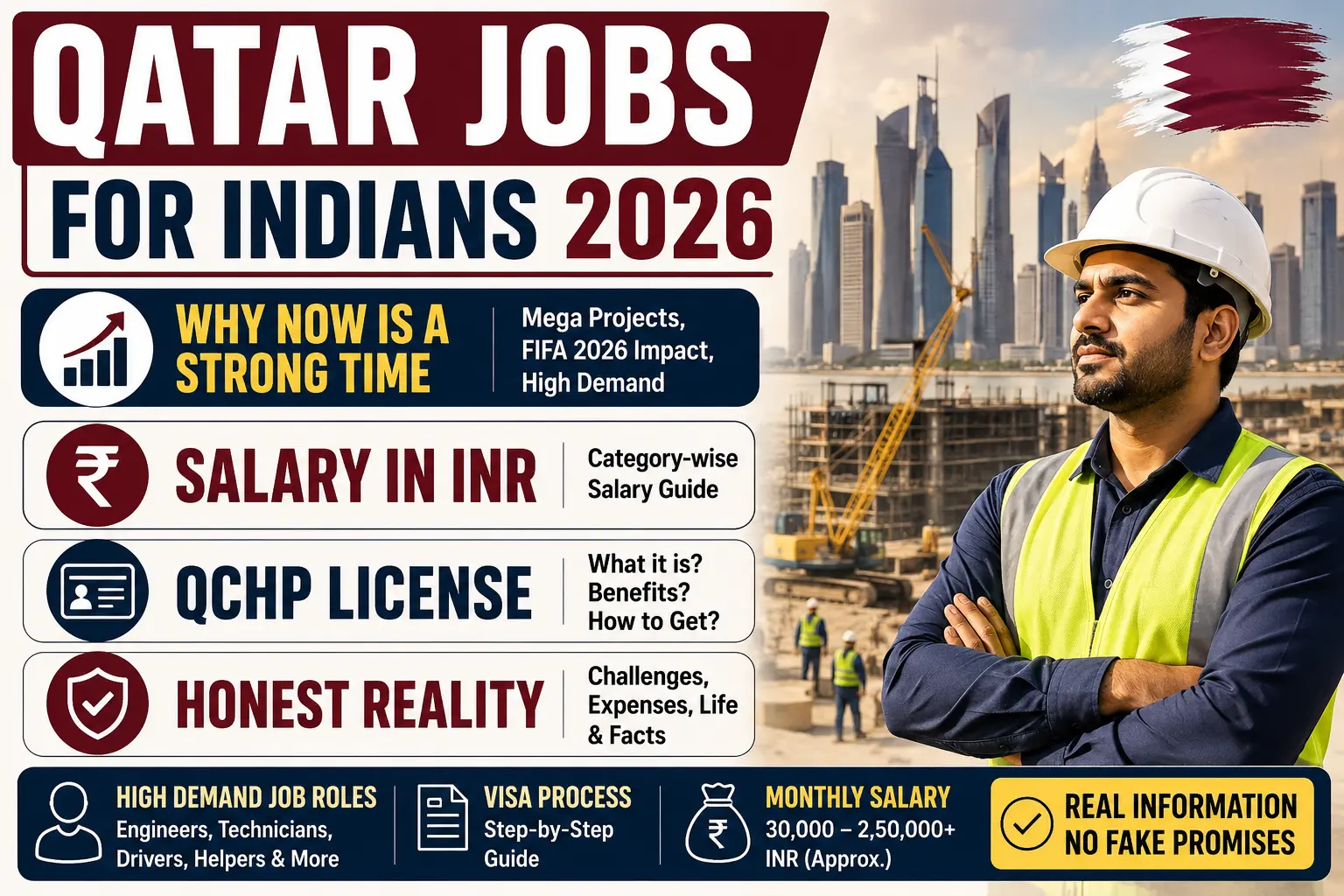
Qatar has become one of the most significant destinations for Indian professionals in the Gulf — not because of hype, but because of a specific set of structural realities. The country is home to over 700,000 Indian nationals, its healthcare infrastructure continues expanding under Qatar National Vision 2030, Hamad Port and Ras Laffan Industrial City generate continuous demand for logistics and engineering talent, and Law No. 9 of 2026 (in force 25 July 2026) has introduced new worker protections and enforcement mechanisms since the earlier kafala reforms of 2020–2021.
This guide covers who can realistically target Qatar, which occupations actually have verified vacancies, how the visa and Qatar Visa Centre process works in 2026, what QCHP licensing requires for healthcare professionals, how to apply from India without paying an agent, how to protect yourself from recruitment scams, and what to do before accepting any offer.
Last reviewed: August 2026. Visa and licensing information verified against Qatar Ministry of Labour (mol.gov.qa), Ministry of Public Health / DHP, Qatar Visa Center, and Hukoomi e-Government Portal. Labour law references are from Law No. 9 of 2026 (enacted July 8, 2026).
Who Can Realistically Target Qatar
Qatar's job market is unusual in the Gulf. Unlike the UAE, which absorbs workers across almost every skill level, Qatar's private sector is smaller and its government and quasi-government employers — Hamad Medical Corporation, QatarEnergy, Ashghal, Milaha, Qatar Rail — dominate hiring in the categories that matter most to Indian professionals.
You have a realistic shot at Qatar if your profile matches one or more of the following:
- Healthcare professionals with 2+ years post-qualification experience — Registered Nurses (especially ICU, OT, Emergency, NICU), Lab Technicians, Radiographers, Physiotherapists, and Doctors with specialist training. QCHP/DHP licensing is mandatory and takes 2–4 months. Begin it before you apply.
- Civil and infrastructure engineers with GCC or major project experience — Ashghal (Public Works Authority), Parsons, AECOM, Consolidated Contractors Company (CCC), and several tier-1 contractors have ongoing programmes. Minimum 4–6 years experience for mid-level roles.
- Oil, gas and petrochemical professionals — QatarEnergy and its joint ventures are major employers of petroleum engineers, process engineers, instrument technicians and HSE professionals. Competition is high and most roles are mid to senior level.
- IT and software professionals — Qatar's technology sector is growing but smaller than the UAE's. Ooredoo, ictQATAR, Qatar National Bank and some multinational firms hire. Most roles are hybrid or on-site in Doha.
- HTV and heavy vehicle drivers with Code 14 licence eligibility — Milaha, Gulf Warehousing, and logistics firms at Hamad Port consistently recruit. Salary is lower than engineering but benefits (accommodation, transport, visa) are typically provided.
- Logistics and port operations professionals — Hamad Port is one of the largest container ports in the Middle East. Milaha alone manages a significant portion of Qatar's maritime and logistics operations.
- Accountants and finance professionals — QatarEnergy affiliates, KPMG, Deloitte and major Qatari banks hire CA, CPA and ACCA holders. Arabic is not always required for Big 4 roles.
You are unlikely to find a suitable Qatar opportunity if you are in retail sales, hospitality management, domestic work, or service-sector roles below skilled trade level. The Qatar job market is not a volume market for unskilled labour the way some Gulf countries are — vacancies that appear credible in this category are often the entry point for recruitment fraud.
In-Demand Occupations with Verified Vacancies
Healthcare — Nursing
Hamad Medical Corporation (HMC) is the largest employer of nurses in Qatar with over 2,000 nurses at Hamad General Hospital alone. Sidra Medicine recruits for paediatric and maternity specialties. Both are JCI-accredited. The QCHP/DHP licence is mandatory (see the licensing section below). Salary at government hospitals: QAR 8,000–14,000/month for registered nurses, plus free accommodation, transport, and annual return flights.
Current vacancies in LMG job database: ICU Nurse — Hamad Medical Corporation, Registered Nurse — QCHP Licensed (HMC), ICU Nurse — Sidra Medicine, Staff Nurse — ICU / Trauma Centre (HMC). Start your profile at LMG Career Desk to see matches for your profile.
Infrastructure and Civil Engineering
Ashghal (Public Works Authority) is Qatar's government infrastructure agency responsible for roads, drainage, tunnels and public buildings. It directly recruits civil engineers and site engineers, particularly for projects under Qatar National Vision 2030. Parsons Corporation and AECOM have major contracts in Qatar. Typical salary: QAR 10,000–20,000/month for mid-level civil engineers, with package benefits.
Current Qatar civil engineering vacancies in LMG: Civil Engineer — Ashghal Infrastructure, Civil Engineer — Parsons Qatar, Mechanical Engineer — CCC Qatar.
Logistics and HTV Driving
Milaha (formerly Qatar Navigation) has been Qatar's primary shipping and logistics company since 1957. It operates Hamad Port container terminals, logistics city warehouses, and a fleet of heavy vehicles. Heavy Vehicle Drivers transport containers between Hamad Port and the Industrial Area. Milaha is one of the few logistics employers in Qatar with a transparent direct-application careers portal.
Current LMG listings: HTV Driver — Milaha (Port Operations), Logistics Coordinator — Milaha.
Oil, Gas and Petrochemical
QatarEnergy is the state-owned energy company responsible for the world's largest LNG export operation. It recruits petroleum engineers, process engineers, instrument technicians and HSE professionals, largely for its facilities at Ras Laffan Industrial City. Most roles require 5+ years of relevant experience and offer among the highest salary packages in Qatar's market. Recruitment is direct through the QatarEnergy careers portal; QatarEnergy does not use unregistered recruitment agents.
IT and Software Engineering
Qatar's technology employer base is narrower than the UAE's. Key employers include Ooredoo (telecommunications), Qatar National Bank (QNB), the Ministry of Communications and Information Technology (MCIT), and some regional offices of global firms. Remote-first roles are less common here than in India or the UAE — most IT roles in Qatar are on-site in Doha. Salary range for software engineers: QAR 10,000–22,000/month depending on seniority.
Accounting and Finance
QatarEnergy subsidiaries, the Big 4 firms (KPMG, Deloitte, PwC, EY), and Qatar's major banks (QNB, Commercial Bank, Ahli Bank) recruit CA, CPA and ACCA holders. Most mid-to-senior finance roles prefer candidates with Gulf experience. Salary range: QAR 8,000–18,000/month for qualified accountants.
Qatar vs UAE — Honest Comparison for Indians
| Factor | Qatar | UAE |
|---|---|---|
| Tax | 0% income tax | 0% income tax |
| Job market size | Smaller, concentrated in government-linked employers | Larger, more diverse private sector |
| Healthcare salaries | QAR 8,000–14,000 (nurses) — competitive | AED 6,000–18,000 (wide range) |
| Cost of living | High in Doha; many employer packages include accommodation | High in Dubai; accommodation often self-funded |
| Job mobility (2026) | Can change jobs after 1 year without NOC (Law No. 9, 2026) | Can change jobs; notice period applies |
| Indian community | 700,000+ Indians; largest expat group | 3.5 million+ Indians |
| Lifestyle | Conservative; alcohol restricted to licensed venues | More cosmopolitan; alcohol widely available |
| PR / long-term residency | No direct PR pathway; permanent residency very rare | No direct PR; Golden Visa for select profiles |
| Pre-departure medical | Mandatory QVC visit in India before departure | Medical after arrival |
The key difference in practice: Qatar's government-linked employers tend to provide more complete packages (accommodation, transport, flights) than many UAE private-sector employers. For professionals targeting roles at HMC, QatarEnergy or Ashghal, the total compensation is often competitive even if the base salary looks similar to UAE.
Where Genuine Vacancies Actually Come From
This is the single most important section to read before you apply anywhere.
The overwhelming majority of legitimate Qatar job vacancies reach Indian candidates through three routes:
- Direct employer career portals. HMC (hamad.qa/careers), Sidra Medicine (sidra.org), QatarEnergy (careers.qatarenergy.qa), Ashghal (ashghal.gov.qa), Milaha (milaha.com/careers). These are the primary and most reliable source. If the role exists, it will appear here.
- Bayt.com, Naukrigulf and LinkedIn — the three Gulf job platforms that aggregate verified employer listings. Not perfect, but significantly more reliable than WhatsApp forwards or Facebook job groups.
- Recruitment agencies registered with the Ministry of External Affairs (MEA) of India. You can verify any agency on the eMigrate portal at emigrate.gov.in. Agencies not registered here cannot legally place you for employment in ECR countries, and Qatar is an ECR country.
What genuine Qatar vacancies do NOT look like:
- WhatsApp messages from unknown numbers with PDF offer letters
- Facebook posts promising "urgent hiring" with no company name or registration details
- Job offers requiring you to pay any fee before the visa is issued
- Offers arriving on business or visit visa (Qatar does not permit job-seeking on visit visa)
- Salary figures that seem unusually high for an entry-level role
How to Apply from India — Step by Step
Step 1: Assess your profile honestly
Before applying anywhere, use the LMG Career Mobility Score to understand how your profile compares for Qatar — it covers profession fit, experience requirements, and language considerations. Qatar has specific requirements (QCHP for healthcare, relevant engineering certification for construction) that make profile assessment genuinely important before you invest time applying.
Step 2: Build a Gulf-format CV
Qatar employers expect a CV of no more than 2–3 pages. Include your full name, contact number with country code, professional summary, work history in reverse chronological order, education, and any professional registrations or licences (even eligibility or pending status matters — mention it). Do not include a photograph unless specifically requested. Do not include religion, caste, or marital status.
Step 3: Apply directly through the employer portal
For the major employers — HMC, Sidra, QatarEnergy, Ashghal, Milaha — the direct careers portal is always the most reliable application route. Create an account, upload your CV, and apply to the specific role. Do not rely on third parties to submit your application on your behalf.
Step 4: For regulated professions, begin licensing before the interview
For nurses and healthcare professionals, starting your QCHP/DHP process before you have a job offer is strongly advisable. The PSV (Primary Source Verification) through DataFlow currently takes approximately 20 working days according to DHP/DataFlow guidance. Employers at HMC and Sidra expect candidates to have begun the process or be able to demonstrate eligibility. A candidate who cannot explain their licensing pathway will be deprioritised.
Step 5: For IT and engineering roles, prepare for a technical interview
Most Qatar engineering and IT employers conduct at least one technical interview, often remotely. For government-linked roles at QatarEnergy and Ashghal, shortlisting is strict and the process can take 4–12 weeks from initial application.
Step 6: Do not resign or pay anything until the visa is in your passport
This is the most important practical advice this article can give you. Do not resign from your current job, do not pay any agent any fee, and do not travel to Qatar on a visit visa to "look for a job" until you have a signed offer letter verified through official channels and a work visa issued in your passport. The QVC process (below) is the official pre-departure step — not optional, and not something a legitimate employer will ask you to bypass.
Work Visa and Qatar Visa Centre Process 2026
For Indian nationals, the Qatar work visa process in 2026 follows a specific sequence. The Qatar Visa Centre (QVC) is a mandatory pre-departure facility for Indian applicants — you complete your biometrics, medical examination, and employment contract signing in India before flying to Qatar.
The complete sequence
- Employer submits visa application — Your employer initiates the work permit and entry visa application through the Ministry of Interior (MOI) portal in Qatar.
- MEA attestation chain for educational and employment documents — State education board/university → MEA Regional Authentication Centre → Qatar Embassy in India. Allow 3–6 weeks for this chain. Begin it as soon as you receive your offer letter.
- Book QVC appointment — Once your employer confirms your visa is in process, book your appointment at a Qatar Visa Centre in India. QVC locations in India as of 2026: Delhi, Mumbai, Hyderabad, Chennai, Kochi, Bengaluru, Kolkata, Lucknow. Book through qatarvisacenter.com. Delhi appointments fill weeks in advance — book immediately upon receiving your visa reference number.
- Attend QVC appointment — At the QVC, you will complete: biometric enrollment (fingerprints and iris scan); mandatory medical examination (blood tests and chest X-ray); digital signing of your employment contract (explained in your language); document verification.
- Medical clearance and visa issuance — Upon successful clearance, the Ministry of Interior issues your single-entry work visa. This visa is valid for travel within 30 days of issuance.
- Track status through Hayya — You can track your visa application status through the Hayya digital platform (hayya.qa). Since May 2025, most queries are processed within 1–3 working days.
- Arrive in Qatar and convert to Residence Permit — After arrival, you have a statutory window (typically 30 days) to complete your Residence Permit (RP/QID) processing through your employer. Your employer handles this — you should not need to pay any government fee yourself for the RP under standard employment arrangements.
Important — passport validity
Since September 2023, Qatar Visa Centre rules require your passport to have at least 195 days of validity remaining from your QVC appointment date. Passports that do not meet this threshold will be rejected. Renew your passport before beginning the visa process. (Source: qatarvisacenter.com official guidance.)
Total timeline from offer letter to arrival in Qatar
Allow 8–14 weeks in total: MEA attestation (3–6 weeks) running concurrently with the employer visa application (2–6 weeks), plus QVC appointment and medical clearance (1–2 weeks). In practice, the attestation chain is usually the longest element.
QCHP / DHP Licensing for Healthcare Professionals
The licensing authority for healthcare professionals in Qatar is the Department of Healthcare Professions (DHP), operating under the Ministry of Public Health (MOPH). It was formerly known as the Qatar Council for Healthcare Practitioners (QCHP) — both names remain in common use, but the system and portal are the same.
As of 2026, the following requirements apply to all internationally trained nurses applying for DHP registration:
- Recognised nursing qualification — BSc Nursing from a DHP-recognised institution, or a diploma with sufficient post-qualification experience. DHP maintains an updated list of recognised universities; institutions not on the list will result in application rejection regardless of experience.
- Minimum 2 years post-qualification clinical experience — for most nursing categories. Experience must be continuous; gaps of more than 6 months require explanation.
- Primary Source Verification (PSV) through DataFlow — mandatory for all applicants from January 2026 with no exceptions. This is a credential verification process conducted by DataFlow Group on behalf of DHP. Start this immediately upon deciding to pursue Qatar — DHP/DataFlow guidance indicates approximately 20 working days.
- Qatar Prometric exam — a computer-based licensing exam required for applicable healthcare licensing categories under DHP. Recognised exemptions exist for candidates from certain countries and accredited institutions, but from January 2026, any exemption claim must be supported by a DataFlow verification report. Check your eligibility on the Sheryan portal (portal.moph.gov.qa) — requirements vary by profession and category.
- Good Standing Certificate — from your current nursing council or regulatory body. DHP stopped accepting certificates sent by email or post from August 2025; certificates must now be submitted through official channels.
- BLS certification — mandatory. Specialty certifications (ACLS, PALS) are additionally required for ICU, Emergency and paediatric roles.
Timeline for DHP/QCHP licensing: Allow 2–4 months from initiating DataFlow PSV to receiving your licence or eligibility letter, depending on document completeness and exam scheduling. Most HMC and Sidra recruitment processes expect candidates to have an active application in progress or an eligibility letter before the final job offer stage.
Applications are submitted through the Sheryan electronic portal of the Ministry of Public Health. Application fee for preliminary evaluation: QAR 100 (official fee as published).
For the most current DHP requirements and recognised institution lists: check portal.moph.gov.qa (official MOPH portal). Requirements change; do not rely on third-party agents who claim to have the "latest" lists. Verify directly from the official source.
Documents and Attestation for Qatar Employment
The documents you need to prepare depend on your profession, but the following apply to most Indian professionals:
- Educational certificates — attested by the issuing university, then MEA Regional Authentication Centre, then the Qatar Embassy in India.
- Experience certificates — from each previous employer, on letterhead, attested where required by your profession.
- Police Clearance Certificate (PCC) — from the Indian police authority. Required for visa processing. Apply through the Passport Seva portal.
- Passport — valid for at least 195 days from your QVC appointment date. Full name, father's name and family/last name must match exactly across all documents — partial name mismatches cause delays.
- Medical fitness certificate — completed at the QVC appointment in India (for Indian nationals).
- For healthcare professionals: DataFlow PSV report and DHP application confirmation
- For engineers on regulated projects: degree attestation from India's engineering council (if required by employer)
A note on attestation chains: The standard chain for educational documents is university → MEA Regional Authentication Centre → Qatar Embassy in India. Some employers also require Chamber of Commerce attestation for commercial documents. The MEA step typically takes 7–10 working days if you apply in person at a regional centre, and longer if you use courier-based services. Start this process immediately upon receiving an offer letter — do not wait until the QVC appointment to begin.
Labour Law No. 9 of 2026 — Your Rights as a Worker in Qatar
Qatar's Law No. 9 of 2026 was published in the Official Gazette on 25 June 2026 and came into force on 25 July 2026. It amends Labour Law No. 14 of 2004. The following provisions from Law No. 9 and the wider 2020–2026 Qatar labour reforms are most directly relevant to Indian workers: (Sources: Clyde & Co, Crowell & Moring, Global Law Experts, analysis of Law No. 9 of 2026.)
- Job mobility without employer permission. Qatar abolished the mandatory No Objection Certificate (NOC) requirement for private-sector job changes through Law No. 18 of 2020 — not Law No. 9 of 2026. As of 2026, most private-sector workers governed by Labour Law No. 14 of 2004 can change employers by serving their notice period and processing the transfer through the Ministry of Labour’s electronic portal (mol.gov.qa), without requiring their current employer’s permission. Law No. 9 of 2026 strengthened digital enforcement and WPS mechanisms but did not introduce job mobility rights.
- Regulated right to strike under Law No. 9 of 2026. Qatar’s Labour Law has long recognised the right to strike. Law No. 9 of 2026 introduced detailed new conditions: a strike is lawful only after an employer breach that remains unresolved through amicable settlement or formal collective dispute proceedings; workers must give written notice to both the employer and the Ministry of Labour; strikes are capped at six working days; must take place only at the workplace or workers’ accommodation; must cease once formal collective proceedings begin; and strike days are unpaid. Employers may engage temporary replacement workers with Ministerial approval. (Source: Clyde & Co and Crowell & Moring analysis of Law No. 9 of 2026.)
- Vocational certification requirements for designated professions. A new Article 23 bis requires workers in designated vocational professions to obtain a training and examination certificate from a Ministry of Labour-accredited centre before commencing employment. The Ministry will publish the list of covered professions on mol.gov.qa.
- Strengthened wage enforcement. Law No. 9 of 2026 expands the Ministry of Labour’s enforcement powers, including over the Wage Protection System (WPS). Employers must pay salaries within the contractually and legally required period. File wage complaints through the Hukoomi portal (hukoomi.gov.qa) or the Ministry of Labour helpline: 16008 (24/7, multilingual). Serious or repeated non-compliance can result in suspension of an employer’s ability to recruit and renew work permits.
- Passport confiscation is illegal. Qatar law prohibits employers from confiscating workers’ passports. This is a pre-existing legal protection, not a new provision of Law No. 9 of 2026. If your passport is confiscated, report it to the Ministry of Labour helpline (16008) or the Indian Embassy in Doha.
- Minimum wage: QAR 1,000/month basic salary. Employers must additionally provide QAR 500/month for accommodation and QAR 300/month for food if not provided in kind, making the total minimum package QAR 1,800/month. This was established by Law No. 17 of 2020 and remains unchanged in 2026 — Law No. 9 of 2026 strengthened enforcement but did not change the amounts. Applies to all workers regardless of nationality including domestic staff. (Source: Expatica, wage.is, tradingeconomics.com — all citing Qatar Ministry of Labour.) Actual market salaries for skilled professionals in healthcare, engineering and IT are significantly above this floor.
Official channels for labour disputes: mol.gov.qa | Hukoomi unified complaints portal | SMS: send "5" + QID to 92727 | Helpline: 16008 (24/7, multilingual)
Scams and Agent-Fee Warnings
Qatar job fraud targeting Indian candidates is well-documented. The Indian Embassy in Doha has issued repeated advisories. Here is what you must know:
⚠️ Red flags — stop and verify before proceeding
- Any recruiter asking for money before your visa is issued — for "registration", "documentation", "medical tests" or "visa processing"
- A job offer arriving via WhatsApp from an unknown number with a PDF attachment
- An offer that promises a Qatar job on a visit or tourist visa — Qatar does not permit job-seeking on a visit visa
- Salary figures that seem unusually high for an entry or mid-level role
- An agent who cannot provide their eMigrate registration number or physical office address
- A recruiter who asks for your original documents before you have received a visa
- An offer from a company you cannot find on Qatar's official commercial registration database (Hukoomi)
How to verify a recruitment agent in India: All agents legally permitted to recruit for ECR countries (Qatar is an ECR country) must be registered on the eMigrate portal of India's Ministry of External Affairs. If an agency is not listed there, it is not legally authorised to place you for employment in Qatar.
How to verify a Qatari employer: Check the company's registration through the Hukoomi e-Government Services portal (hukoomi.gov.qa). For government-linked employers like HMC and QatarEnergy, verify the vacancy directly on the employer's official careers page before engaging with any recruiter claiming to represent them.
If you are defrauded: File a complaint with the Indian Embassy in Doha (indianembassyqatar.gov.in), through the MEA Madad portal (madad.gov.in), and through the national cybercrime reporting portal (cybercrime.gov.in) if money was transferred.
Common Rejection Reasons
Understanding why applications fail helps you avoid them:
- QCHP/DHP licensing not initiated for healthcare roles. HMC and Sidra receive hundreds of applications. Candidates who cannot demonstrate active DHP registration or eligibility assessment are typically deprioritised.
- Medical fitness failure at QVC. Qatar has specific fitness standards. Certain conditions result in automatic rejection. The QVC medical examination is conducted by approved centres and results are non-negotiable. Pre-departure health screening before committing to the Qatar route is advisable.
- Document mismatch. Name spelling differences between your passport, degree certificate, and experience letter cause delays and sometimes rejection. Ensure all documents are consistent before beginning the attestation chain.
- Passport expiry. Passports must have at least 195 days validity from the QVC appointment date.
- Unrecognised institution. For DHP/QCHP applications, degrees from institutions not on DHP's recognised list will be rejected regardless of experience. Verify your institution's status before starting the application.
- Gaps in employment history longer than 6 months (healthcare). DHP requires a written explanation for gaps exceeding 6 months. Unexplained gaps can result in rejection.
- Applying for roles significantly above your experience level. Qatar employers, particularly government-linked ones, apply their stated requirements strictly. An application for a senior role with junior-level experience will not progress.
Is Qatar Right for Your Profile — Honest Assessment
Qatar is a strong choice if:
- You are a registered nurse with ICU, OT or NICU experience and you are prepared to begin DHP licensing
- You are a civil or mechanical engineer with 4+ years of GCC or large-project experience
- You are an HTV driver seeking a formal direct-employer arrangement with accommodation and visa included
- You are a chartered accountant or finance professional targeting a Big 4 or energy-sector role
- You value a complete package (accommodation, transport, flights) over a higher base salary with no benefits
- You prefer a smaller, more predictable job market over the breadth and complexity of the UAE
Qatar may not be the right choice if:
- You need a large, diverse job market with frequent opportunities to change employers
- You are targeting retail, hospitality or service-sector roles below the skilled professional level
- You are in a profession with no current Qatar demand (interior design, security, domestic work outside established channels)
- You are not ready to invest 2–4 months in licensing and attestation before receiving an offer
- You want a path to permanent residency — Qatar does not offer a straightforward PR route for expatriates
If you are unsure whether your profile is competitive for Qatar, the LMG Career Mobility Score assesses your fit for Qatar and five other countries in 60 seconds. The LMG Career Desk then shows you only the Qatar jobs that match your specific profession, experience and target country — without the noise of irrelevant listings. Both tools are free to use.
Immigration policies, visa requirements, and salary thresholds change frequently. All information on this page has been verified using official government sources as of September 2026. Always confirm current requirements directly at the official government website before making any application or financial decision. letsmoveglobally.com is an independent information platform — not a visa agent, immigration consultant, or legal advisor.


0 Comments
Have a question or insight? Share it below. All comments are moderated within 24 hours.
Be the first to share your thoughts.
Leave a Comment
Your email will not be published. Fields marked * are required.