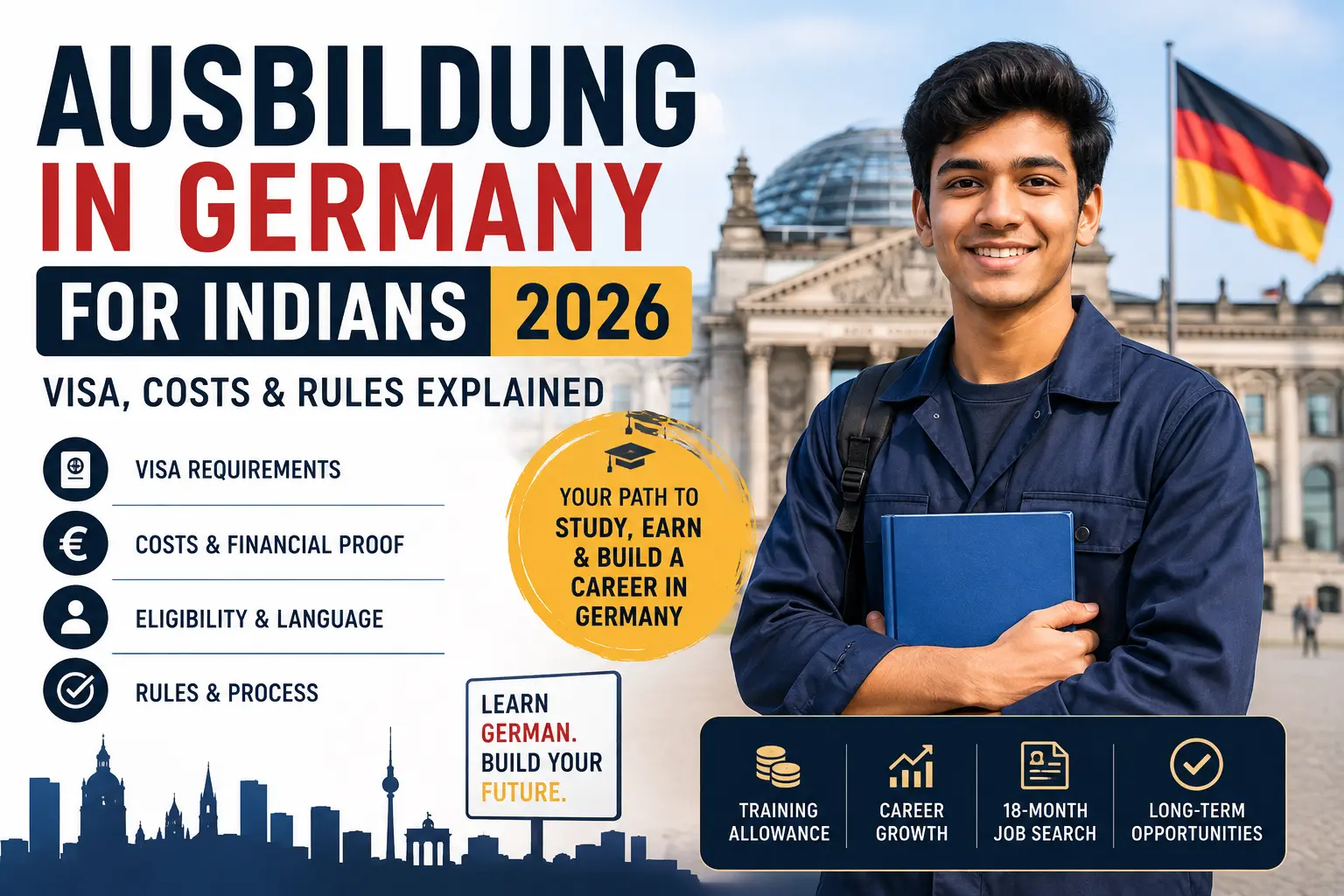
Ausbildung in Germany for Indians (2026): Visa Rules, Real Training Allowance Numbers, and the Blocked Account You Probably Don't Need
Last updated: August 2026. Figures verified against BIBB, the German Residence Act (AufenthG), and current visa-provider guidance current as of this update — always cross-check dates and thresholds before you apply, as embassy rules shift year to year.
I keep seeing the same confusion when Indian candidates ask me about Ausbildung — one site tells them they need a €12 lakh blocked account, another quotes a stipend that hasn't been accurate in years, a third throws around a success-rate number nobody can trace back to a real source. Most of that confusion comes from mixing up student visa requirements, company-based Ausbildung, school-based Ausbildung, and the separate training-place-search visa — four different routes with four different cost structures. I went through the official rules for each one so this guide actually separates them properly.
What Is Ausbildung, Exactly?
Ausbildung is Germany's dual vocational training system. You split your time between a paid apprenticeship at a company and classroom instruction at a Berufsschule (vocational school), typically two to three years, ending in a nationally recognised qualification from your chamber (IHK or HWK). Unlike university study, tuition is free and you earn a wage from day one — which is exactly why the financial requirements are so different from a student visa.
Ausbildung Visa Requirements for Indians in 2026
The Ausbildung visa falls under Section 16a of the German Residence Act (AufenthG) and is applied for as a National (D) visa through the German mission covering your state of residence in India.
Language Requirements: B1 or B2?
Immigration authorities accept a B1 certificate (Goethe-Institut, telc, ÖSD, or TestDaF) as the legal minimum to enter Germany on an Ausbildung visa. In practice, most IHK and HWK chambers push candidates toward B2, because Berufsschule instruction runs entirely in German — arriving at B1 often means struggling through your first semester. Healthcare and nursing programmes are the exception where B2 is treated as close to mandatory rather than a recommendation, given the technical vocabulary and patient-communication demands.
Age and Education Criteria
- If you already have a signed Ausbildungsvertrag, there is no strict legal upper age limit under Section 16a — most training contracts in practice go to applicants between 18 and 35, but the law itself doesn't close the door on older applicants.
- If you don't have a contract yet and want to travel to Germany to search for one, that's a separate route — the training-place-search visa under Section 17 — and it does carry a hard under-35 requirement. Don't confuse the two: the age limit belongs to the search visa, not to an already-secured Ausbildung position.
- Minimum secondary school completion (12 years of education), assessed case-by-case for equivalency — not automatically granted.
- Science background preferred for healthcare, IT, and engineering tracks; commerce background for retail, logistics, and hospitality tracks.
Documents You'll Need
- Signed Ausbildungsvertrag (training contract) — this is the single document your whole application hinges on
- Valid passport (validity beyond your planned stay)
- Recognised B1 (or B2) language certificate
- Proof of financial means — this is where most guides get it wrong; see the blocked account section below
- Educational certificates, officially translated where needed
Ausbildung Training Allowance (Ausbildungsvergütung): What You'll Actually Earn in 2026
Germany sets a statutory minimum training allowance (Mindestausbildungsvergütung) that rises every year of your training — this is a legal floor, not a market salary, so what you're actually offered can be higher. For 2026 starters, published in the Bundesgesetzblatt in October 2025, the floors are:
| Training Year | Statutory Minimum Allowance (Monthly) |
|---|---|
| Year 1 | €724 |
| Year 2 | €854 |
| Year 3 | €977 |
These are legal minimums, not what most trainees actually get. In tariff-bound companies (those under a collective agreement), the average allowance across all years was closer to €1,133/month in the most recent data. Nursing trainees under TVöD/DKG agreements typically earn €1,341–€1,490/month even in Year 1 — well above the statutory minimum, because healthcare is under acute staffing pressure.
Sector Differences
Healthcare and skilled trades in high-shortage sectors (metalworking, construction, nursing) tend to pay meaningfully above the statutory floor. Retail, hospitality, and general logistics roles are more likely to sit closer to the legal minimum. This is a genuine, underreported differentiator worth factoring into which track you target — not just which one has open seats.
Do You Actually Need a Blocked Account for Ausbildung?
This is the single most misreported fact across Ausbildung content online — and I'd be careful about any article that quotes one blocked-account figure for "Ausbildung" as if it were a single thing. It isn't. There are three distinct financial-proof situations, and they're often lumped together by mistake.
1. Company-Based (Dual) Ausbildung — the most common route
If you have a signed Ausbildungsvertrag with a German employer, your training salary itself is generally treated as proof of financial means, provided it reaches the official livelihood threshold — currently around €1,048 gross / €822 net per month. If your contracted salary reaches this level, you typically do not need a blocked account at all. If it falls short, the shortfall can usually be supplemented rather than requiring the full annual sum.
2. School-Based Ausbildung — no employer stipend
Some Ausbildung programmes are school-based rather than company-based, meaning there's no monthly salary from an employer. In that case, you need to demonstrate roughly €959 net per month, either through a blocked account or a declaration of commitment (Verpflichtungserklärung) from a sponsor.
3. Training-Place-Search Visa — no contract yet
If you're travelling to Germany first to look for a training placement (Section 17 AufenthG, under-35 requirement applies here), you need to show funding of roughly €1,091 per month for the length of your search visa — this is a separate financial bar from either Ausbildung route above.
4. University Study Visa — a different track entirely
The widely quoted €11,904/year blocked-account figure is the 2026 university study-visa requirement — it is not a universal Ausbildung requirement. Confusing these two is where most of the bad information online comes from. If an article quotes €11,904 for "Ausbildung" without specifying which of the three situations above it means, treat it with caution.
My advice would be: don't assume your situation until you know which of these four routes you're actually on — the financial bar is completely different for each, and getting it wrong either scares people off unnecessarily or leaves them under-prepared.
Total Cost of Applying for Ausbildung from India (2026)
Here are the individual, itemisable costs involved — these are the components, not a single official total:
| Item | Cost Range |
|---|---|
| National D-visa fee (official) | €75 (flat, non-refundable) |
| VFS Global service charge (official) | ~€90 |
| German language course (A1 to B1) | €1,000–€2,000 |
| Exam fees | €150–€250 per exam |
| Document attestation / translation | €200–€400 |
| Flight | Varies by season and city |
A realistic upfront budget can vary considerably. Applicants should plan for language training, exams, document preparation, visa/application costs, travel and other individual expenses. The exact amount depends heavily on your current German level, documents and personal circumstances.
For planning purposes, LMG estimates that many applicants starting from India may need around €2,000–€3,000 before travel. This is an indicative planning estimate from LMG, not a government-set fee or mandatory financial requirement.
What's genuinely official in that table is just the visa fee and the VFS charge — everything else is a range that depends on your choices. Even at the higher end of LMG's estimate, it's still well short of the €13,000+ a university study visa requires once its blocked account is factored in — that structural gap, not any single exact total, is the real takeaway.
Timeline: From Application to Arrival
This is a planning estimate based on a typical case, not a guarantee — your actual timeline depends on your starting German level, embassy processing speed, and how quickly you find a matching employer:
- 4–6 months — reaching B1 German certification (longer if starting from zero, longer still for B2)
- 1–2 months — employer matching and document attestation
- 4–12 weeks — National (D) visa processing at the German mission, with wide variation by location and season
- Rough total: 6–8 months from first serious preparation to arrival, as a planning estimate rather than a fixed timeline
Start your employer search 12–18 months before your target intake as a general rule of thumb, since most Ausbildung cohorts begin September 1 and competitive companies fill slots well in advance. One thing I would be careful about: don't treat any of these windows as fixed — I've seen candidates plan around a 6-month timeline and then lose months to a slow embassy queue or a re-sit on their language exam.
After Ausbildung: What Happens Next
Once you pass your chamber exam (IHK or HWK), you get a nationally recognised Fachkraft qualification. If your employer doesn't retain you directly, successful completion can lead to up to an 18-month residence permit to search for qualified employment under Section 20 AufenthG, during which you can work in any job to support yourself. If you secure qualified employment — whether with your training employer or elsewhere — you can then pursue the appropriate residence status for that job, such as a Skilled Worker Permit. This is not an automatic conversion, and it isn't the same as permanent residence or citizenship; those remain separate applications with their own requirements further down the line, typically after several years of qualified employment.
A Word on "Success Rate" Claims
You'll see figures like "94% of Ausbildung graduates get PR" circulating on consultancy and visa-agency sites. This number is widely repeated but not traceable to a reliable official source — I haven't been able to find it in BAMF, BIBB, or any published government statistic, and I'd treat any article citing it without a source the same way. You'll also see dropout percentages quoted for Ausbildung generally — those figures cover the overall German trainee population, and I haven't found a version verified specifically for foreign or Indian trainees, so I'm not quoting one here.
Is Ausbildung Right for You?
Ausbildung suits candidates who want a lower-cost, structured entry into Germany with an income from day one — particularly in healthcare, skilled trades, and logistics, where shortages are acute enough that employers actively sponsor visas. I would not choose Ausbildung simply because it looks cheaper on paper — it's a 2-3 year commitment at trainee-level pay, and it suits a specific kind of goal (a recognised trade qualification and a structured path in Germany) better than it suits someone purely optimising for the fastest possible move.
Our free Career Mobility Score tool evaluates your Market Opportunity, Profile Fit, and Current Readiness for Germany and UAE — it's a useful starting point for understanding where your profile stands generally. It doesn't currently make an Ausbildung-versus-skilled-worker recommendation specifically; that's a judgment call worth making with the context in this article, or by talking it through with our counselling team directly.
If nursing is your track specifically, our detailed breakdown on GNM nurse jobs abroad (UAE, Germany, UK) covers the healthcare-specific visa and stipend picture in more depth.
Frequently Asked Questions
Do I need a blocked account for the Ausbildung visa?
It depends on which route you're on. For company-based Ausbildung, your training salary counts as proof of funds if it reaches roughly €1,048 gross / €822 net per month, with no blocked account needed. School-based Ausbildung (no employer stipend) requires around €959 net/month via blocked account or sponsor declaration. The €11,904/year figure often quoted is actually the university study-visa requirement, not a universal Ausbildung rule.
What German level do I need for Ausbildung?
B1 is the legal minimum for the visa. B2 is strongly recommended by most chambers, and close to mandatory for healthcare and nursing tracks, since vocational school instruction is entirely in German.
How much does Ausbildung pay in 2026?
Statutory minimums are €724 (Year 1), €854 (Year 2), and €977 (Year 3) per month. Many sectors, especially nursing and metalworking, pay well above these floors — often €1,100–€1,490/month even in Year 1.
How long does the whole Ausbildung visa process take?
As a planning estimate, roughly 6–8 months from starting German lessons to arriving in Germany — but this varies with your starting language level and embassy processing speed, so treat it as a rough guide rather than a fixed timeline. Start employer applications 12–18 months ahead of your target intake.
What happens after I complete Ausbildung?
Successful completion can lead to up to an 18-month permit to search for qualified employment if your employer doesn't retain you. Once you secure qualified employment, you can pursue the appropriate residence status for that role — this isn't an automatic conversion to permanent residence or citizenship, which remain separate steps later on.
Is the 94% Ausbildung-to-PR success rate real?
This figure is widely repeated but not traceable to a reliable official German government source. Treat it with caution rather than as a verified statistic.
Is Ausbildung cheaper than studying in Germany?
Yes, structurally — for company-based Ausbildung meeting the salary threshold, you avoid the €11,904 blocked account that university study visas require. Only the visa fee (€75) and VFS charge (~€90) are fixed official costs; everything else (language course, exams, documents) is a real but variable expense. LMG's own indicative planning estimate for the whole pre-departure phase is roughly €2,000–€3,000 — this is our estimate, not a government-mandated figure.
Can I bring family with me on an Ausbildung visa?
Family reunification (spouse and minor children) is generally possible once your training contract and accommodation are confirmed and you can show income sufficient to support dependants.
Sources referenced for this update: Federal Ministry of Education and Research (BIBB) Mindestausbildungsvergütung data; German Residence Act (AufenthG) Sections 16a, 17, 18a, and 20 — gesetze-im-internet.de; Make it in Germany official portal; Bundesagentur für Arbeit. The €2,000–€3,000 pre-departure budget figure is LMG's own indicative planning estimate, not an official government figure. All figures are current as of August 2026 and change periodically — verify against official sources before making visa decisions.
Immigration policies, visa requirements, and salary thresholds change frequently. All information on this page has been verified using official government sources as of October 2026. Always confirm current requirements directly at the official government website before making any application or financial decision. letsmoveglobally.com is an independent information platform — not a visa agent, immigration consultant, or legal advisor.




0 Comments
Have a question or insight? Share it below. All comments are moderated within 24 hours.
Be the first to share your thoughts.
Leave a Comment
Your email will not be published. Fields marked * are required.