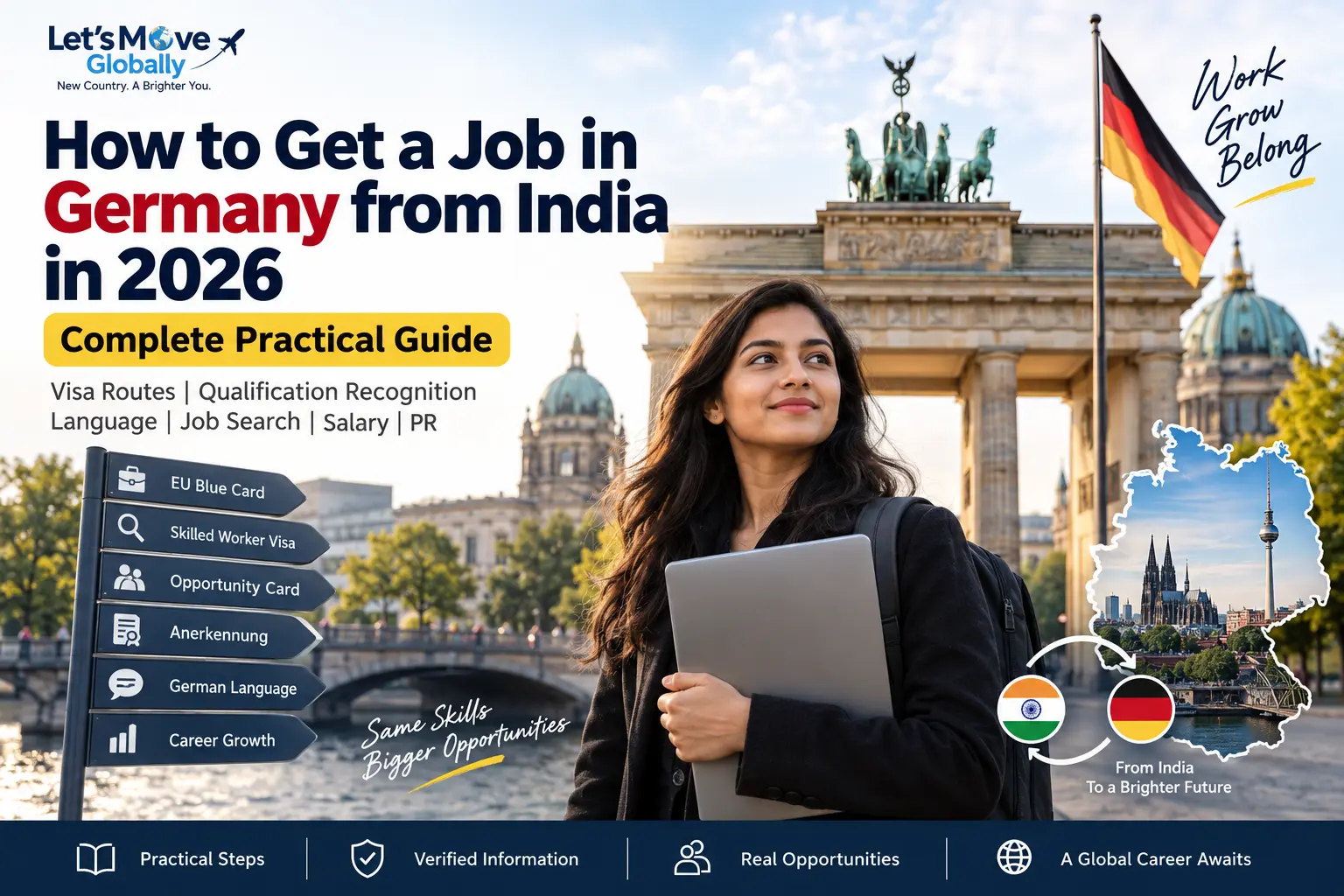
Germany is the largest economy in the European Union and one of the few developed countries actively recruiting skilled workers from India through multiple official channels. This is not optimism — it is policy. The Federal Employment Agency (Bundesagentur für Arbeit) classifies 163 occupations as Engpassberufe (bottleneck professions) — roles where demand significantly exceeds supply, concentrated in healthcare, IT, engineering, construction and skilled trades. The IAB (Institute for Employment Research) projects a need for approximately 400,000 foreign workers annually to sustain Germany's workforce as approximately 4.7 million employees retire by 2028. The immigration reforms of 2023–2024 were designed to make it easier for qualified non-EU professionals to enter and work legally across these shortage fields.
But "Germany is hiring" is not the same as "Germany is easy." The path from India to a German job involves qualification recognition, language requirements that most candidates underestimate, a visa system with several overlapping routes, and a job market that rewards patience and preparation over speed. This guide covers the reality, not the promise.
Last reviewed: September 2026. Visa information verified against Make it in Germany (official German Federal Government portal), BAMF (Federal Office for Migration and Refugees), Bundesagentur für Arbeit (Federal Employment Agency), and Anabin database. Salary data from StepStone Gehaltsreport 2026 and Bundesagentur für Arbeit Entgeltatlas. Minimum wage from BMAS (Bundesministerium für Arbeit und Soziales).
Who Can Realistically Target Germany
Germany's labour shortage is real but concentrated. The professions in genuine demand are specific, and the barriers — primarily language and qualification recognition — are significant. Your chances are strong if you are in one of these categories:
- Healthcare professionals — Nurses (BSc, GNM, Post Basic BSc), doctors, physiotherapists, medical technologists. Germany has a structural nursing shortage of 30,000–40,000 positions, with projections of 200,000 by 2030 according to the Federal Employment Agency. The route requires German language and formal qualification recognition (Anerkennung), but is well-established with government support programmes.
- IT and software professionals — Software engineers, cloud/DevOps engineers, data engineers, SAP consultants, QA engineers. Germany actively recruits IT professionals, and uniquely among European countries, it offers an IT specialist visa that does not require a formal degree — relevant work experience is sufficient. English-language roles are common in large tech employers and multinationals.
- Civil and mechanical engineers — Infrastructure, MEP, automotive, industrial. Southern Germany (Bavaria, Baden-Württemberg) has Europe's highest concentration of engineering employers — BMW, Bosch, Siemens, KUKA, Volkswagen. Most engineering roles require German at B2 level for practical workplace communication.
- Skilled tradespeople — Electricians, mechatronics technicians, welders with formal ITI or apprenticeship-equivalent training. Germany's Skilled Worker Visa recognises vocational qualifications, not just degrees.
- Accountants and finance professionals — CA, CPA, ACCA holders. German employers in finance, Big 4 firms, and multinational corporations hire finance professionals, though German language is increasingly expected for client-facing roles.
Germany is unlikely to work for you in the near term if:
- You are not willing to invest in German language learning — B1 minimum for most roles, B2 for regulated professions
- Your qualification has not been assessed for recognition (Anerkennung) — most regulated professions require this before you can work
- You are targeting entry-level roles with no specific skill shortage — Germany prioritises shortage occupations
- You need a fast outcome — the Germany route typically takes 12–24 months from decision to first payslip
In-Demand Occupations for Indian Professionals
Nursing and Healthcare
Germany's nursing sector is the most structured and supported pathway for Indian healthcare professionals. The Federal Employment Agency's Triple Win Programme has placed over 8,000 nurses from India, the Philippines and other countries since 2013. Kerala and Telangana nurses have a dedicated pathway through this programme. Apply directly at triple-win-programm.de.
For nurses applying independently, the Anerkennungspartnerschaft (Recognition Partnership) visa — introduced in March 2024 — allows entry into Germany with A2 German to complete both language training and professional recognition while employed. Full professional licensure requires German at B2 level and a Fachsprachprüfung (specialist language examination). Recognition processing typically takes 3–4 months per state.
Salary during Anerkennung (recognition) internship period: approximately €2,200–€2,800/month gross (illustrative estimate based on published German hospital Tarifvertrag collective wage scales; actual amounts vary by employer, state and agreement). Fully recognised nurses: €3,000–€4,200/month gross depending on speciality, state and employer. Verify current Tarifvertrag rates at bundesgesundheitsministerium.de or through your employer.
Current Germany nursing vacancies in LMG: Registered Nurse — Charité Berlin, Nurse — Anerkennung Internship (Helios), Registered Nurse — Helios Kliniken, Nurse — Anerkennungsberatung Route (Charité). Use LMG Career Desk to see matches for your profile.
Software Engineering and IT
Germany's technology sector recruited heavily in 2025–2026. SAP SE (Walldorf), Bosch, Siemens, Deutsche Telekom, and a growing ecosystem of Berlin and Munich startups all hire internationally. The EU Blue Card is the standard route for degree-holding software engineers; the IT Specialist Visa is available for those without a degree but with demonstrable experience.
English is the working language at SAP, large multinationals, and many Berlin tech companies. German becomes important at mid-to-senior level and for client-facing roles. Median gross salary for software developers: approximately €63,000–€66,750/year (StepStone Gehaltsreport 2026). Senior engineers in Munich or Frankfurt can earn €80,000–€100,000+.
Current Germany IT vacancies in LMG: Software Developer — SAP Cloud (SAP SE), Software Engineer — Embedded Systems (Bosch), Data Engineer — Deutsche Telekom, Graduate Engineer — SAP (Graduate Programme).
Civil and Mechanical Engineering
Southern Germany concentrates most engineering hiring. BMW (Munich), Volkswagen (Wolfsburg), Siemens (Munich/Berlin), KUKA (Augsburg) and dozens of Mittelstand manufacturers recruit engineers internationally. Civil engineers with EU Blue Card qualifications can find roles in infrastructure consultancies and construction firms. Most roles require German B2 for technical communication, documentation and client work.
Civil engineer salary: €45,000–€72,000/year gross for mid-level (source: Strabag, AECOM Germany job listings). Mechanical engineer salary: €52,000–€80,000/year gross depending on speciality and employer.
Germany Visa Routes — Which One Applies to You
EU Blue Card (Blaue Karte EU)
The primary route for Indian professionals with a university degree and a job offer. Requirements as of 2026:
- University degree recognised in Germany (check Anabin database at anabin.kmk.org)
- Job offer with gross annual salary of at least €50,700 for standard occupations, or €45,934 for shortage occupations (IT, engineering, medicine, natural sciences) — these thresholds are updated periodically by BAMF; verify at bamf.de before applying
- No minimum German language requirement to apply — but practical German helps significantly in finding a role
The EU Blue Card leads to permanent residence (Niederlassungserlaubnis) after 27 months of qualifying Blue Card employment with German at A1 level, or 21 months with German at B1 level. The distinction is language level, not shortage occupation. (Source: BAMF — bamf.de.) The EU Blue Card is transferable to other EU member states after 18 months of employment in Germany.
Skilled Worker Visa (Fachkräftevisum)
Covers a broader range of qualifications than the EU Blue Card, including vocational training (not just university degrees). Requirements:
- German-recognised vocational qualification or degree
- Job offer in the relevant field
- No minimum salary threshold (unlike EU Blue Card)
- For regulated professions (nursing, medicine, engineering in some states): recognition (Anerkennung) required before or alongside the visa
Opportunity Card (Chancenkarte) — Job Seeker Route
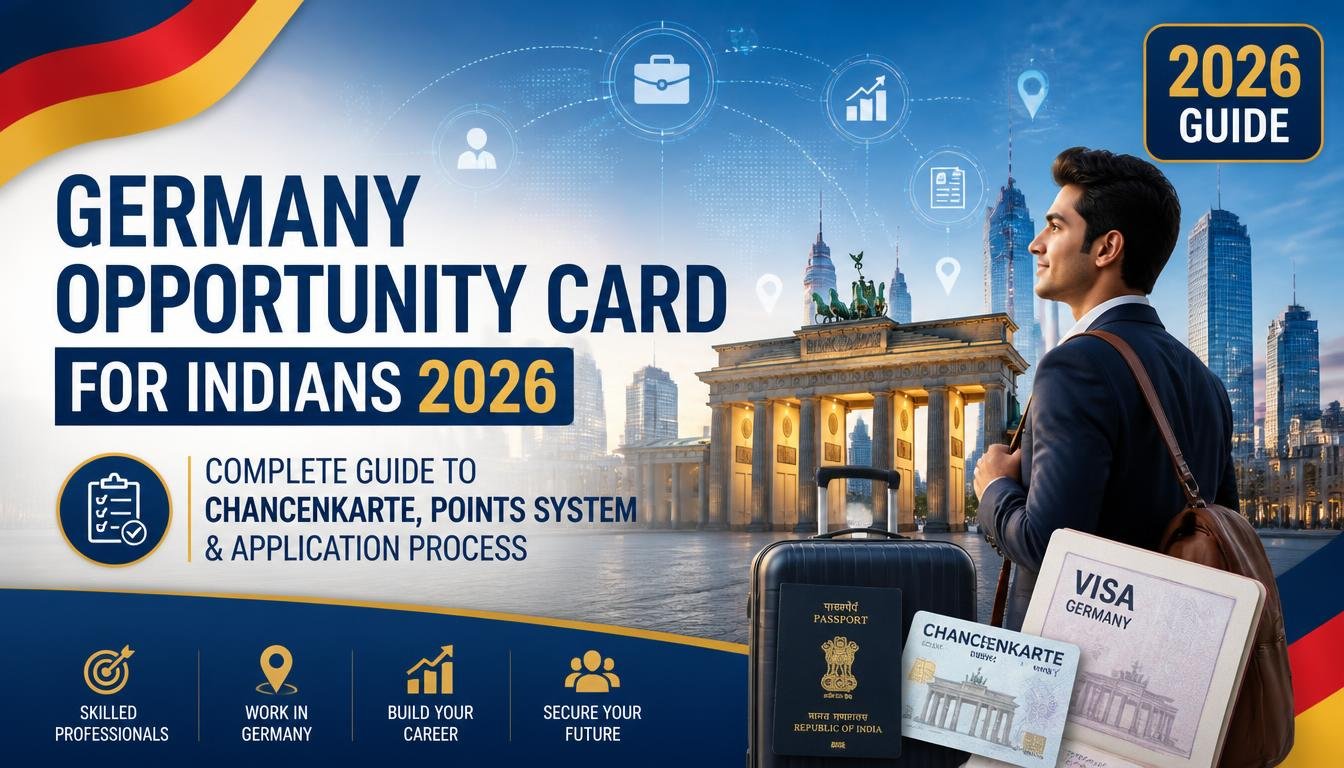
Introduced on 1 June 2024 under Section 20a of the German Residence Act. This is Germany's points-based job seeker visa — you enter Germany without a job offer and have 12 months to find qualifying employment.
To qualify: You need either a German-recognised degree/vocational qualification (direct route), or score at least 6 points on the points grid while holding any recognised qualification of minimum 2 years' duration.
| Criteria | Points |
|---|---|
| Recognised qualification (degree or vocational) | 3 |
| Partial recognition of qualification | 2 |
| 5+ years relevant professional experience | 2 |
| German language (B2 or above) | 3 |
| German language (A1 to B1) | 1 |
| Age under 35 | 2 |
| Spouse's recognised qualification | 1 |
| Previous stay in Germany (6+ months) | 1 |
Baseline requirements for the Chancenkarte points route: English at B2 or German at A1 minimum; financial proof of approximately €1,091/month for the duration of stay in 2026 (blocked account or equivalent). (Source: Make it in Germany — make-it-in-germany.com, 2026 official figure.); recognised qualification of at least 2 years' duration.
During the Chancenkarte period you can work part-time up to 20 hours/week and undertake trial employment. The Chancenkarte is valid for 12 months and cannot be renewed. Once you receive a qualifying job offer you convert it to a long-term work permit.
Important — Anabin check vs formal Anerkennung
For the EU Blue Card and most work visas in non-regulated professions, Germany requires your degree to be comparable to a German university degree — checked via the Anabin database at anabin.kmk.org. This is a comparability check, not full Anerkennung. For regulated professions (nursing, medicine, etc.), full Anerkennung from the state authority is additionally required before you can practise. Degrees from Indian IITs, NITs and most central universities are listed in Anabin — but confirm your specific institution and programme individually.
Qualification Recognition — What Is Actually Required
Germany's recognition requirements depend on whether your profession is regulated or non-regulated — and on which visa route you are pursuing. Understanding this distinction saves months of unnecessary paperwork.
Regulated professions (nursing, medicine, pharmacy, dentistry, physiotherapy, teaching, certain engineering roles by state) legally require formal Anerkennung before you can practise. For these, recognition is mandatory — not optional.
Non-regulated professions (most IT roles, accountancy, most engineering outside state-regulated contexts, business) do not require formal Anerkennung to work. However, for visa purposes — particularly the EU Blue Card — your degree must be comparable to a German qualification, which is checked via the Anabin database or a ZAB assessment. Recognition can also strengthen your negotiating position on salary. (Source: anerkennung-in-deutschland.de official portal.)
For academic degrees (university level)
Check the Anabin database. Your institution and degree must have an "H+" rating and an "Entspricht" or "Gleichwertig" assessment. IIT, NIT, BITS Pilani, Delhi University, and most central/state universities are listed. Private universities vary — check individually. If your degree is not in Anabin, you can apply for an individual assessment through the ZAB (Central Office for Foreign Education).
For regulated professions (nursing, medicine, engineering in some states)
Apply to the relevant authority (Anerkennungsstelle) in the German state where you plan to work. The process:
- Submit your documents (degree, transcripts, experience certificates, registration) — translated into German by a certified translator
- The authority compares your qualification to the German reference profession
- You receive either: full recognition (Gleichwertigkeit), partial recognition with a compensatory measure (Defizitbescheid — requiring an adaptation internship or knowledge test), or rejection
- A Defizitbescheid is normal for Indian nurses and most healthcare professionals — it does not mean rejection, it means you complete additional training in Germany
Processing time: typically 3–4 months for healthcare. Use the Anerkennungsfinder (official government tool) to identify the correct authority for your profession and state.
For IT professionals
IT is a non-regulated profession in Germany. Degree recognition for visa purposes is required, but you do not need a separate Anerkennung to practice. The IT Specialist Visa allows entry with demonstrated professional experience even without a formal degree — check eligibility at make-it-in-germany.com.
German Language — How Much Do You Actually Need
This is the question every Indian professional asks, and most guides give an optimistic answer. Here is the honest version:
| Profession / Route | Minimum to apply | Required to work fully |
|---|---|---|
| EU Blue Card (any field) | None (for visa) | Employer-dependent (B2 common) |
| Chancenkarte (job seeker) | A1 (or English B2) | Job-dependent |
| IT roles (English-language employer) | None | Helpful from B1 for daily life |
| Engineering (Mittelstand/German firms) | B1 typically expected | B2 for full effectiveness |
| Nursing (Anerkennungspartnerschaft visa) | A2 (since March 2024) | B2 + Fachsprachprüfung for full licensure |
| Nursing (standard visa) | B1 | B2 + Fachsprachprüfung |
The Fachsprachprüfung (FSP) — the specialist medical language examination required for full nursing and medical licensure in most German states — requires medical-context German at approximately C1 level. Standard B2 language certificates are not sufficient for the FSP alone. Plan for 12–18 months of total language preparation from scratch.
Important distinction: The language levels in the table above are a mix of legal visa requirements, regulated-profession licensing requirements, and typical employer expectations — not all carry the same legal weight. The EU Blue Card has no German language requirement at all for the visa itself. The Chancenkarte requires A1 German or B2 English. Nursing licensure legally requires B2 + FSP. Language expectations for engineering and other roles reflect employer practice, not German law.
Free German language courses are available to employed workers in Germany through the BAMF Berufssprachkurse programme (professional language courses). These are employer-linked and significantly reduce the cost of language preparation after arrival.
How to Find a Job in Germany from India
Direct employer portals
The most reliable source. Key employers for Indian professionals:
- Healthcare: Charité Berlin (karriere.charite.de), Helios Kliniken, UKE Hamburg, university hospitals by state
- IT/Engineering: SAP (jobs.sap.com), Siemens, Bosch, BMW Group, Volkswagen Group
- Construction/Infrastructure: Strabag, AECOM Germany, Hochtief, DB Engineering
Official job platforms
- Arbeitsagentur (Federal Employment Agency job board) — free, government-run, highly reliable
- Make it in Germany job search — specifically for international skilled workers
- StepStone, XING (LinkedIn equivalent in Germany), LinkedIn Germany
Triple Win Programme (nurses specifically)
The most structured and supported route for Indian nurses. Government-run, free for candidates, includes German language training and placement support. Apply at triple-win-programm.de. Kerala and Telangana have dedicated state-level coordination.
LMG Career Desk shows you current verified vacancies at German employers matched to your specific profession, experience and German language level — without requiring you to search through generic job boards. Start your free trial →
Step-by-Step Application Strategy
Step 1: Check your degree on Anabin
Before anything else. Go to anabin.kmk.org and find your institution and degree. If it is listed as H+ with Entspricht or Gleichwertig — you are on the EU Blue Card track. If not, you need an individual ZAB assessment or may only qualify for the Chancenkarte points route.
Step 2: Start German language
Do not wait until you have a job offer to begin German. The language is the long-lead item — A1 to B2 takes 12–18 months of consistent study. For IT roles at English-language employers, A1–A2 is sufficient to start. For nursing and engineering, B1–B2 is the practical minimum to be employable.
Step 3: For regulated professions, begin Anerkennung
Use the Anerkennungsfinder to identify the correct state authority. Prepare certified German translations of your degree, transcripts, registration certificate and experience letters. Submit the application. Processing typically takes 3–4 months.
Step 4: Build a German-format CV (Lebenslauf)
German CVs differ from Indian or Gulf CVs. A German Lebenslauf: includes a professional photo (traditional in Germany, though many international and tech employers now consider this optional or explicitly request no photo — follow the employer's guidance); is chronological in reverse order; lists school-leaving certificate (12th standard equivalent) as education entry; uses European date format; is typically 2 pages maximum. Many German employers also expect a motivational cover letter (Anschreiben).
Step 5: Apply directly through employer portals
German employers prefer direct applications through their own portals. Applications through recruitment agencies are common for IT but less so for healthcare and engineering. Follow up via XING or LinkedIn after 2–3 weeks if no response.
Step 6: Interview preparation
German interviews are formal and structured. Expect technical questions, scenario-based competency questions, and discussion of your recognition/visa status. For nursing and healthcare, expect clinical scenario questions in German if you have claimed B2. Be prepared to explain your Anerkennung status clearly.
Step 7: Visa application at German Embassy / VFS
Once you have a job offer, apply for the appropriate visa (EU Blue Card or Skilled Worker) at the German Embassy in India or through VFS Global. Book your appointment immediately upon receiving the offer — appointment slots in major Indian cities book 6–8 weeks in advance during peak season. In 2026, many document submissions are processed through the Consular Services Portal digitally — physical originals may not be required for all categories.
Step 8: Arrival and registration
Register your address (Anmeldung) at the local Einwohnermeldeamt within two weeks of arrival — this is legally required and triggers your tax number, bank account eligibility and health insurance. Your employer typically assists with the Ausländerbehörde (immigration office) appointment for your residence permit.
Salary Expectations and the Tax Reality
Germany's salaries are strong by global standards, but the tax and social contribution system takes a significant share. Understanding gross-to-net is essential before comparing Germany to Gulf countries.
| Profession | Gross/year (typical) | Net/month (approx) |
|---|---|---|
| Nurse (recognition internship) | €26,000–€34,000 | €1,700–€2,200 |
| Nurse (fully recognised) | €36,000–€52,000 | €2,200–€3,000 |
| Software Engineer (mid-level) | €55,000–€75,000 | €3,000–€4,000 |
| Software Engineer (senior, Munich) | €80,000–€110,000 | €4,000–€5,500 |
| Civil Engineer (mid-level) | €45,000–€65,000 | €2,600–€3,600 |
| Mechanical Engineer | €52,000–€72,000 | €2,900–€3,900 |
Note: salary figures in the table above are illustrative estimates compiled from StepStone Gehaltsreport 2026, Bundesagentur für Arbeit Entgeltatlas, and published Tarifvertrag scales. Actual salaries vary by employer, German state, experience level and collective bargaining agreement. Nursing figures during the Anerkennung period reflect published Tarifvertrag hospital scales; actual employer offers may differ.
Tax reality: A single employee on €60,000 gross in Germany takes home approximately €3,200–€3,500/month net, depending on tax class, church tax status and health insurance type. Income tax, pension, health insurance, unemployment insurance and care insurance together take approximately 38–42% of gross salary. This is fundamentally different from Gulf countries where take-home equals gross. (Net estimate based on standard Tax Class I; verify your position with a German payroll calculator before accepting any offer.)
Germany's statutory minimum wage as of 1 January 2026 is €13.90 gross per hour, rising to €14.60 on 1 January 2027. (Source: BMAS — Bundesministerium für Arbeit und Soziales, Germany's official minimum wage authority.)
Permanent Residency and Citizenship Pathway
This is Germany's strongest advantage over Gulf countries for long-term planning. Germany offers a genuine permanent residency and citizenship pathway:
- EU Blue Card holders: Permanent residence (Niederlassungserlaubnis) after 27 months of qualifying employment with A1 German, or 21 months with B1 German. The distinction is language level, not occupation type. (Source: BAMF — bamf.de, § 18c(2) AufenthG.)
- Skilled Worker Visa holders: Permanent residence after 4 years of employment and sufficient German
- German citizenship: The standard naturalisation path requires 5 years of legal residence (reduced from 8 years under the June 2024 reform). A 3-year fast-track introduced in 2024 was abolished on 30 October 2025 — as of 2026, 5 years is the minimum for all applicants. Requirements include B1 German, passing the naturalisation test, financial self-sufficiency, no criminal record, and renunciation of Indian citizenship (India does not permit dual citizenship). Note: Germany does permit dual citizenship. (Sources: German Bundestag — 8 October 2025 repeal vote; BAMF.)
- Family reunification: Spouses and dependent children of EU Blue Card holders can apply to join in Germany; spouses of Blue Card holders are exempt from the pre-entry A1 German language requirement that normally applies, and receive unrestricted work rights from the date their permit is issued. Processing at Indian embassies currently takes approximately 4–6 months from a complete application. (Source: BAMF, visaright.eu analysis of § 30 AufenthG.)
Germany vs Gulf — Honest Comparison
| Factor | Germany | UAE / Qatar (Gulf) |
|---|---|---|
| Tax | 38–42% deductions on gross | 0% income tax |
| Take-home (nurse example) | €2,200–3,000/month net | AED 8,000–14,000/month (full amount) |
| Permanent residency | Yes — 21–27 months (Blue Card) | No direct pathway |
| Citizenship | Yes — 5 years; requires renouncing Indian citizenship | No |
| Language barrier | High — German B1–B2 needed for most roles | Low — English widely used |
| Time to first payslip | 12–24 months from decision | 3–6 months from offer |
| Social security | Full — health, pension, unemployment insurance | Employer-provided only |
| Quality of life | High — public services, nature, travel within EU | Good infrastructure; limited outside work |
The practical conclusion: for most Indian professionals, the Gulf delivers higher take-home pay in the first 3–5 years. Germany delivers better long-term security, family stability, permanent residency and — for those who value it — EU citizenship and travel. Neither is universally better. The right choice depends on your profession, your language readiness, your family situation and your 10-year goal.
The LMG Career Mobility Score assesses your profile for Germany specifically — qualification recognition probability, language requirements, visa route eligibility and realistic timeline — alongside UAE, Qatar, Australia, Canada and UK, so you can make an informed comparison in 60 seconds.
Scams and Agent-Fee Warnings
⚠️ Red flags — stop before proceeding
- Any agent charging fees for "Germany job placement", "visa guarantee" or "work permit processing" — legitimate German employers pay for recruitment, not the candidate
- An offer promising a German job without any reference to language requirements or qualification recognition — these two elements cannot be bypassed
- An agent claiming to have "direct contact" with German hospitals or companies for a fee — verify any vacancy directly on the employer's official careers portal
- Requests to pay for "blocked account preparation", "German language certificate shortcut", or "embassy appointment guarantee"
- WhatsApp groups or Telegram channels advertising "urgent Germany job openings" for unskilled or semi-skilled workers with no language requirement
Verify any German employer through the Bundesagentur für Arbeit employer database or directly on the company's official website. For nursing placements, the Triple Win Programme is free — any agent claiming to offer Triple Win placement for a fee is fraudulent. Report fraudulent agents to the MEA Madad portal at madad.gov.in.
Is Germany Right for Your Profile
Germany is a strong choice if:
- You are a nurse, physiotherapist or healthcare professional willing to invest 12–18 months in German language preparation
- You are an IT professional with 3+ years experience, English fluency, and either a recognised degree or demonstrable skills for the IT Specialist Visa
- You are an engineer targeting a long career in automotive, industrial or infrastructure sectors and are willing to invest in B2 German
- You have a 5–10 year horizon and value permanent residency and EU citizenship over maximising immediate take-home salary
- You are willing to accept lower net income for the first 2–3 years in exchange for social security, stability and long-term residency rights
Germany may not be the right choice if:
- You need a job within the next 6 months — Germany typically requires 12–24 months from decision to first payslip
- You are not willing to learn German to at least B1 level — the vast majority of roles beyond IT require it
- Your qualification is from an institution not listed in Anabin and you cannot obtain ZAB assessment — recognition is a prerequisite for most visa routes
- You need maximum tax-free take-home to support family in India — Gulf countries offer better immediate income
Immigration policies, visa requirements, and salary thresholds change frequently. All information on this page has been verified using official government sources as of September 2026. Always confirm current requirements directly at the official government website before making any application or financial decision. letsmoveglobally.com is an independent information platform — not a visa agent, immigration consultant, or legal advisor.


0 Comments
Have a question or insight? Share it below. All comments are moderated within 24 hours.
Be the first to share your thoughts.
Leave a Comment
Your email will not be published. Fields marked * are required.