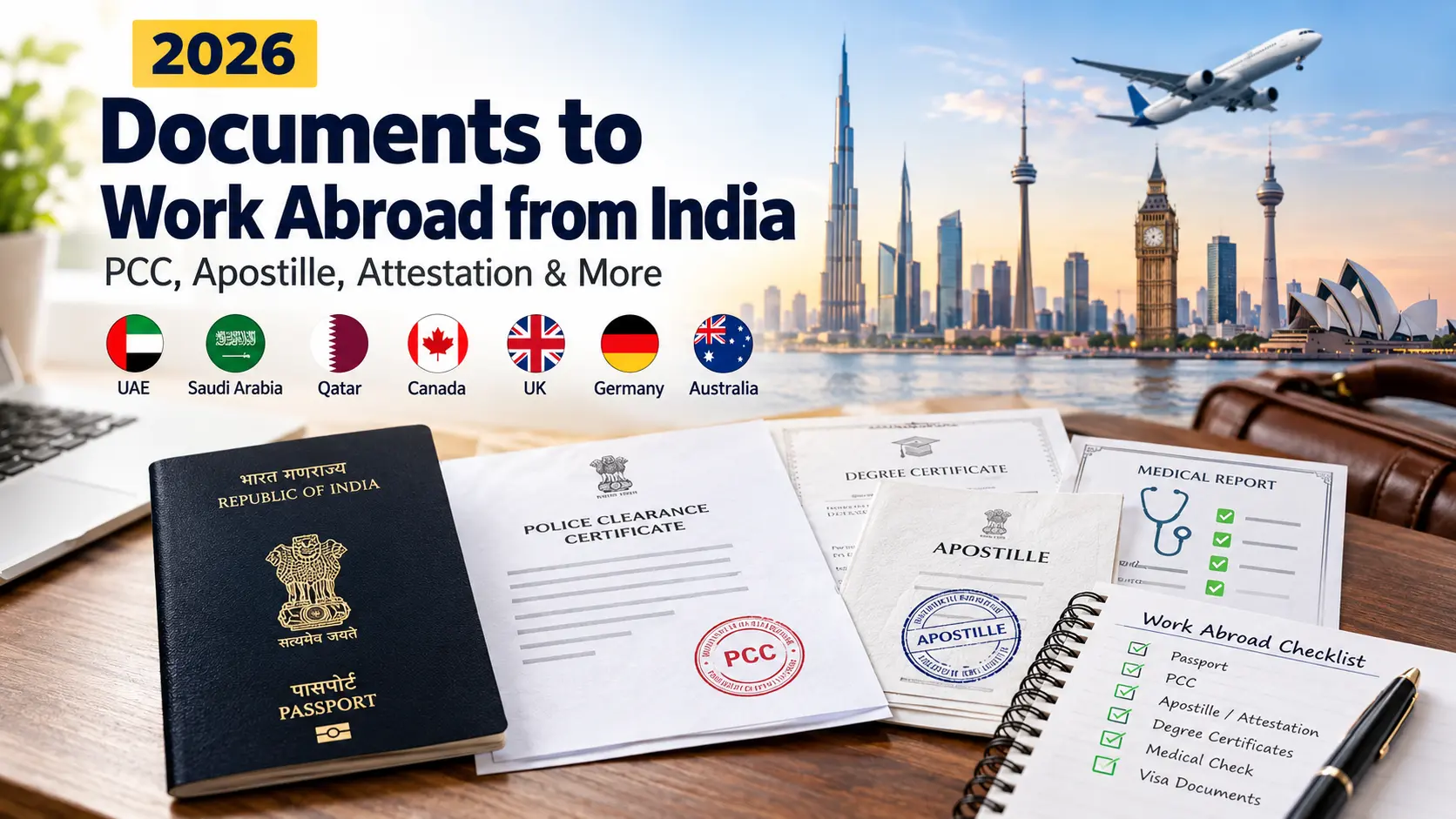
If you are planning to work abroad, you will hear the same advice from everyone: "keep your documents ready." Nobody tells you which documents, in what order, who reads them, or how recent they must be. That gap is what this guide is for.
We built it the way we would want it explained to a family member. We went to the official pages (MEA, Passport Seva, HCCH, the ministries and immigration departments of seven countries), read what they actually say, and wrote down what applies to you in plain language. Where an official page is silent, we say so and tell you who to ask, instead of repeating what some agent said on a forum.
How to use this page. Start with the route finder below. Then read the section for your destination, send the employer questions we have written for you, and keep the tracker sheet up to date. Every important claim links to the official source beside it.
About our sources. Requirements can depend on your visa, occupation, employer and the authority that issues or reads a document. Every date shown is the date on the source page, or we say the page shows none. Let's Move Globally (LMG) is an independent information and career-support platform. We are not a government authority, an immigration consultant or a law firm.
The short answer
There is no single list of documents to work abroad from India. What you need depends on the country, the visa, your profession and your employer. Most people need a mix of three things:
- Your own documents: passport, education and experience proof, and a police clearance certificate (PCC) where the destination asks for one.
- Proof that those documents are genuine: an apostille, an attestation or a verification, depending on the country. These are different things.
- The Indian side of the journey: emigration clearance, if you hold an ECR passport and are going abroad for employment under the applicable rules.
Four rules save most of the trouble:
- Get the document list from your employer or the visa authority in writing before you spend money.
- Do not assume a PCC has a fixed life. The authority that reads it sets the age limit, and some do not state one.
- Do not assume that a country's membership of the Apostille Convention settles everything. Germany is the best example (see the Germany section).
- Do not confuse authentication with recognition. A stamp proves a document is genuine. It does not make your qualification count.
A case from our desk: the document list was complete, and he still could not board
A candidate we spoke with, a man in his forties, applied from India for a Sales Manager role in Dubai. He had passed Class 8. This was his first job outside India. The employer ran a telephone interview, a skills check, a personality check and a video interview, and then made him an offer: AED 2,500 a month, with food and accommodation.
He did everything the employer's list asked for. He spent his savings on the air ticket, clothes and the other preparation, and the day before joining he went to the airport to fly from Delhi to Dubai via Amritsar.
At the check-in counter, after he had handed over his baggage, an airline staff member told him his ticket did not show "OK TO BOARD" and that he could not fly without it. He showed the employer's document list and explained that nothing on it mentioned this. A senior staff member gave the same answer: no "OK TO BOARD", no flight.
He could not afford to rebook for the next day. He had about ₹10,000 left. Someone at the airport told him that the message could be arranged for ₹3,000. He paid it, the message was arranged, and he flew. To this day he does not know whether that payment was needed.
What we take from it
- A complete employer list is not always a complete list. The employer's list covered what the employer needed. It did not cover every check between his house and the plane.
- Nobody had explained the missing step to him in writing, so he could not tell which step was missing, who issues it or what it officially costs.
- He had no money or time buffer, so the only option he could see was to pay.
- The most expensive moment to learn about a requirement is the airport.
What to do differently
- Ask the employer, in writing and well before the flight, whether there is any clearance, message or approval that must be in place before you board, and who arranges it. The message in section What to ask your employer has a line for this.
- Check whether you hold an ECR passport and are going abroad for employment. If so, emigration clearance applies. See emigration clearance. Do not assume it is the same thing as what the airline asked for, and do not assume it is not. Ask.
- Ask your airline directly, before the day of travel, what it checks for employment travellers.
- Keep money in reserve for one rebooking.
- Use only official routes, and ask for a receipt for any official fee. If a stranger offers to "arrange" a clearance for cash, stop and ask the employer or the official authority first.
We have removed his name and personal details, and we share his account with his permission.
Route finder: where to start for your case
Find your destination and read across. Each row only states what the official pages we read support. Where a row says "ask", the official page did not settle it for Indian applicants, so the employer or the visa authority has to answer in writing.
| If you are going to... | Start with | Police certificate | Authenticating documents | Medical |
|---|---|---|---|---|
| UAE | The employer's written document list | Ask | Attestation through UAE missions abroad (UAE MOFA). Original, not laminated, Arabic or English or certified translation, for the courier route. | Ask |
| Saudi Arabia | The employer and the official visa channel | Ask | Ask. Saudi Arabia is in the Apostille Convention, but that does not tell you its visa rules. | Ask |
| Qatar | Check your university is on Qatar's accredited list | Ask | Attestation by the Qatari mission (Qatar MOFA). Host-country foreign ministry first if not already authenticated. | Ask |
| Canada | Your programme's own document checklist | Required for PR, citizenship and IEC. Other programmes: may be needed if you have a prior criminal record. | Not stated on the IRCC pages we read | Check your IRCC checklist |
| United Kingdom | Your certificate of sponsorship and occupation code | Only for specified jobs (education, healthcare, social care and similar). 12 months in 10 years from age 18, shorter if 18 to 27. | Ecctis evidence for overseas qualifications where relevant. Certified translation if not in English or Welsh. | TB test depends on stay length and residence in a listed country. India is listed. |
| Germany | Recognition of your qualification | Ask | Apostille Convention does not apply between Germany and India. A German authority can request a verification. | Ask |
| Australia | Your visa's own checklist at Home Affairs | Depends on the visa. May be requested after you apply. | Not stated on the pages read | Follow your visa's instructions |
Then, for every route:
- Check whether you hold an ECR passport and are going abroad for employment. If so, see emigration clearance.
- Check names and dates match across every document.
- Do not buy a PCC, medical or stamp until you know who reads it and how recent it must be.
What is in this guide
- A case from our desk
- Route finder
- Why documents cause delays
- Core documents most applicants gather
- PCC: how to get it and what the rules say
- Apostille, attestation, verification and recognition
- Which countries are in the Apostille Convention
- Degree and certificate authentication: conditional steps
- Country by country: UAE, Saudi Arabia, Qatar, Canada, UK, Germany, Australia
- Medical and TB requirements
- Emigration clearance (ECR)
- Costs and timelines
- A sensible order of work
- Documents by profession
- Common documentation errors
- Agents and who to ask
- What to ask your employer, with a message you can send
- Master checklist
- Your document tracker
- Frequently asked questions
- Limits of this guide
- Official links in one place
Why documents cause delays
A foreign employer, an immigration department and the Indian government each look at your paperwork for a different reason.
- The employer wants to know you can do the job: degree, experience letters, licence or registration, sometimes a skills test.
- The destination government wants to know you are admissible: passport, job offer or sponsor reference, sometimes a police certificate and a medical or TB test.
- The Indian government has its own rules for some workers travelling for employment: emigration clearance and registered recruitment agents.
Problems usually start when a document is right but arrives in the wrong form. A certificate stamped in the wrong order may have to be stamped again. A police certificate issued before the permitted window may be refused. A name spelt two ways across documents can stall a check. Each one costs time and sometimes a repeat fee. A little planning at the start avoids most of it.
Core documents most applicants gather
Not every item applies to every job. Treat this as a starting list and confirm each one with your employer.
| Document | Why it is asked | Notes |
|---|---|---|
| Passport | Identity and travel | Check expiry and blank pages. MEA guidance for semi-skilled workers applying directly to a Protector of Emigrants asks for a passport valid for at least six months with a valid visa. Your destination may ask for more. |
| Job offer or contract | Basis of the work visa | Get it in writing with employer name, role, location, salary and duration. |
| Degree, mark sheets, diploma | Proof of qualification | May need apostille, attestation or recognition, depending on the country. |
| Experience letters | Proof of work history | Usually on company letterhead with dates and role. |
| Police clearance certificate (PCC) | Character check | Asked by some destinations or for some visa categories only. |
| Medical or TB test | Health check | Rules differ by country and by how long you will stay. |
| Professional licence or registration | Regulated jobs | For example nursing or medicine, in many countries. |
| Certified translations | Documents not in the accepted language | Check which language is accepted and who may certify. |
| Passport photos | Applications | Follow the destination's specification. |
| Marriage and birth certificates, proof of funds | Some visas, and family applicants | Names must match the passports. |
Fix names and dates first. Before any stamping, check that your name, date of birth and roll number are consistent across passport, degree, mark sheets and experience letters. Correcting a mismatch at the university or employer is far easier before a document has been authenticated.
PCC: how to get it and what the rules say
A police clearance certificate states whether there is any adverse police record against you. For Indian citizens the usual routes are:
- In India: apply through Passport Seva.
- From abroad: apply through the Indian embassy, high commission or consulate in your country of residence.
IRCC (Canada) lists, for India, a local district police station, a passport office, an Indian embassy or consulate, or a BLS International centre as places to get a police certificate. See IRCC: police certificate, India.
Fee. Under the amended schedule in the Passports (Amendment) Rules, 2026, G.S.R. 516(E), effective 1 July 2026, the reported PCC fee is ₹750 for applications in India and US$40 for applications abroad. An Indian High Commission press release on the revised fees gives the same ₹750 / US$40 figure (release). An older Passport Seva FAQ may still show ₹500. Use the amended schedule, and confirm the amount payable in the current official Passport Seva application and payment process, or with your mission if you are abroad. A mission may also charge local service fees.
How long it takes. There is no standard time. It varies by application and by whether police verification is needed for your address. Plan for the longer case, and ask the authority that will read the certificate when you must submit it.
How recent must a PCC be?
There is no single Indian rule. The authority reading the certificate decides. This is what the official pages we reviewed say.
| Authority | What it says | Source |
|---|---|---|
| IRCC (Canada), for permanent residence, Express Entry, International Experience Canada and citizenship | For the country where you currently live, the certificate must be issued no more than 6 months before you submit your application. For other countries, it must be issued after the last time you lived there for 6 consecutive months or longer since you turned 18. IRCC may ask for updated documents at any time. | IRCC: when to get a police certificate, modified 19 Feb 2026 |
| UK Home Office, for jobs that need a criminal record certificate | For your latest country of residence, issued no more than 6 months before the application. For other countries, issued within 6 months before your last stay there ended. | Home Office guidance, updated 11 Nov 2025 |
| Australia, Department of Home Affairs | Depends on your visa and Home Affairs' instructions. The character page says the department may ask for a police certificate after you apply. | Home Affairs: character, "last updated 7/10/2026" on the page |
| UAE, Saudi Arabia, Qatar, Germany | We did not establish a requirement or an age limit from an official page. Ask your employer or the visa authority. | n/a |
Two cautions. First, the Canadian six-month rule is written for the programmes named in the table. For other work permits, IRCC's who needs a police certificate page says you may need one if you have a prior criminal record, and tells you to follow your own programme's checklist. Second, IRCC says certificates that limit the jurisdiction or the period searched will not be accepted, and that character certificates are not accepted.
The practical rule: do not apply for a PCC until you know who will read it and how recent it must be.
Apostille, attestation, verification and recognition
People mix these up all the time. They answer different questions.
| Term | The question it answers | Who does it |
|---|---|---|
| Apostille | Is this Indian public document genuine, for a country in the Apostille Convention? | The MEA, for documents going to Convention countries |
| Attestation (authentication) | Is this Indian document genuine, for a country outside the Convention? | The MEA gives a normal attestation. The destination's embassy or mission may add its own step. |
| Verification | Does the receiving authority want to check the document with the issuer? | Depends on the country. Germany's route for Indian documents is explained below. |
| Recognition | Does this qualification count here? | A body in the destination country, such as a regulator, a ministry or an agency |
Authenticating a document proves it is genuine. It does not make the qualification equivalent to a local one. A degree can be properly apostilled and still not be recognised for a regulated profession. Do both checks.
What the MEA says. The MEA describes apostille as the route for documents going to Hague Apostille Convention member countries. Normal attestation, for non-member countries, is free of MEA fee. See the MEA attestation and apostille page and the MEA Apostille page. The Apostille page describes authentication at a Regional Authentication Centre, then deposit with an outsourced service provider. For educational certificates there can be earlier steps at the state or university level that differ by state and issuing authority. There is no single sequence that fits every state, document and destination.
Membership is not acceptance. If a country is in the Convention, it accepts a proper apostille in place of further legalisation. That does not guarantee that a particular immigration authority or employer will accept a particular document for a particular purpose. Always ask the authority that will read it.
Which countries are in the Apostille Convention
We used the HCCH status table for the Convention of 5 October 1961. The table we reviewed shows its last update as 30 June 2026. Status can change after that date, so treat the table below as the position on that date.
Two points about reading this table:
- A country can be a member of the HCCH as an organisation without having joined the Apostille Convention. Only the Convention's own status table shows who is a Contracting Party to it. We do not infer Convention status from HCCH membership. That applies to Qatar in particular.
- The table tells you about the Convention only. It does not tell you what a country's work-visa process requires.
| Country | Status in the HCCH table dated 30 June 2026 | Entry into force |
|---|---|---|
| India | Contracting Party | 14 July 2005 |
| Saudi Arabia | Contracting Party | 7 December 2022 |
| Canada | Contracting Party | 11 January 2024 |
| United Kingdom | Contracting Party | 24 January 1965 |
| Germany | Contracting Party, but the Convention does not apply between Germany and India (see Germany) | 13 February 1966 |
| Australia | Contracting Party | 16 March 1995 |
| United Arab Emirates | Not listed in that table | n/a |
| Qatar | Not listed in that table | n/a |
For the UAE and Qatar, follow the country-specific authentication procedure on each ministry's page, described below.
Degree and certificate authentication: conditional steps
There is no universal Indian sequence. Use these questions to find yours.
- Does the destination want your degree authenticated at all? Some do not state it on the pages we read (UK, Canada, Australia). Ask the employer or read your visa checklist.
- Is the destination in the Apostille Convention, and does the Convention apply between it and India? If yes, the route is normally an MEA apostille. If the country is outside the Convention, the route is normally MEA attestation followed by the destination's own mission step. Germany is a special case.
- Does your state or university require a step before the MEA? For educational certificates, earlier steps can exist and differ by state and issuing authority. Check with the issuing university or board.
- Does the destination also require recognition? Germany, for example, requires recognition for the skilled worker visa. Qatar requires the university to be on its accredited list.
- Does the destination want a certified translation? The UK does when documents are not in English or Welsh. The UAE courier route asks for Arabic or English, or a legally certified translation.
- Is an original needed? The UAE MOFA courier route asks for the original, not laminated.
Do not pay anyone until you know the answers to these six questions for your destination.
Country by country
Each country below covers general documents, police certificate, authentication, medical and licensing, and what we could not confirm.
Summary table
| Country | Apostille status (HCCH table, 30 Jun 2026) | Police certificate | Authentication route | Main official source | Source date shown |
|---|---|---|---|---|---|
| UAE | Not listed | Not established | Attestation through UAE missions abroad, per MOFA | UAE MOFA | None on page (© 2026) |
| Saudi Arabia | Contracting Party | Not established | Not established | HCCH table | Table as of 30 Jun 2026 |
| Qatar | Not listed | Not established | Attestation by the Qatari mission, per MOFA | Qatar MOFA | None on page (footer 2025) |
| Canada | Contracting Party | Depends on programme | Not stated on the pages read | IRCC | 19 Feb 2026 |
| United Kingdom | Contracting Party | Only for specified jobs | Not stated on the pages read | GOV.UK | See sections below |
| Germany | Contracting Party, not applicable with India | Not established | Verification on request of a German authority | German Mission India | 16 Jun 2026 |
| Australia | Contracting Party | Depends on the visa | Not stated on the pages read | Home Affairs | "Last updated 7/10/2026" |
UAE
- General documents: we did not establish an official list. Your employer applies for the work permit and visa. Ask for their written list.
- Police certificate: not established from an official page.
- Authentication: the UAE Ministry of Foreign Affairs describes attestation for documents issued outside the UAE through UAE missions abroad, and says to check whether your country's UAE mission offers the service online or only in person. For its courier route, the original must be in Arabic or English or accompanied by a legally certified translation, certified by the relevant competent authorities where applicable, and not laminated. The UAE does not appear in the HCCH status table dated 30 June 2026. UAE MOFA attestation.
- Medical and licensing: not established. Regulated jobs such as nursing have their own licensing; see our UAE nurse licence guide for the role-side picture.
- Could not confirm: the exact degree-attestation sequence for Indian documents, any UAE equivalency step, and medical requirements. Ask the employer and read the MOFA page.
- More: UAE country page, how to get a job in the UAE from India.
Saudi Arabia
- What the official source establishes: Saudi Arabia is a Contracting Party to the Apostille Convention, in force from 7 December 2022, per the HCCH status table dated 30 June 2026. That is all it establishes. It does not tell you what a Saudi employment visa requires.
- What determines your documents: your employer and the official Saudi visa channel decide which documents are required and how they must be authenticated. Start with the Saudi Embassy in India and the KSA Visa portal.
- Specific employment-visa requirements not independently verified for this guide. That includes document lists, police certificate rules, medical rules, fees and timelines. We give none, rather than guess.
Qatar
- General documents: not established from an official page.
- Police certificate: not established.
- Authentication: Qatar's Ministry of Foreign Affairs describes documents issued outside Qatar being sent to the Qatari mission in the relevant country for attestation, or to the host country's foreign ministry if they have not already been authenticated. For educational certificates, the university must be accredited and on the Ministry of Education and Higher Education's list. You need an e-services account to submit a case. The page does not mention an apostille. Qatar does not appear in the HCCH status table dated 30 June 2026, and we do not infer Convention status from any other HCCH membership. Qatar MOFA.
- Medical and licensing: not established. Healthcare roles have separate licensing.
- Could not confirm: the exact order of steps for a degree issued in India, and medical requirements.
- More: Qatar country page, Qatar jobs for Indians.
Canada
- General documents: depend entirely on the programme. Follow the checklist for your own application.
- Police certificate, by category: IRCC lists the police certificate as required for permanent residence, citizenship and International Experience Canada. For other programmes it says you may need one if you have a prior criminal record, and to follow the programme's checklist. IRCC: who needs one, modified 19 Feb 2026.
- Timing: the "no more than 6 months" rule for your current country of residence, and the "after your last 6-consecutive-month stay" rule for other countries, are stated on IRCC's when to get a police certificate page in the context of Express Entry, International Experience Canada and citizenship. Do not apply them to a work permit unless your checklist says so.
- Indian certificates: IRCC says certificates can be sought from a district police station, passport office, Indian embassy or consulate, or BLS centre; that there are different formats depending on the issuing authority; and that character certificates are not accepted. IRCC: India, modified 25 Feb 2026.
- How to get one: giving fingerprints for a police certificate is different from giving biometrics for your application. If the certificate is not in English or French, send the original with a translation from a certified translator. If you cannot get one, you must show proof that you requested it and write a letter explaining your efforts, and IRCC cannot guarantee acceptance. IRCC: how, modified 13 Aug 2026.
- Authentication: Canada is a Contracting Party (in force 11 January 2024). The IRCC pages we read do not state an apostille requirement for work permits.
- Medical and licensing: not established here. Check your IRCC checklist and, for regulated jobs, the provincial regulator.
- More: Canada country page.
United Kingdom
- General documents (Skilled Worker): GOV.UK lists a certificate of sponsorship reference, proof of English, a valid passport or other identity document, job title and salary, occupation code, and the employer's name and sponsor licence number. Depending on your case you may also need savings evidence, relationship proof, TB test results, a criminal record certificate, an ATAS certificate, a UK PhD certificate or an Ecctis reference for overseas qualifications, and a certified translation. GOV.UK: documents you must provide.
- Criminal record certificate: not every Skilled Worker applicant. GOV.UK says you need one if you apply from outside the UK and work in certain jobs, such as education, healthcare, therapy and social services. The Home Office guidance (updated 11 November 2025) lists the occupation codes, which include doctors, nurses, midwives, pharmacists, dentists, paramedics, social workers, teachers and senior care workers. You need a certificate from each country other than the UK where you were present for 12 months or more in the 10 years before applying, while aged 18 or over, with a shorter period if you are aged 18 to 27. Exemptions exist where it is not reasonably practicable to get a certificate and you give a satisfactory explanation. Home Office guidance.
- TB test: based on where you have lived, not on nationality alone. Adults need one if they are coming to the UK for 6 months or more, have lived in a listed country for 6 months or more, and were living in one within the last 6 months. Some shorter stays and visa types also need one. Children go through a clinician. The certificate is valid for 6 months from the date of the X-ray. India is on the current list, which links to the clinics in India. GOV.UK: TB test, updated 18 Sep 2026; country list. Read the page for exemptions and special cases.
- Authentication: the UK is a Contracting Party. The GOV.UK pages we read do not tell Indian applicants to apostille their degree. They ask for Ecctis evidence of overseas qualifications where relevant, and a certified translation when documents are not in English or Welsh.
- Licensing: regulated jobs have their own registration. See GNM nurse jobs abroad and the UK country page.
Germany
- General documents (skilled worker visa): the Federal Foreign Office says a skilled worker residence title needs an officially recognised foreign degree or certificate (training or study completed in Germany excepted), a specific job offer with the employer's declaration on the employment relationship, written permission to practise for regulated professions, and general requirements such as a valid passport and secure means of support. It tells applicants not to submit the visa application until they can provide a complete set of documents, and says that without official recognition the application cannot be processed. Auswärtiges Amt: skilled workers (no date shown).
- Recognition is its own process. Recognition is mandatory for regulated professions. For non-regulated professions, a vocational qualification must be recognised, and university graduates generally need an anabin database extract, according to the Federal Employment Agency. The responsible office depends on the profession and the place of work. A decision should usually be made within 3 months, and the procedure usually has a fee you pay yourself. Bundesagentur für Arbeit: professional qualifications.
- Apostille and verification: both countries are Contracting Parties, but the German Mission in India states that the Convention does not apply between Germany and India because Germany objected to India's accession. Germany does not legalise Indian public documents either. Instead, documents are verified case by case, and only a German authority can request a verification. Private individuals cannot start one. The mission page dated 16 June 2026 describes the process as generally taking about 2 to 4 months. German Mission India. An earlier mission information sheet (2 June 2025) agrees on applicability but gives a different fee, so we quote no verification fee. Mission information sheet.
- Police certificate and medical: not established from an official page.
- What to do: ask the German employer or authority which documents they need and who will request any verification, before you pay for stamps.
- More: Germany country page, how to get a job in Germany from India.
Australia
- General documents: depend on the visa. Read the checklist and instructions for your own visa on the Department of Home Affairs website.
- Police certificate: requirements depend on the relevant visa and on Home Affairs' instructions. The Home Affairs character page says the department may ask you to provide a police certificate after you apply, and does not state a period or list of countries. We do not apply a condition from one visa subclass to every Australian work visa, and we give no universal validity period. Follow your visa's checklist.
- Medical: most visa applicants must meet the health requirement. Check your visa's instructions for the examination process and how long results stay valid.
- Authentication: Australia is a Contracting Party (in force 16 March 1995). The pages we read do not say what Indian applicants must authenticate.
- Skills and licensing: not established here. Many occupations need a skills assessment or registration; check the assessing authority for your job.
- More: Australia country page.
Medical and TB requirements
Medical rules vary by destination, stay and visa. This is what we could establish.
| Destination | What we could establish | Source |
|---|---|---|
| UK | TB test depends on stay length and residence in listed countries. India is on the list. Result valid 6 months from the X-ray. | GOV.UK: TB test |
| Australia | Most visa applicants must meet the health requirement. Follow your visa's instructions. | Home Affairs |
| Canada | Not established here. Check your IRCC checklist. | IRCC |
| UAE, Saudi Arabia, Qatar, Germany | Not established from an official page. Ask the employer which clinic or format is accepted. | n/a |
Do not book a medical test until the authority or employer tells you which clinic and format it accepts.
Emigration clearance (ECR)
This is an Indian requirement for some workers. It is separate from the destination's employment visa, and it does not replace anything the destination or your employer asks for.
How it works. Indian passports are either ECR (Emigration Check Required) or ECNR. A passport endorsed ECR needs emigration clearance only when the holder travels for employment to a country covered by the applicable notification. People travelling for other purposes do not need it, and a passport not endorsed ECR is ECNR. Clearance is granted by the Protector of Emigrants under the Emigration Act, 1983. See the MEA's guidance on emigration abroad for employment and issues of intending emigrants, and the eMigrate portal.
Education level and passport category. The MEA's Emigration and You guide lists categories of people who are ECNR, and one of them is people with Class 10 or higher qualifications. If your education is below that, do not assume you are ECNR. Look at your passport and ask.
What decides your case. Three things: your passport's ECR or ECNR status, the nature of your journey (employment or not), and whether your destination is covered by the applicable notification. We do not print a country list or a count here, because the official lists should be read directly from MEA and eMigrate for your own case.
What it does not mean.
- Not every Indian worker needs emigration clearance.
- ECNR status removes the emigration clearance step. It does not remove the destination's visa, medical or document rules, or your employer's requirements.
- Clearance does not replace the destination's employment visa. You need both where both apply.
Fee and time. The MEA Citizen Charter (June 2025) gives ₹200 and 3 working days for emigration clearance, subject to complete documents. Confirm the current fee and timing on the official portal.
Registered agents. The MEA advises checking the agent's registration certificate issued by the Protector General of Emigrants, not dealing with sub-agents, and checking the foreign employer's demand letter and the employment contract.
Costs and timelines
We list a figure only when an official source states it. Government fees and separate service charges are shown separately. We do not add them into a total, because they depend on your documents, your city, your route and your employer. Where a cell says "varies", the figure was not established and depends on the authority named.
India-side items
| Item | Government fee | Separate service, courier or third-party charges | Official time | Source |
|---|---|---|---|---|
| MEA apostille | ₹50 per apostilled document | ₹40 for online e-Sanad with speed post; or ₹84 plus ₹3 per page via offline outsourced agencies | "Usually within 7 working days after receiving in MEA" | MEA Citizen Charter, June 2025 |
| MEA normal attestation (non-Convention countries) | Free of MEA fee | Same service charges as above | Same wording as above | Same |
| PCC, Indian citizens | ₹750 in India; US$40 abroad (from 1 July 2026) | Possible local mission service fees; courier | Varies by application and police verification | G.S.R. 516(E); High Commission release |
| Emigration clearance | ₹200 | None stated | 3 working days with complete documents | MEA Citizen Charter, June 2025 |
The apostille or attestation stamp is only one step. State or university charges, courier and translation costs are separate and vary.
Destination-side items
| Country | Item | Government fee | Official time | Depends on |
|---|---|---|---|---|
| UAE | Attestation through UAE missions abroad | Varies; check MOFA | MOFA says the courier-based route "may take up to 7 business days" | Document type, route, your country's UAE mission |
| Saudi Arabia | Employment-visa documents | Not established | Not established | Employer and the official visa channel |
| Qatar | Attestation of documents issued outside Qatar | MOFA lists QAR 150 (attestation completion) and QAR 120 (Qatari mission), plus host-country foreign ministry fees. The same page also shows a QAR 0.00 processing fee, so confirm in the e-services portal before paying. | Not stated | Document, host-country fees |
| Canada | Police certificate | Set by the issuing authority; IRCC states no figure | Not stated by IRCC | Issuing authority; certified translation is a separate cost |
| UK | Criminal record certificate; TB test | Varies by issuing country and approved clinic | Varies | Country of issue; approved clinic |
| Germany | Qualification recognition | Usually has a fee, paid by you; varies by office | "Usually within 3 months" | Profession and responsible office |
| Germany | Document verification | Not quoted (two mission pages differ) | About 2 to 4 months per the mission page of 16 June 2026 | Requested by a German authority |
| Australia | Police certificate; health examination | Varies; follow your visa's instructions | Varies | Visa, countries lived in |
Where the table says "varies", ask the named authority, or the service provider it directs you to.
A sensible order of work
The order matters, but it is not the same for everyone. Use this as a flexible sequence.
- Check the basics. Passport validity, identity consistency across documents, and the actual job and visa you are applying for.
- Get the employer's written list. Ask which documents, in what form, and how recent. Confirm whether your qualification needs recognition.
- Start long or multi-stage processes when they apply. Degree authentication, qualification recognition, professional registration.
- Collect time-sensitive evidence according to the authority's rules. PCC, medical examination, TB test. Canada and the UK state timing for some cases. Where no limit is stated, ask.
- Complete the destination's application and, if it applies to you, the Indian emigration clearance.
Timing depends on the destination and the application. Do not assume an attested document stays acceptable forever, or that every PCC expires after the same period. Both depend on who reads them.
Documents by profession
This table separates what is commonly asked from the requirements we found on official pages.
| Profession | Commonly asked | Requirement stated on an official page we read |
|---|---|---|
| Nurses and doctors | Degree, registration, experience letters, English test, regulator exams | UK: criminal record certificate for listed healthcare occupations. Germany: recognition and written permission to practise for regulated professions. |
| IT workers | Degree, experience letters, payslips | UK: proof of English and sponsorship reference for Skilled Worker. Germany: recognised degree; an anabin extract can suffice for non-regulated professions. |
| Engineers | Degree, experience, sometimes registration | Depends on the country and whether the profession is regulated. |
| Skilled trades (electrician, welder) | Trade certificate, experience proof, trade test | Not established here. Depends on country and employer. |
| Drivers | Licence, experience letters, driving test | Not established here. Confirm licence conversion with the employer. |
| Hospitality workers | Training certificates, experience letters | Not established here. |
| Freshers | Degree, provisional certificate, internships | Ask whether a provisional certificate is accepted before you authenticate anything. |
| Family members | Marriage and birth certificates | UK: proof of relationship when a partner or child applies with you. |
Role-side guides: HTV driver jobs in the UAE, GNM nurse jobs abroad, ITI electrician jobs abroad.
Common documentation errors
- Applying for a PCC too early. Canada and the UK state timing rules for some cases. Find the rule first.
- Submitting a certificate with a limited scope. IRCC will not accept certificates that limit the jurisdiction or the period searched, or character certificates.
- Laminating an original. The UAE MOFA courier route says the original must not be laminated.
- Treating Convention membership as a guarantee. Germany does not apply the Convention with India.
- Mixing up authentication and recognition. Germany and Qatar both ask about recognition or accreditation separately.
- Filing a visa application with an incomplete set. The German Federal Foreign Office says not to submit until you have a complete set of documents.
- Name or date mismatches across documents. Fix them at the source before any stamp.
- Relying on an agent's word. A recruiter's statement is not an official requirement.
Agents and who to ask
- Ask any agent for the government page that supports what they say.
- Check an agent's registration with the Protector General of Emigrants before you pay (see the MEA guidance).
- Ask which office puts which stamp on which date, and who holds your original documents.
- Ask in writing who pays for what (visa, medical, attestation, travel) before you commit.
- When in doubt, go to the authority named in this guide.
What to ask your employer, with a message you can send
Most document problems are solved by one written answer from the right person. Send this before you spend money. Change the country and job to match yours.
Questions to get answered in writing
- Which documents do you need from me, and in what form (original, photocopy, scan, translated)?
- Which of them must be apostilled or attested, and who will do each step?
- Do you need a police clearance certificate? If yes, how recent must it be, and from which country or countries?
- Do you need a medical or TB test? Which clinic or format do you accept?
- Must my qualification be recognised or registered before the visa is filed? By which body?
- Who pays for each step: visa, attestation, medical, translation, travel?
- If any document is refused, who tells me, and how long do I have to replace it?
- Is there any clearance, message or approval that must be in place before I board, apart from my visa, and who arranges it and when?
- Do I need emigration clearance, and who will help me get it?
A message you can copy
Hello, thank you for the offer for the [job title] role in [country]. Before I start any paperwork, could you please send me, in writing, the full list of documents you need from me, the form each must be in, and which ones need apostille or attestation? Please also tell me whether a police clearance certificate or medical test is needed, how recent it must be, and who pays for each step. I want to avoid doing anything in the wrong order. Thank you.
Keep the reply. If a recruiter or agent gives you a requirement that the official page does not mention, ask them for the government page that says so.
Master checklist
Before you accept an offer
- ☐ Passport valid, enough blank pages, name matches other documents
- ☐ Written offer or contract: employer, role, location, salary, duration
- ☐ Employer's written document list
- ☐ Check whether your qualification needs recognition or a licence in the destination
While the job and visa are in progress
- ☐ Education and experience documents scanned, with name and date mismatches fixed
- ☐ Authentication route confirmed for your destination (apostille, attestation or verification)
- ☐ Translation needs confirmed
- ☐ PCC timing confirmed with the authority that will read it
- ☐ Medical or TB test requirements confirmed for your destination and stay
Before you travel
- ☐ Destination visa or permit in hand
- ☐ Emigration clearance checked, and obtained if it applies to you
- ☐ Written answer from the employer on any clearance or approval needed before boarding
- ☐ Money kept in reserve for one rebooking
- ☐ Originals and copies packed separately
- ☐ A single sheet listing each document, its issue date and the authority that wants it
Your document tracker
Copy this into a notebook or spreadsheet. It takes five minutes and keeps you from losing track of which stamp is missing.
| Document | Issued by | Issue date | Needs (apostille / attestation / translation / recognition) | Who reads it | Must be issued after / valid until | Status |
|---|---|---|---|---|---|---|
| Passport | ||||||
| Degree and mark sheets | ||||||
| Experience letters | ||||||
| PCC | ||||||
| Medical or TB test | ||||||
| Licence or registration | ||||||
| Translations | ||||||
| Emigration clearance (if applicable) |
Frequently asked questions
What documents do I need to work abroad from India?
It depends on the country, visa, profession and employer. Most applicants need a passport, a job offer, proof of qualifications and experience, and sometimes a police certificate, a medical or TB test, and authenticated documents. Ask your employer for a written list and check the official source for your country in this guide.
How much is the PCC fee?
The reported fee under the amended schedule (G.S.R. 516(E), effective 1 July 2026) is ₹750 in India and US$40 abroad. An older Passport Seva FAQ may still show ₹500, so confirm the amount in the current official payment process. Processing time varies by application and verification.
How long is a PCC valid?
There is no single rule. The authority reading it decides. IRCC, for the programmes it names, asks for a certificate from your country of residence issued no more than 6 months before you apply. The UK's criminal record guidance uses a similar 6-month window for your latest country of residence. For the other destinations we could not establish a limit.
Do I need a PCC for every country?
No. Canada lists it for permanent residence, citizenship and International Experience Canada, and says you may need one for other programmes if you have a prior criminal record. The UK asks only for specified jobs. Australia depends on the visa and may ask after you apply. For the UAE, Saudi Arabia, Qatar and Germany we did not establish a requirement, so ask.
What is the difference between apostille and attestation?
An apostille is the MEA's authentication for documents going to Apostille Convention countries. Normal attestation is for countries outside it. Verification and recognition are different processes again. See the table above.
Is an apostille enough for Germany?
No. The German Mission in India says the Convention does not apply between Germany and India. Germany does not legalise Indian documents; a German authority can request a verification, and private individuals cannot start one.
Do I need an apostille for the UAE or Qatar?
Neither is listed in the HCCH Apostille Convention status table dated 30 June 2026. Both ministries describe attestation involving their missions abroad, so follow their pages and your employer's instructions.
What do we know about Saudi Arabia?
Saudi Arabia is a Contracting Party to the Apostille Convention, in force from 7 December 2022. Specific employment-visa requirements are not independently verified for this guide. Your employer and the official visa channel decide.
Do I need a TB test for the UK?
If you are coming for 6 months or more, have lived in a listed country for 6 months or more, and were living in one within the last 6 months. India is on the current list. The rule is residence-based, so read the GOV.UK page for your case.
Does every Indian worker need emigration clearance?
No. It depends on your passport's ECR status, the nature of your journey and the applicable notification. Check the MEA and eMigrate guidance for your own case.
Does ECNR mean I have no other formalities?
No. ECNR removes the emigration clearance step. The destination's visa, medical and document rules still apply.
Is a stamped degree the same as a recognised degree?
No. Authentication shows a document is genuine. Recognition decides whether the qualification counts for a job or visa. Germany and Qatar both involve recognition or accreditation separately.
Limits of this guide
We would rather tell you than guess. We did not establish from an official page:
- Saudi Arabia: employment-visa documents, police certificate rules, medical rules, fees and timelines.
- UAE and Qatar: the full degree-authentication sequence for Indian documents, medical rules and police certificate requirements.
- Germany: police certificate and medical requirements, and a verification fee.
- Australia: a police-certificate period that applies to every visa, and health-result validity.
- Canada: medical examination requirements for work permits.
- UK: the fee for a criminal record certificate or a TB test.
For each, the authority named in the relevant section is the place to confirm.
Talk to us
If you want a second pair of eyes before you spend money, contact LMG by form, email or WhatsApp. We can help you sort your questions and point you to the right official page. We cannot approve documents, verify them with an authority, or guarantee a visa or a job.
Final word
Most of what goes wrong with overseas paperwork is avoidable. Ask for the list in writing, find out who will read each document and how recent it must be, keep authentication and recognition apart, and follow the official page for your own destination. When a source cannot tell you something, ask the authority, not a third party.
Related reading on LMG
- How to get a job in the UAE from India
- How to get a job in Germany from India
- Qatar jobs for Indians
- GNM nurse jobs abroad
- HTV driver jobs in the UAE
- ITI electrician jobs abroad
- Country pages: UAE, Qatar, Canada, UK, Germany, Australia
Official links in one place
- India: MEA attestation and apostille, MEA Apostille, MEA Citizen Charter, June 2025, MEA: emigration abroad for employment, MEA: issues of intending emigrants, eMigrate, Passport Seva, G.S.R. 516(E), High Commission fee release
- HCCH status table, Convention of 5 October 1961, last update shown 30 June 2026
- UAE MOFA; Qatar MOFA; Saudi Embassy in India; KSA Visa portal
- IRCC: who, when, how, India
- GOV.UK: documents, TB test, criminal record certificate guidance
- Germany: German Mission India, mission information sheet, Auswärtiges Amt, Bundesagentur für Arbeit
- Australia: Department of Home Affairs: character
Disclaimer
Let's Move Globally is an independent information and career-support platform. We are not a government authority, a licensed immigration consultant, a visa agent or a law firm. This guide is general information based on the official sources named above, using the dates shown on those sources. Requirements, fees and processing times change, and they can depend on your visa, occupation, employer and issuing authority. Always confirm with your employer, the issuing authority and the destination's official visa page before you act.
Immigration policies, visa requirements, and salary thresholds change frequently. All information on this page has been verified using official government sources as of October 2026. Always confirm current requirements directly at the official government website before making any application or financial decision. letsmoveglobally.com is an independent information platform — not a visa agent, immigration consultant, or legal advisor.




0 Comments
Have a question or insight? Share it below. All comments are moderated within 24 hours.
Be the first to share your thoughts.
Leave a Comment
Your email will not be published. Fields marked * are required.